
Wheat output largely steady despite drop in acreage

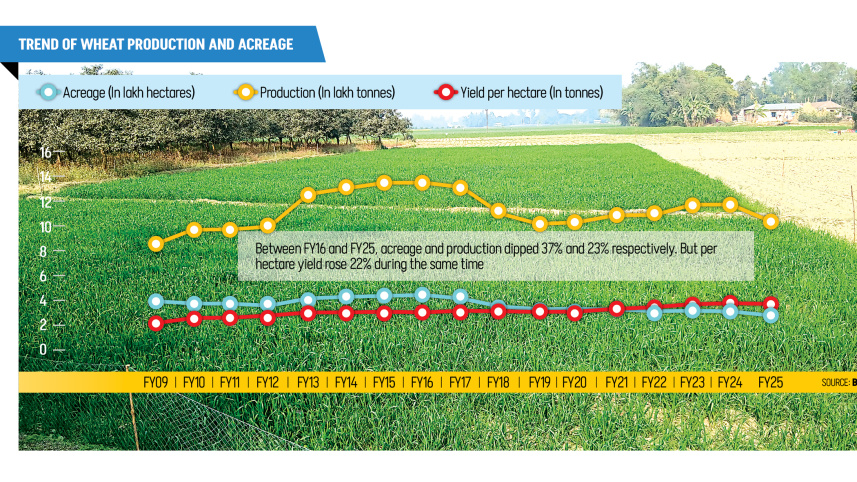
Over the past decade, wheat acreage has fallen, giving way to more profitable crops. Yet farmers kept bagging over 10 lakh tonnes of the cereal annually as rising yields per hectare, driven by the spread of improved, heat- and disease-tolerant varieties, helped cushion total production losses.
Data from the Bangladesh Bureau of Statistics (BBS) shows that the area under wheat declined from 4.44 lakh hectares in fiscal year 2014-15 (FY15) to 2.8 lakh hectares in FY25, a drop of nearly 37 percent.
 For all latest news, follow The Daily Star's Google News channel.
 Over the same period, total output fell by about 23 percent, from 13.48 lakh tonnes to 10.41 lakh tonnes, remaining above 10 lakh tonnes a year despite the sharp reduction in cultivated area.
The divergence between acreage and output reflects a steady improvement in productivity with average wheat yield rising from 3.04 tonnes per hectare in FY15 to 3.72 tonnes per hectare in FY25, an increase of 22 percent over the decade.
Scientists attribute the gains to the growing adoption of improved wheat varieties suited to Bangladesh’s short winter and rising temperatures.
Wheat requires an optimum temperature of 20°C to 25°C and can tolerate up to 35°C. Sowing typically begins in early December, with harvesting in March and April, leaving farmers little room to adjust to heat stress late in the season.
In the short winter of Bangladesh, farmers have been shifting to varieties that mature early and can tolerate higher temperatures while giving better yields.
For example, with a yield potential of up to 5.5 tonnes per hectare, early-maturing and heat-tolerant Bari Gom-33 is cultivated extensively by farmers, mainly in the north-west region. The Bangladesh Agricultural Research Institute (Bari) released the blast-resistant variety in 2017, after the outbreak of the fungal disease severely damaged the wheat crop in Bangladesh in 2016.
“The variety covered 35 percent of the wheat area two years ago. Its area has expanded further,” said Mohammad Rezaul Kabir, principal scientific officer at the Bangladesh Wheat and Maize Research Institute (BWMRI).
“Bari Gom-33 has gained popularity for two reasons: it is heat-tolerant and blast-resistant. At the same time, it has enabled farmers to bag higher yields,” he said.
Aside from this popular variety, Bari Gom-30 and Bari Gom-32 are grown, along with four varieties developed by BWMRI. The research institute is working on developing another heat-tolerant and blast-resistant variety.
“We are targeting increased yields to above 6 tonnes, keeping in mind the short duration of winter in our country,” he said.
At present, the yield potential of the improved varieties of wheat is 4.5-5.5 tonnes per hectare.
“We could boost production further if we could reduce the yield gap,” he said.
Kabir said wheat has been losing out to other crops – maize, potato and vegetables – because it generates lower profits for farmers than maize, potato and vegetables.
“The situation of wheat is worsening day by day. The main problem is ensuring fair prices for the grain during the harvesting season. If we could do this, cultivation would have increased. Farmers are cultivating crops that offer them higher returns.”
“Wheat farmers in Chuadanga Sadar Upazila rarely use any variety other than Bari Gom-33, because they want to avoid the risk of wheat blast,” said Md Anisur Rahman, Chuadanga Sadar Upazila Agriculture Officer.
Wheat blast disease first emerged in six southwestern districts in 2016. Research conducted by the Cereal Systems Initiative for South Asia in collaboration with Bari estimates average yield losses of 25-30 percent, with severely infected fields suffering total crop failure. The prospect of suffering such severe losses makes wheat farmers steer clear of varieties that may be susceptible to the disease.
Rana Biswas, a wheat farmer in Monirampur village under Chuadanga Sadar Upazila who grows wheat in five-and-a-half bigha of land, echoed the sentiment.
“I have been growing wheat since 1977, and now I only grow Bari Gom-33,” he said.
While Rana has stuck to wheat cultivation all his life, fellow farmers in the upazila have moved onto more profitable options like papaya.
During the current sowing season, farmers sowed wheat on 2.84 lakh hectares as of January 11. The figure rose marginally from 2.8 lakh hectares the previous year, the lowest on record, according to a provisional estimate by the Department of Agricultural Extension.
Bangladesh cultivated the cereal on 8.88 lakh hectares in FY99, the highest in 37 years.
In its Grain and Feed Update on Bangladesh, released in December 2025, the US Department of Agriculture (USDA) predicted that wheat acreage could be 2.90 lakh hectares and production 10.5 lakh tonnes.
It blamed the lack of improved varieties, saying this has led to a gradual decline in both wheat acreage and production over time. “Wheat blast disease reduces yields significantly, and farmers are earning higher profits cultivating fruits and vegetables during the Rabi season.”
Local production currently meets only about 13 percent of Bangladesh’s total wheat demand, according to the USDA. The Food and Agriculture Organisation of the United Nations estimates that imports cover the rest – roughly 80 percent of national consumption.
Md Abdul Hakim, director of administration and finance and chief scientific officer at the BWMRI, said despite comparatively lower profit, farmers are still growing wheat because yields are increasing.
The scientist said wheat could be expanded in the southern coastal regions if more salinity- and heat-tolerant varieties are developed, pointing out that farmland remains fallow for nearly eight months in the region.
Currently, farmers in Patuakhali, a southern coastal district, are growing BWMRI Gom-4 in some areas as demonstration plots. The variety can withstand salinity of 8-10 deci siemens (dS/m), a unit of electrical conductivity primarily used in agriculture and soil science to measure salinity levels in soil or water.
“We are working on developing more salinity-tolerant inbreds that can tolerate up to 12 dS/m of salinity,” he said. “Wheat cultivation can be expanded to 2 lakh hectares in the southern region.”
Comments