


To cheers, they arrive
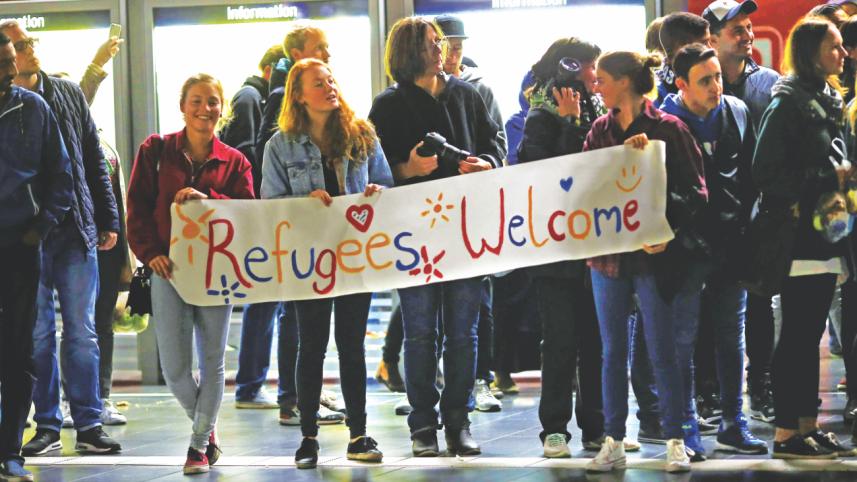
Hundreds of migrants streamed into Germany yesterday to cheers and "welcome" signs, joining the thousands who arrived the previous day as Austria called for an emergency EU summit on the continent's worst refugee crisis since World War II.
Austrian Chancellor Werner Faymann warned his country's admittance of thousands of refugees crossing from Hungary was just a "temporary" measure and urged the 28-member European Union to collectively deal with the record numbers.

Masses of people fleeing war and misery from Syria, Iraq and beyond have rushed from Hungary through Austria into Germany, which expects to take in 800,000 refugees this year at a cost of 10 billion euros ($11 billion).
In moving scenes the newcomers, clutching their children and sparse belongings, stepped off trains in Munich, Frankfurt and elsewhere to cheers from well-wishers who held balloons, snapped photos and gave them water and food.
"The people here treat us so well, they treat us like real human beings, not like in Syria," said Mohammad, a 32-year-old from the devastated town of Qusayr, his eyes welling up with tears.

With the EU divided along east-west lines on how to handle the record numbers, Pope Francis called for every Catholic parish to take in a refugee family.
German Chancellor Angela Merkel on Saturday spoke by phone with Hungary's Prime Minister Viktor Orban, who has called the refugee wave a "German problem" caused by Berlin's public statement saying it would welcome Syrians.
"Both sides agreed that both Hungary and Germany must meet their European obligations, including their obligations under the Dublin agreement," said Merkel's spokesman Georg Streiter.
Under the EU's so-called Dublin rules, asylum applications must be processed by the country where a person first arrives.
Orban and Merkel had agreed that the weekend influx was exceptional, due to the emergency situation in Budapest, Streiter said.
Merkel also faces political pressure at home, where her Bavarian sister party CSU criticised the eased travel rules as "a wrong decision", according to its party secretary Andreas Scheuer.
Members had warned that this had created "an additional pull-factor" - aside from push factors such as war, poverty and repression in their home countries.
Merkel was set to hold a crisis meeting on the refugee issue later yesterday with her coalition partners.
On Saturday, she said Germany can cope with a record influx of refugees this year without raising taxes and without jeopardizing its balanced budget.
With relatively liberal asylum laws and generous benefits, Germany is the European Union's biggest recipient of refugees fleeing war in the Middle East and economic migrants from southeastern Europe.
"We cannot just say 'Because we have a difficult task now, the balanced budget or the issue of debt are no longer important'," Merkel said in her weekly video podcast.
In an interview with local newspapers, Merkel promised that Berlin would not raise taxes because of the refugee crisis.
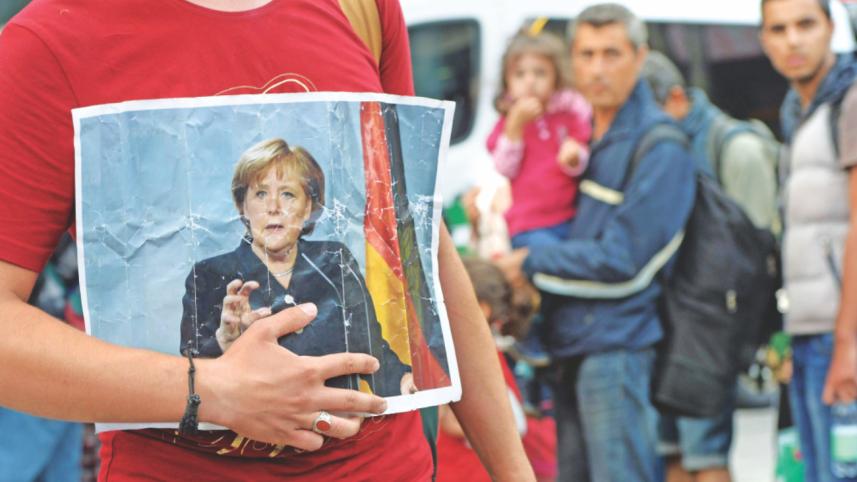
Berlin's comfortable budgetary position is making it easier to master such "unexpected tasks", Merkel said, adding the refugee crisis was the government's priority now.
 For all latest news, follow The Daily Star's Google News channel.
 Thanks to higher-than-expected tax revenues, Berlin could have leeway for extra public spending of up to 5 billion euros ($5.6 billion) this year, officials have said.
On Saturday alone about 8,000 migrants crossed German borders, federal police told AFP.
In Munich, some 1,200 came in early yesterday, a day after trains brought 6,800 to the southern German city.
As refugees got off trains, police directed them to waiting buses bound for temporary shelters, which have been set up in public buildings, hotels and army barracks across the country.
"Say it loud, say it clear, refugees are welcome here," crowds chanted at the Frankfurt railway station overnight.
Yesterday, a convoy of around 140 cars and vans filled with food and water left Vienna to collect exhausted migrants, many from Syria, who had set out to walk the 170km stretch through the rain from Hungary's capital Budapest to the Austrian border, from where many would continue onto Germany.
One of the Austrian activists taking part, Angelika Neuwirth, told the BBC that their aim was to take them back to shelters in Austrian capital.
"I think this is my duty. I'm a mum, I'm a woman from Austria and I can't close my eyes anymore," she said. "We are all human. No-one is illegal."
A dozen or so well-wishers offering chocolate and bananas greeted between 600 and 700 people, mostly from Syria, arriving on two trains arriving in the southern German city of Munich, early in the morning with between 600 and 700 people. A third was expected with about 450 people, an regional administration spokeswoman said.
Most were bussed to reception centres after given medical checks, food and clean clothing. Many said they were from Syria, while others were from Afghanistan or Iraq.
Germany has said it expects 800,000 refugees and migrants this year and urged other EU members to open their doors. But others say the focus should be on tackling the violence in the Middle East that has caused them to flee their homes.
The numbers in Europe are small compared to several million refugees in Syria's neighbors Lebanon, Turkey and Jordan and Pope Francis called on yesterday for every European parish and religious community to take in one migrant family each.
But a poll in France's Aujourd 'hui en France newspaper showed 55 percent of French people are opposed to softening rules for migrants to access refugee status.
While Germany has seen a spate of ugly xenophobic rallies and attacks against foreigners, it has also seen an outpouring of support, donations and volunteer efforts by people who believe the country, given its dark history and current wealth, has a special obligation to help refugees.
Politicians in Germany and elsewhere in Europe have voiced growing concern about the record numbers, and warned the influx would spell both logistical and political problems.
In Austria, Faymann said that Vienna's assistance was a temporary manifestation of Vienna's "goodwill" in the face of a humanitarian emergency.
"There is no alternative to a common European solution," said Faymann, calling for a summit of EU leaders "immediately after" an interior ministers' meeting on September 14, the APA news agency reported.
Many other EU countries, particularly smaller and poorer ones and those without a strong tradition of receiving migrants, are facing a much greater challenge to cope with the influx of people.
German Finance Minister Wolfgang Schaeuble said on the sidelines of a meeting of the Group of 20 leading economies in Turkey that Berlin was still calculating how much money it would cost to shelter the increased number of refugees.
The Frankfurter Allgemeine Sonntagszeitung said in a report to be published on Sunday that the costs for the government, federal states and municipalities would rise to roughly 10 billion euros this year from 2.4 billion euros in 2014.
(From AFP, Reuters and BBC)
BANGLADESHIS AMONG REFUGEES
A good number of Bangladeshis are among the asylum seekers in Austria, sources here in Dhaka and Vienna told our diplomatic correspondent.
They said they learnt from local interpreters working in refugee camps that a number of Bangladeshis were there.
The officials at the Bangladesh Embassy in Austria could not give any specific number of Bangladesh nationals seeking asylum in Austria.
Asked about migrants seeking asylum in Austria, a senior official at the foreign ministry said rules do not allow them to get involved when a Bangladeshi seeks asylum in another country.
"That's why we don't know the exact figure of Bangladesh nationals in refugee camps … ," the official said.
A TV channel in Bangladesh quoting a Bangladeshi journalist in Vienna said there were at least 500 Bangladeshis there.


Comments