


‘All shades of opinion will be considered’

APRIL 10 & 11, 1972
GONOPARISHAD OF BANGLADESH COMMENCED
 For all latest news, follow The Daily Star's Google News channel.
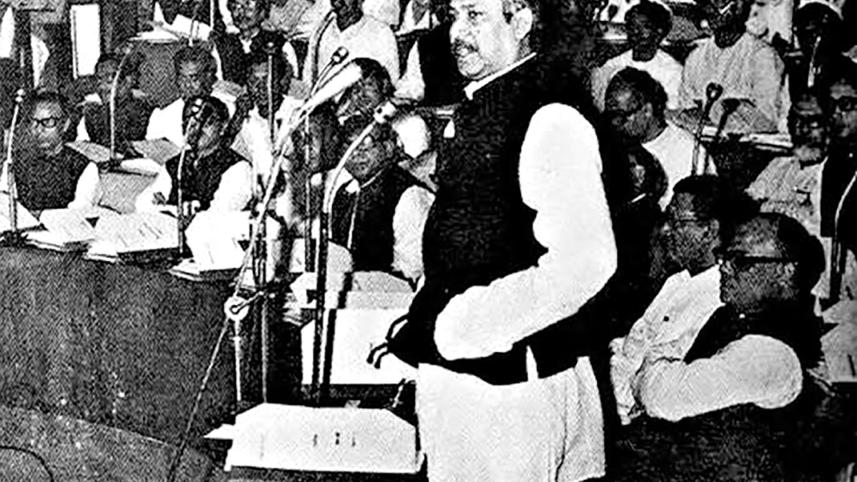
 The first Constituent Assembly of Bangladesh commences its session on April 10, 1972, with a promise to give the new nation a constitution on the basis of four pillars of the state policy: nationalism, socialism, democracy and secularism. Prime Minister Bangabandhu Sheikh Mujibur Rahman, who is also the leader of the house, tells the house that all shades of opinion will be taken into consideration in framing the constitution. The discussion will not remain confined to the members of the house alone, he adds. The business of the house is conducted in Bangla for the first time in history.
Shah Abdul Hamid and Muhammad Ullah Chowdhury are unanimously elected Speaker and Deputy Speaker of the Bangladesh Ganoparishad.
During its deliberations for two hours and 45 minutes the house adopts a resolution condoling the death of those who laid down their lives for liberation of Bangladesh. The condolence resolution is moved by Bangabandhu. In another resolution the House expresses its complete solidarity with the Declaration of Independence made by Bangabandhu Sheikh Mujibur Rahman on the night of March 25 last year.
On April 11, 1972 , the Gonoparishad forms four committees which include Draft Constitution Committee, Rules of Procedure Committee, Rights and Privileges Committee and House Committee. The Draft Constitution Committee will submit its report in the form of a bill. This Committee has 35 Members of Constituent Assembly as its members.
BANGABANDHU'S SPEECH AT GONOPARISHAD
Bangabandhu in his twenty-minute speech at the inaugural session (April10, 1972) of the Constituent Assembly of Bangladesh recalls that the hordes of Yahya Khan launched a cowardly attack on the people of Bangladesh.
He says, "I immediately realised that the final [point] had [been] reached, contacted our people in Chittagong through wireless and told them that from that moment Bangladesh was independent and sovereign. I asked them to announce my declaration all over so that they can put up resistance." The prime minister cautions all quarters that there should not be any attempt to misinterpret the history of the Liberation War. If that happens, he fears, future generations will fail to get the correct picture.

Bangabandhu pays glowing tributes to the martyrs of the Liberation War. The blood of the martyrs will not be allowed to go in vain, he declares.
Bangabandhu recalls with gratitude the great help and assistance advanced by the people and government of India and the Soviet Union. He also records his thanks to the people of Great Britain, Germany, France, East European countries and also the US for their support to the cause of Bangladesh.
In conclusion, Bangabandhu hopes that the Speaker will maintain complete neutrality and will help establish a sound parliamentary convention. He assures the Speaker of all possible help and cooperation of the House in this regard.
JAPAN WILL GIVE $8M IN AID
On April11, 1972 Japan decides to give Bangladesh humanitarian aid amounting to eight million dollars. The assistance will be in the form of trucks, ferryboats and other transportation items. A recent Japanese mission to Bangladesh was asked in Dhaka for these "urgently required" items to restore the transportation system.
SOURCES: April 10 & 11, 1972 issues of Bangladesh Observer, Dainik Bangla and Ittefaq and Parliamentary Proceedings of Bangladesh Ganoparishad (April 10, 1972).
Comments