


Save lives now, all else can wait

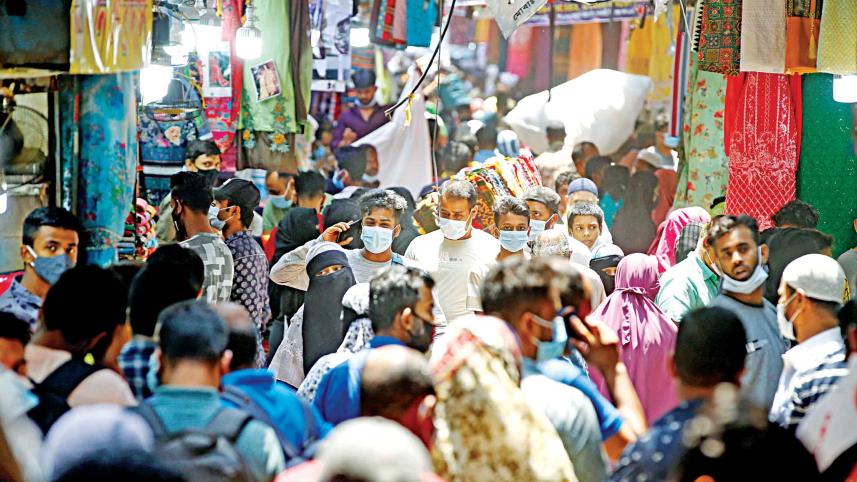
Ten months ago, a government-commissioned research report on the fallout of the pandemic-induced shutdown divulged some grim projections: over 1.64 crore people in the country would become new poor in the second quarter of 2020.
The report, prepared by a team of researchers of the Bangladesh Institute of Development Studies (BIDS) in June last year, estimated that the poverty rate could rise by 9.1 percentage points.
 For all latest news, follow The Daily Star's Google News channel.
 It meant that the new poor would join the previous 20.5 percent of the country's population who had already been poor, said the report titled "Poverty in the time of Corona: Trends, Drivers, Vulnerability and Policy Responses in Bangladesh".
According to the report, the poverty rate increased to 25.13 percent at the end of 2020.
Although the government does not have the latest data of new poor as a result of Covid-19 crisis, the report's lead researcher, Binayak Sen, warns that the second wave of the pandemic could take a more severe humanitarian and economic toll.
Reflecting on last year's situation, Binayak, now the director general of BIDS, fears a frequent shift in the policy over the lockdown and reopening businesses would hardly make any positive impact on containing the rogue virus.
"There would be a rise in the infection, which would lead to more deaths and prompt the government to go for a stricter lockdown. People's livelihood would be destroyed and the poverty rate would further rise," he told The Daily Star.
He suggested enforcing a "hard lockdown" for three months at a stretch to control the virus transmission, and expanding the government's food, cash assistance and other social protections so that the people who would be affected by the preventive measure could survive.
"Now we are seeing a death toll of around 100 people a day. If it reaches 1,000 per day, it would create a huge social unrest and the cost of [dealing with] that would be much higher than the cost of a three-month lockdown," the noted economist said.
"We need to sacrifice livelihood in order to save lives," he said, adding, "We have to spend an additional amount in this regard. If we can contain the transmission and provide food assistance to the affected people, it will have an economic return in the long run."
The BIDS report was a background paper commissioned by the General Economics Division, Planning Commission and prepared for the 8th Five Year Plan.
According to the report, the poverty rate was 20.3 percent in the first quarter of 2020. Because of Covid-19 pandemic, it increased to 25.13 percent at the end of the year.
NEW POOR
The research report estimated the new poor considering five different scenarios amid a "hard lockdown".
The first scenario was considered as zero income for labouring class in urban areas, but rural income remained unaffected and as a result of that 93.60 lakh people may be pushed into poverty due to the inevitable lockdown effect owing to Covid-19 -- an additional 5.2 percentage point increase in the headcount index of poverty.
In the second scenario, if there is an 80 percent drop in income for the labouring class in urban areas and a five percent drop in income for labouring class in rural areas, 1.28 crore people might be added as new poor and the index of poverty will witness a 7.1 percentage point increase.
The third scenario will occur if there is an 80 percent drop in income for labouring class in urban areas and 10 percent drop in income for labouring class in rural areas. It might make 1.64 crores new poor and the index of poverty will witness a 9.1 percentage point rise.
For poverty projection purposes under the Covid-19 shock, researchers had picked the third scenario as the one likely to occur because it realistically portrays the possible impact of shocks on consumption/ income.
According to the fourth scenario, if there is an 80 percent drop in income for labouring class in urban areas and a 20 percent drop in income for labouring class in rural areas, this may add 2.53 crore people new poor and a 14.1 percentage point increase in the headcount index of poverty.
In the fifth scenario, it considered that in the case of a 70 percent drop in income for labouring class in urban areas and 30 drops in income for labouring class in rural areas, it will make 3.54 crores people new poor and the index of poverty will witness 19.7 percentage point increase.
Binayak said that among the new poor, majority of them are "transient poor", who are pushed into poverty shortly after sudden shocks, and these groups have some kind capacity to be able to graduate from poverty.
But some of the new poor do not have the resilience and capacity to be able to come out of the poverty line, he said, adding people who have no capacity to graduate from poverty are the real new poor.
This group usually needs assistance, he said.
REVERSE PROGRESS
The report said that the Covid-19 crisis threatens to destroy the gains of years of efforts and initiatives in the areas of poverty reduction.
Bangladesh would have achieved the SDG target of zero poverty by 2031 under a seven percent average growth scenario had there been no Covid-19. Even a six percent average growth rate of GDP would have taken the country closer to achieving the target.
It will take almost nine years to reach the poverty level of 2019 and almost five years to reach the poverty level of 2016 under a more realistic six percent average growth scenario in the next two Five-Year Plans, said the study.
"This is a huge economic shock and it is unique in Bangladesh's history. None of the natural shocks that have visited the country before had such a dire consequence for poverty," it added.
Comments