
Cyber-resilient future: How to keep up with the evolving threat landscape

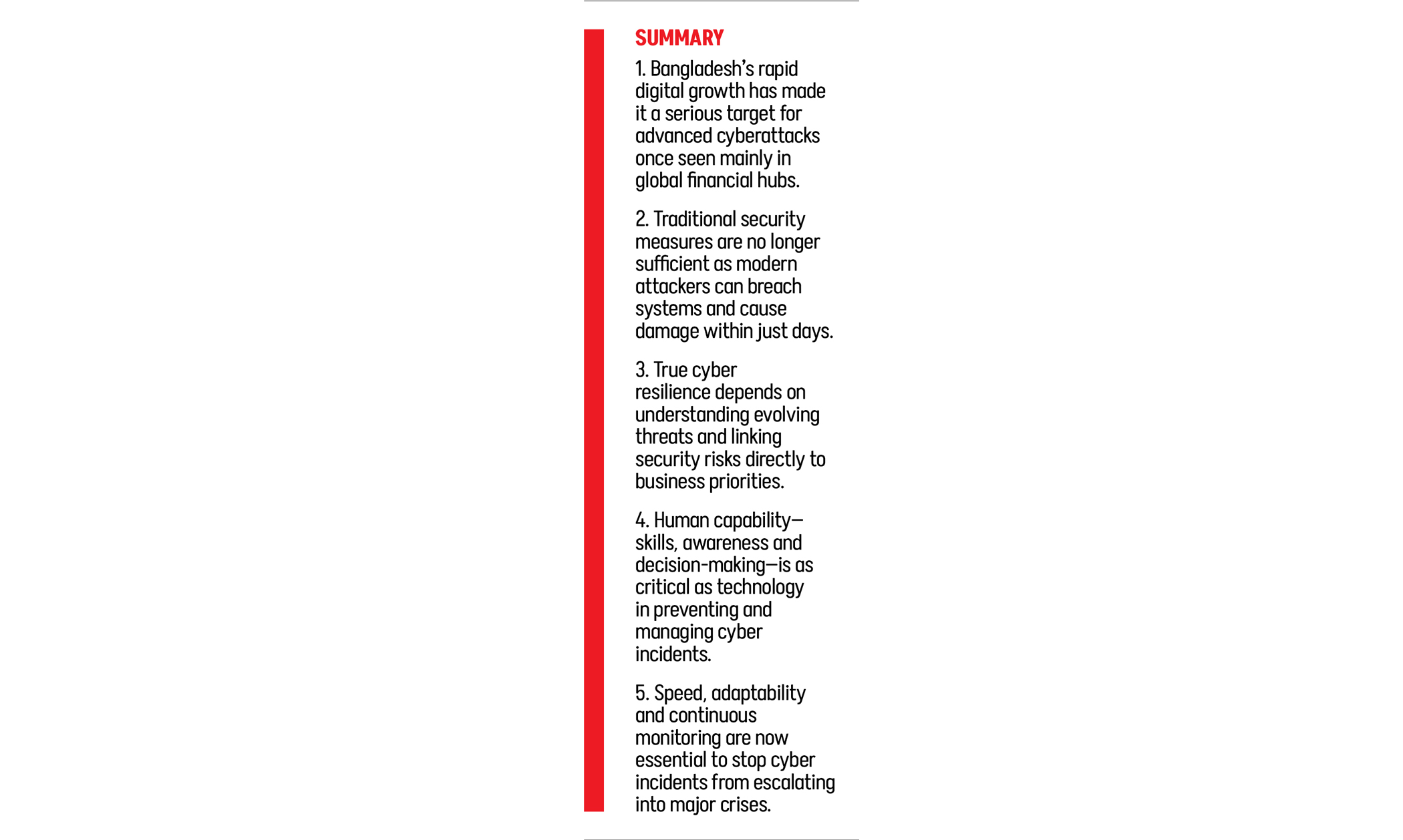
Something has quietly changed in Bangladesh’s digital economy over the past five years, and not everyone has noticed. The country that once dealt mainly with phishing emails and basic malware now faces the same cyber threats troubling organisations in London, Singapore and New York. In one sense, this is a sign of progress. Cybercriminals do not waste advanced attacks on unimportant targets. That Bangladesh’s financial services, telecoms networks, manufacturing supply chains and government platforms are now receiving serious attention from organised crime groups, hacktivists and state-sponsored actors reflects how far the country’s digital transformation has come.
But this shift also brings a new reality. The old security playbook of firewalls, antivirus software and occasional security audits is no longer enough.
 For all latest news, follow The Daily Star's Google News channel.
 Insights from Sophos show that attackers now remain hidden inside systems for a median of just two days, often enough time to steal data, disrupt operations or deploy ransomware. Two days is all it takes for a security incident to become a major crisis.
For Bangladeshi organisations still viewing cybersecurity as an IT department concern rather than a business priority, this timeline should be a wake-up call. Building true cyber resilience matters. The ability not only to prevent attacks, but also to adapt, respond and recover, requires focusing on five connected principles.
Understanding the threat landscape
Cyber threats today do not arrive at random. They follow patterns, reuse techniques, exploit known vulnerabilities and evolve in response to defensive measures. Organisations that stay informed about current attack methods and monitor threat intelligence gain a clear advantage. Those that only react after an incident has begun are always one step behind.
Look at threats in context
A security alert on its own means very little. What matters is whether it affects critical systems, sensitive data or essential services. Without a clear view of business priorities, regulatory obligations and supply chain exposure, security teams can become overwhelmed by alerts while missing the real risks. The strongest organisations connect security signals to business reality and focus on what truly matters.
Cybercriminals adapt constantly, and security strategies must evolve just as quickly. Tools and processes that worked last year may not work today. Resilient organisations can adjust policies, update defences and respond to new threats without slowing business operations.
Research repeatedly points to the same conclusion: a lack of skills or awareness plays a role in most successful attacks. Technology alone cannot compensate for undertrained staff, overstretched security teams, or decision-makers who do not understand cyber risk. Investing in human capability through training, expert support and clear decision-making is essential to long-term resilience.
Work on speed and agility
As cybercriminals increasingly use automation and artificial intelligence to move faster, slow responses become costly. The ability to detect threats early, investigate quickly and respond across systems such as endpoints, networks and cloud environments can determine whether an incident remains a manageable problem or becomes an existential crisis.
For Bangladesh, the path forward is clear, even if it is not easy. Cyber resilience is not achieved by buying technology alone. It requires intelligence, context, adaptability, skilled people and speed working together as a single strategy. Organisations that understand this will be better equipped to protect digital trust, support economic growth and meet the challenges ahead.
Attackers are already paying attention to Bangladesh. The real question is whether Bangladeshi organisations are paying the same attention in return.
Comments