


One health, one future: The critical role of Bangladesh’s veterinarians

Bangladesh’s public health story is often told through the lens of hospitals, epidemics, and human suffering. We speak of dengue seasons that grow longer, of malnutrition that persists, and of climate driven diseases entering new regions. Yet beneath these visible crises lies another struggle; one that begins not in hospital wards but in farms, fish ponds, live bird markets, and the countless households where humans and animals share space, water, and risk. This struggle determines whether our food is safe, whether outbreaks can be contained, and whether lifesaving antibiotics will remain effective for the next generation. At the centre of this quiet frontline stand Bangladesh’s veterinarians.
Their work extends far beyond treating sick livestock, poultry or pets. Veterinarians stand at the intersection of human, animal, and environmental health; an intersection that global experts now call “One Health.”
In a country where people live in close and constant contact with domestic and peri domestic animals, where zoonotic diseases and multidrug resistant organisms are increasingly reported, veterinarians are not peripheral actors. They are central to national health security. Yet their contributions remain largely invisible. Their shortages are rarely discussed. Their challenges seldom reach the policy agenda, and their potential, which is immense, transformative, and urgently needed, remains underused.
A nation built on interdependence
Bangladesh’s food system is vast, intricate, and deeply interdependent. Livestock and aquaculture are woven into Bangladesh’s rural and peri urban life. Chickens in courtyards, goats near kitchens, cattle in backyard sheds, and fish ponds beside homes are not just economic assets; they are daily companions and buffers against crisis. However, this intimacy brings risk. A contaminated batch of milk can affect hundreds of families. A poultry outbreak can seed infection in humans. An anthrax infected carcass can trigger a cluster of human cases. A dog bite can still mean a death from rabies.
These are not hypothetical. Bangladesh has faced repeated anthrax episodes, avian influenza waves, and persistent rabies risks. A national One Health zoonotic disease prioritisation exercise identified anthrax, rabies, Nipah virus, zoonotic influenza, brucellosis, and zoonotic tuberculosis as high priority threats requiring coordinated action that depends heavily on veterinarians.
Geography and demography amplify these risks. High population density means humans and animals share space intensely. Floods, cyclones, and heatwaves disrupt ecosystems and spread pathogens. Urbanisation creates new interfaces: stray dogs around garbage dumps, free roaming poultry near markets, and backyard livestock in expanding townships. In this context, One Health becomes a necessity, not a slogan.
The veterinary frontline: Essential but overstretched
A government veterinarian in a peri urban upazila may be responsible for tens of thousands of animals. His day may begin with a sudden spike in poultry mortality, requiring sample collection and emergency biosecurity advice. Later, he may inspect a slaughterhouse with poor drainage and minimal hygiene. In the afternoon, he may train farmers on antibiotic use; only to see many still rely on unregulated drug sellers.
Veterinarians are trained in both animal production and health management. They possess in depth expertise in epidemiology, microbiology, pathology, and public health, knowledge that is essential for ensuring healthy animals. They understand how diseases jump species, how bacteria evolve under antibiotic pressure, and how food becomes contaminated. Yet the system often treats them as “animal doctors” rather than strategic actors in national health security.
High‑income Asian countries offer a contrasting picture. In Japan, veterinarians are integral to public health centres and food safety agencies. South Korea embeds veterinarians in hazard‑tracking systems that monitor risks from farm to fork. Singapore’s whole‑of‑government One Health model links animal health, food safety, and environmental monitoring. Bangladesh’s veterinarians, by contrast, operate with fewer resources, limited institutional support, and far less recognition, despite carrying responsibilities just as critical.
Food safety: The invisible infrastructure of trust
Food safety attracts attention only during crises: adulterated milk, contaminated meat, or festival related outbreaks. However, most of the time, it is an invisible infrastructure of trust. People eat what is available and affordable, trusting that someone, somewhere, is keeping it safe.
In Bangladesh, that trust is fragile. Live bird markets often have cramped cages, mixed species, poor waste disposal, and minimal hygiene. Slaughter is frequently performed on the floor. Milk may be transported unrefrigerated through multiple intermediaries. Fish ponds may be treated with antibiotics or chemicals without guidance.
Veterinarians should anchor this safety net. But to do so, they need clear mandates, legal authority, laboratory support, and adequate resources. Many countries involve veterinarians at every stage of food safety -- from slaughterhouse approval to export certification. Bangladesh has regulations, but implementation is uneven and veterinary expertise underutilised.
Antimicrobial resistance: A silent epidemic
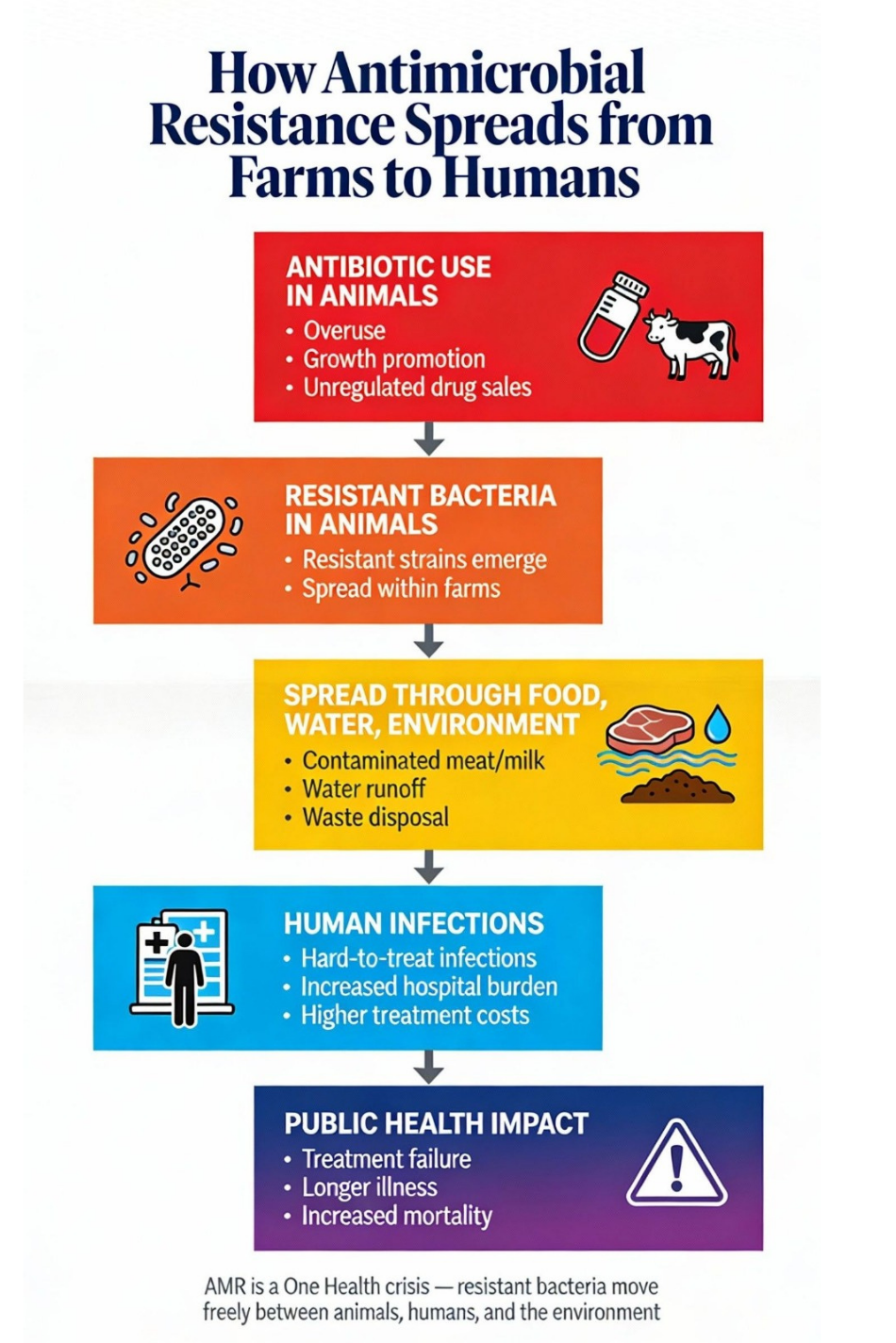
If one issue captures the urgency of One Health, it is antimicrobial resistance (AMR). In Bangladesh, antibiotics are widely accessible without prescription. In the veterinary sector, this leads to prophylactic and growth promoting use in poultry, cattle, and fish. Even well‑trained veterinarians struggle to ensure responsible antibiotic use when diagnostics, enforceable regulations, and economic incentives are lacking.
On the human side, patients often self medicate or demand antibiotics even for viral illnesses. Hospitals and clinics with limited lab capacity rely on broad spectrum drugs. Resistant bacteria move freely between humans, animals, and the environment.
Veterinarians must be empowered as stewards of antimicrobial use in animals, promoting vaccination, better housing, and improved nutrition over routine antibiotics. Still, AMR cannot be solved from the veterinary side alone. It requires joint surveillance, shared data, and multidisciplinary committees involving veterinarians, physicians, microbiologists, and environmental scientists.
Learning from Asia, and moving forward
Japan, South Korea, Singapore, Malaysia, Thailand, China, India, and Nepal all demonstrate elements of strong veterinary public health systems: integrated surveillance, strict food safety enforcement, and veterinarians embedded in public health institutions. Bangladesh has made progress through platforms like One Health Bangladesh and zoonotic disease prioritisation exercises, but implementation gaps persist. Policies exist on paper, yet frontline veterinary services remain underfunded. Coordination is discussed in workshops, but data systems remain siloed.
A call to action
Bangladesh can no longer afford to overlook its veterinary sector. Strengthening it is not a technical detail; it is a strategic imperative. This means deploying more veterinarians, investing in laboratories, integrating veterinary expertise into national health planning, and empowering One Health platforms to function as operational mechanisms rather than symbolic bodies.
Veterinarians are guardians of food safety, custodians of antimicrobial stewardship, and sentinels for emerging diseases. When a veterinarian advises a farmer against indiscriminate antibiotic use, tests pond water, or demands improvements in a slaughterhouse, they are protecting human lives.
Bangladesh’s future health security depends on recognising this truth: when animals are healthy, people are healthy. Unless we support those who keep animals healthy, we will remain unprepared for the challenges ahead.
Prof. Dr. K. B. M. Saiful Islam is a One Health activist, former Member of the National Coordination Committee (NCC), One Health Bangladesh, former Dean of the Faculty of Animal Science & Veterinary Medicine, and former Chairman of the Department of Medicine and Public Health at Sher-e-Bangla Agricultural University, Dhaka, Bangladesh.
Send your articles for Slow Reads to slowreads@thedailystar.net. Check out our submission guidelines for details.