


COVID-19 and the Need for Reshaping Learning Scopes
For my vibrant and joyful 11-year-old niece, frustration is brewing as she can't make it to her school campus. To her, it's the most inviting place on the earth, where she could play with her friends, have fun with the teachers, and attend numerous cultural programs. Right now, she has had enough of keeping her eyes glued to the screen for online classes wearing her school uniform. The dreamy days of running on the grassy field of the school look like a faraway dream thanks to the ongoing pandemic.
This is the scenario of most students at home and abroad, and lack of social interaction and exploration is taking a toll on the cognitive development of these kids. According to a Guardian report, children born during the Covid-19 crisis are found to have lower IQs than others. If that is the case in the developed world, you can guess the situation in a country like ours where not everyone can access the digital means of education offered by schools.
 For all latest news, follow The Daily Star's Google News channel.
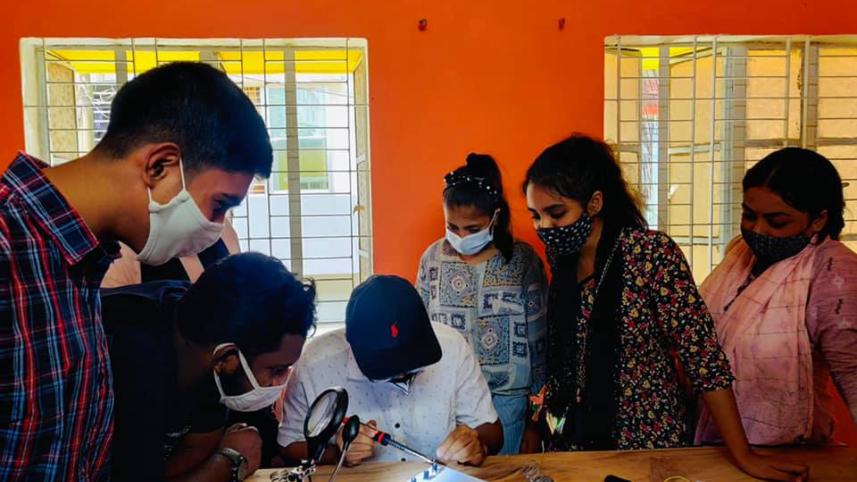
 To offer a bit of relief from this mundane situation, a group of visionaries came up with a different approach to education in Barishal, bringing forth a creative way of learning that requires no formal classroom but is exciting and easy to engage with. They help learners visualize the big picture and apply what they learn to transform their lives and their communities.
Take the case of a teenage girl whose education came to an abrupt halt due to the Covid-19 pandemic. She is now learning the English language through online tools and practising to her level best to enhance her fluency. Their project titled "Nook" operating across the globe is breaking the stereotype that you have to be in a classroom to explore science or handle technology. Equipped with the hands-on training provided by Nook, a recent college graduate is acquiring basic programming skills and transforming his dream of flying a drone into reality.
Irrespective of age or background, everyone is endowed with access to this knowledge-sharing platform. A 65-year-old lady is making an electronic circuit as part of building a mini-robot together with some school children. A farmer's son is experimenting with organic fertilizers and pesticides to boost his income. A single mother is securing some extra penny for her family by making jewellery. A group of young men and women are creating eco-friendly low-cost sanitary pads that they identify as an urgent need in their community.
A twelve-year-old girl, who lives with her single mother running a small kitchen business, has a knack for fashion designing. She explores virtual tutorials on fashion design and practices how to cut cloth with precise measurements. She aims to develop her own fashion design business.
Another girl who hardly enjoys traditional classroom learning has set out on acquiring knowledge on 3D-Design and currently tries her hands at designing a house using 3D sketching software.
Nook helps overcome the limitations of a conventional classroom and encourages people, especially from a marginalized background, to explore their passion and implement their dream projects.
Long-term detachment from the school campus and lack of in-person interaction with friends and classmates are leaving a detrimental effect on kids' psychology. Creative approaches to engage students in what gives them fulfilment can mitigate the crisis to some extent.
Like every cloud has a silver lining, it is a fact that the worst of times often put the best ideas forward. Think about Sir Isac Newton who made the most of his off-the-campus time during a pandemic by getting absorbed in his study of science that led to the invention of some best-of-all-time theories.
With a little inspiration and encouragement, our kids can give their wings a flight and paint the horizon with dreams and hope.
The writer is a journalist of The Daily Star. He can be reached at h2rehman@gmail.com


Comments