Khow Suey – a dish born from migration and adaptation
The comforting smell of a delicious bowl of coconut broth and toasted spices wafting from the kitchen takes me back to my childhood. I am reminded of sitting at the table with my parents, excited about assembling this delicious bowl of chicken and noodles in coconut broth, customised to my needs, with namakpara, boiled egg, shutki powder, chopped coriander, and an abundance of chopped green chilli. The dish is Khow Suey. However, how did this dish—so central to our family get-togethers, yet so different from everything else we eat in Bengali cuisine, with its preponderance of rice in Bangladesh—come to be here? Where did it come from?
Unravelling the historical journey
Khow Suey is a powerful example of displacement and adaptation. Its journey from Burma, now called Myanmar, to the celebratory feasts of the South Asian diaspora reveals a fundamental truth about food: it does not simply travel; it transforms itself. Through the process of dietary acculturation—the adaptations that migrants perform between their heritage food and that of their new environment—ingredients shift and adapt, and flavours hybridise. Yet the main elements of the dish, its capacity to deliver comfort and forge community, carry through. Khow Suey’s story is not one of loss, be it of one’s home or heritage, but of culinary resilience—a testament to how flavour, in its most essential form, migrates and survives.
Khow Suey is a dish packed full of flavour. It was originally called ohn no khao swè, which translates to “coconut milk noodles.” It is a dish that made the journey from Myanmar to the Indian subcontinent with the movement of the Memon community, a Muslim group of Gujarati origin who were living there under British rule. On 2 March 1962, General Ne Win seized power in a military coup and took control of Myanmar. Following this, there was a large outmigration due to growing anti-immigrant sentiment. Many Indians, along with the Memons, were forced to leave Myanmar and return to India and Pakistan. Along with them came the noodle dish, still referred to as a “Burmese” dish despite Burma’s change of name, making it a historical artefact of that period. Resettling in places like Karachi, the Memon community did not simply recreate the dish—they adapted it to their old/new homeland. These adaptations were logical, flavour-driven solutions.
Dietary acculturation
As demonstrated in the chart, some elements were adapted, showing how the recipe assimilated into the pantry of the new country. Over time, as the flavours and functions changed, the recipe became hybridised or crosshatched with its new context. Both adaptation and hybridisation were the building blocks of dietary acculturation.
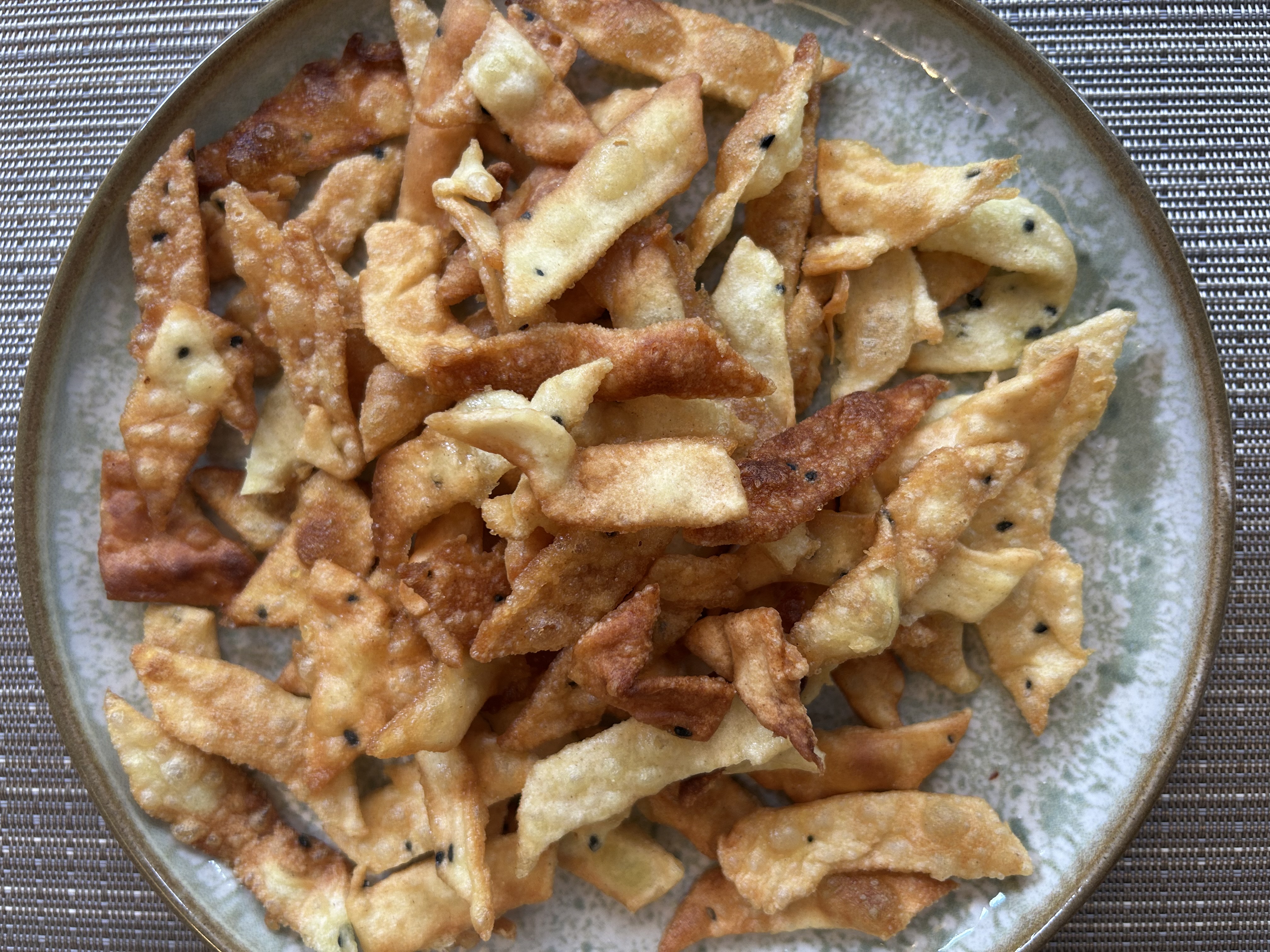
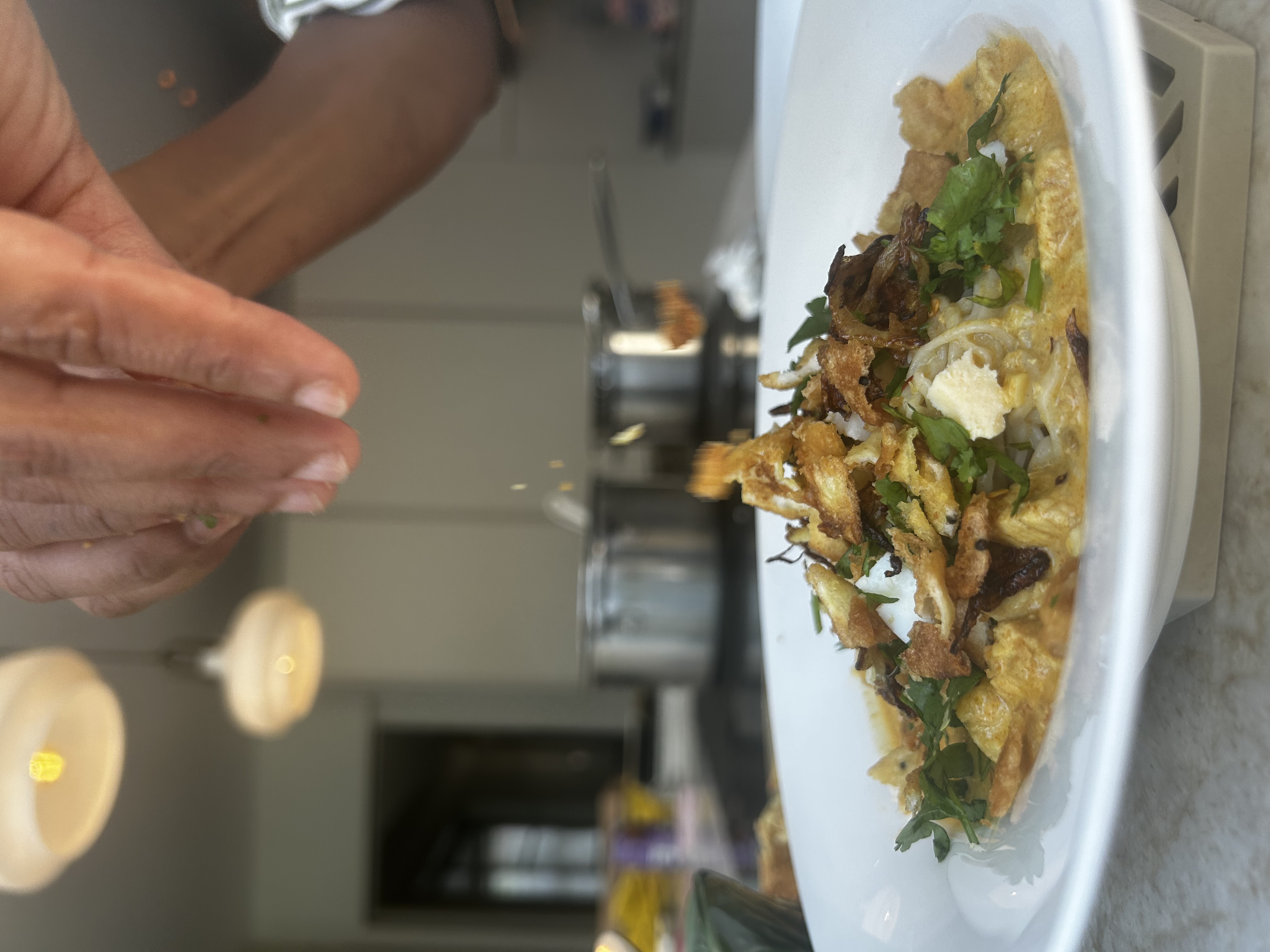
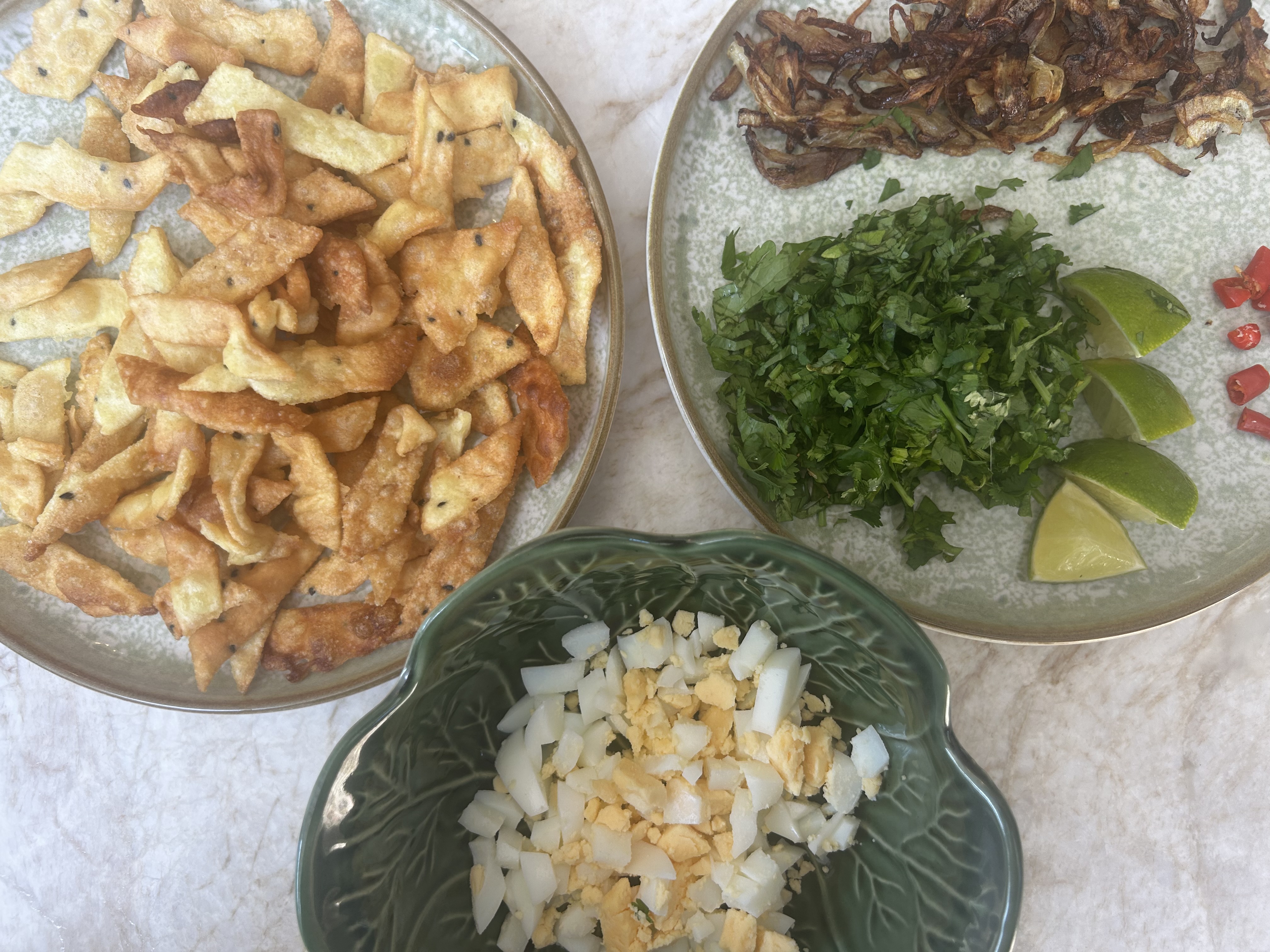
Some examples of adaptation include substituting egg noodles with readily accessible spaghetti, or making a yoghurt and gram flour sauce that resembled coconut milk. The spice profile also shifted from Southeast Asian spices to the warm, familiar spices used in Indian cooking, such as garam masala and chaat masala, which were sprinkled on to add more flavour. Garnish options also changed, coming to include crispy fried samosa dough, slivered ginger, potato sticks, and crushed boiled egg. These changes demonstrate hybridisation—the intentional or unintentional blending of culinary traditions.
As the food experience was being modified, so too was the communal meaning and social function of the dish. The community held on to the feeling that the dish provided, such as that of comfort. It became part of the Memon identity as cosmopolitan Muslims who had travelled outside of the subcontinent. It also became a communal meal, bringing everyone together. In its previous context in Burma/Myanmar, the dish was considered street food, whereas in the Memon diaspora it became the centre of celebrations, often served at weddings, Eid, and communal gatherings. Additionally, while in Burma/Myanmar the dish was served fully prepared, the Memon ritual of customising each bowl gave the dish a wider taste palette, allowing for individual preferences as well as a multiplicity of flavour expressions. See the chart for a summary of these changes.
| The Historical Journey of Khow Suey | ||
| Components of the dish | Original | Memon Adaptation |
| INGREDIENTS |
|
|
| Broth and Base | Coconut milk-based | Often incorporated with yogurt and gram flour, creating a texture like North Indian and Pakistani curry |
| Noodles | Egg | Spaghetti is readily available in post-colonial Pakistan and India |
| Spicing | Southeast Asian aromatic, fried garlic, peanuts and lime | South Asian spices like garam masala, cumin, coriander and chaat masala (in addition to the original) |
| Toppings | Fried onions, coriander, lemon/lime, boiled egg halves | Namakpara, fried tortilla, crushed nachos (in addition to the original) |
| SOCIAL FUNCTION |
|
|
| Dish was considered street food and was served with all the elements. | Dish is often served in celebratory events and customised. |
Dietary acculturation serves as an umbrella term to understand why, when, and how groups of immigrants interact with their dietary traditions. It is less about abandoning one’s traditional food preparation and consumption patterns and more about the types of interactions that can occur among cultures and peoples. The “push and pull” of dietary acculturation creates a dish in which core elements remain the same, while new elements are introduced. These pushes and pulls arise from practical considerations, such as the physical availability of ingredients, as well as from social pressures to conform and feelings of nostalgia for one’s former home. The vocabulary of dietary acculturation helps us to understand how the Memon community creatively adapted and adjusted the traditional dish Khow Suey. They managed to retain the core experience of the dish while allowing it to absorb new and creative elements. It now serves as a sign of the prosperity of the community in its new context.
Conclusion
The journey of Khow Suey from Burma/Myanmar to South Asia, including Pakistan, India, and Bangladesh (then East Pakistan), is a perfect study of dietary acculturation. This story is not about the authenticity of the dish, its origins, or the purity of its transmission; it is about adaptive honesty. It teaches us that flavour is not a prisoner of geography. Instead, it is a fluid yet resilient entity, carried in memory and reconstructed with ingenuity. When we praise a dish for being flavourful, we are acknowledging and celebrating this history of movement and meeting. So, the next time you sit down to a bowl of Khow Suey—whether you reach for spaghetti or egg noodles, coconut milk or yoghurt—remember that you are tasting more than a recipe. You are tasting a story of resilience, a narrative of people who, by holding on to flavour, found a way to carry home with them, transforming it into something new, yet very familiar.
Sabina Khan is a culinary entrepreneur with an MPA from NYU and experience in social enterprise, including founding the Social Enterprise Journal. She now leads her culinary brand, Sabinasflavourlab.
Send your articles for Slow Reads to slowreads@thedailystar.net. Check out our submission guidelines for details.
APO 433: Dhaka’s forgotten post office of World War II
Dadabhai Naoroji: The man who exposed the economics of British colonialism

Untold stories of 1971 through private letters
The extraordinary journey of Atish Dipankar Srigyan

Forgotten story of Jeanette Van Tassel, the American woman who flew over Dhaka in 1892
Beyond 1947 / A personal essay
Abul Mansur Ahmad / A global quest in search of a nation

Chand Bibi and the forgotten history of Muslim women’s political resistance
Women’s voices in Nazrul’s Dhumketu