


How the Iran-US War is conveniently making the world forget Gaza
At dawn in Deir al-Balah, silence has become more terrifying than the thunder of jets. For more than two years, the people of Gaza have learned to read the sky like a map of their own mortality. But as Israeli and American missiles strike Tehran, a different kind of darkness settles over the Gaza Strip. It is the darkness of a cupboard that has finally irrevocably run dry.
When news broke of Israeli and United States strikes on Iran, panic spread across Gaza almost instantly. Palestinians remembered previous escalations when border crossings were abruptly sealed, triggering shortages that spiraled into famine-like conditions. Families rushed to markets, buying whatever they could afford. Within hours, prices of flour, cooking oil and basic staples surged to unaffordable levels, surged by Israel. Soon enough, confirmation arrived; the crossings were closing once again. Fear was not speculative. It was informed by memory.
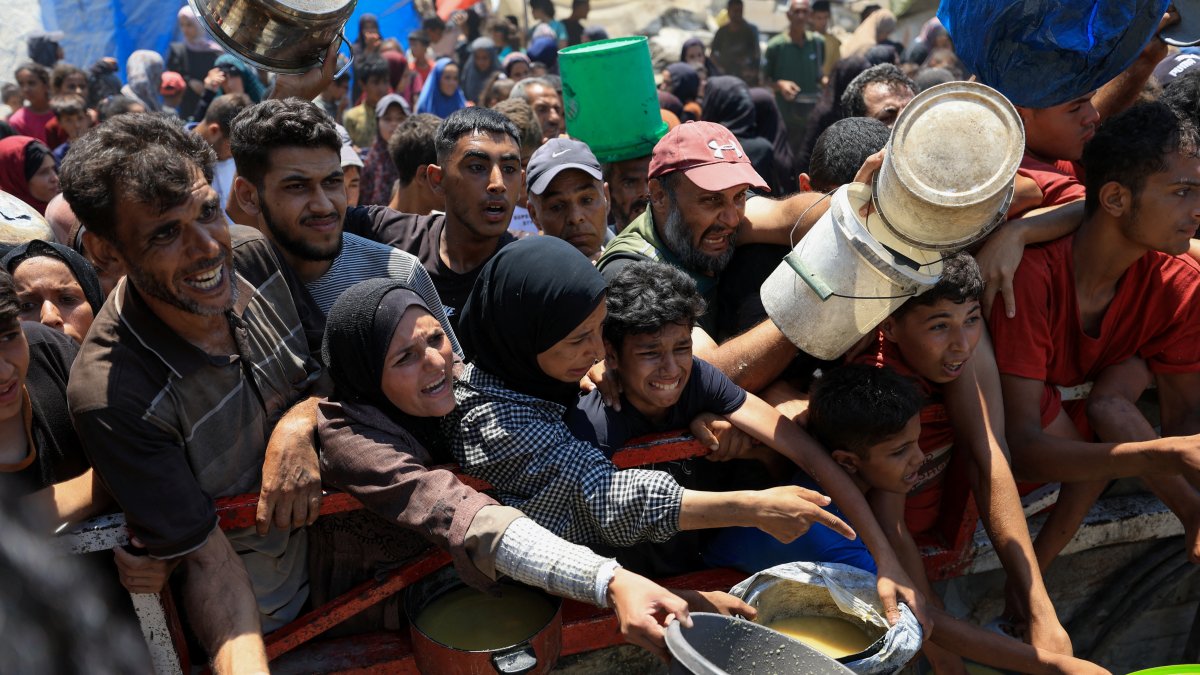
In Maghazi camp, people now stand before a market stall where a 25 kilogram bag of flour that cost 30 shekels last week demands 100, if it can be found at all. These scenes in Gaza exemplify food insecurity and hyperinflation — and the disregarding of it, exemplifies a world that is letting it happen in plain sight. People in Gaza have no stable income, no guarantee of aid deliveries and no assurance that tomorrow’s crossings will open. This is Gaza’s second front, a war of administrative attrition fought not against bombs alone but against what seems mundane to other parts of the world: permits, paperwork and closures of everything from roads to food.
The closure of crossings coincided with another critical development. Israel’s grace period for 37 international NGOs to comply with new registration requirements expired at precisely this volatile moment. Organisations such as Doctors Without Borders (MSF), Medical Aid for Palestinians UK, Handicap International: Humanity & Inclusion, ActionAid and CARE were instructed to halt operations. Although a last-minute ruling by the Israeli Supreme Court allowed them to continue working pending appeal, the decision has not translated into full operational capacity. Supplies remain blocked. Foreign staff are prevented from entering. According to these organisations, they collectively provide roughly half of the food handouts in Gaza and 60 percent of services in field hospitals. Even partial disruption in their activities reverberates immediately through households already living on the edge of survival.
This is not merely about administrative compliance. These measures unfold within a broader context of collective pressure. When layered upon a regional war narrative — dominated by Iran, the US and Israel — these measures become easier to implement and harder to challenge. In the study of international relations, “Diversionary Theory” suggests that governments facing domestic fragmentation or stalled objectives may escalate external confrontations to consolidate support and redirect scrutiny. The US-Israel March 2026 escalation with Iran, particularly the high-profile Israeli strikes dubbed “Operation Roaring Lion,” has had precisely that effect. As the confrontation intensifies, diplomatic red lines that once framed Gaza policy appear to fade. Western capitals now prioritise deterrence against Tehran and the stability of the Gulf over humanitarian monitoring in the Strip. The rhetorical shift is subtle but consequential. Gaza is no longer the crisis commanding urgent multilateral diplomacy; it is a secondary theatre subsumed within a broader regional emergency.
This recalibration has paralysed initiatives once floated under the so-called “Board of Peace” framework, a proposal envisioning transitional governance in Gaza backed by regional Arab states. Those states now face a dilemma. Openly assuming administrative responsibility for Gaza while a Western-backed campaign targets Iran would be politically explosive domestically. The result is inertia. Into that vacuum flows tighter administrative control, prolonged crossing closures, increasingly fragile aid pipelines and continued impasse.
The confrontation has also elevated energy geopolitics to the forefront. With tensions rising around the Strait of Hormuz, Eastern Mediterranean gas infrastructure, particularly Israel’s Leviathan and Tamar fields, has gained heightened strategic importance for Western energy diversification. Under a hardened security doctrine, the Gaza coastline is increasingly viewed as a high-risk zone adjacent to critical infrastructure. That perception carries policy consequences felt directly by civilians. Aid, fuel and goods entering Gaza are screened through an expanded security calculus that often slows or limits flows. As global media fixate on oil prices and naval deployments, the tripling of staple food prices inside Gaza barely registers internationally. Prolonged closures of crossings such as Kerem Shalom and Rafah are justified within a regional security framework rather than debated as components of a localised siege. Security imperatives may be real. But when every calorie and kilowatt is filtered through a threat assessment matrix, civilian life becomes collateral to infrastructure protection.
The gravest consequence of this geopolitical shift is psychological. Chronic uncertainty breeds a sense of abandonment deeper than material deprivation. Families queue for flour and fuel without knowing whether tomorrow will bring resupply or further restriction. International oversight mechanisms that once exerted limited but tangible pressure have receded as attention migrates northward.
For Palestinian factions within Gaza, the margin of manoeuvre narrows further. Their ability to shield civilians from the cascading consequences of a regional war is sharply constrained. Yet it is the population that bears the brunt. History will meticulously record March 2026 for the missile trajectories over Tehran, the brinkmanship in the Strait of Hormuz, the emergency sessions in Western capitals. It may pay far less attention to the incremental tightening of access, the normalisation of scarcity and the steady evaporation of diplomatic urgency around two million people in the Gaza Strip.
The final squeeze of Gaza is not marked by a single dramatic strike. It unfolds through paperwork, delayed convoys, suspended NGO operations, sealed crossings and recalibrated global priorities. None of this implies that the Iran confrontation is fabricated or insignificant. It is consequential and dangerous. But crises do not exist in isolation. When global focus concentrates on deterring one adversary and securing energy lifelines, it inevitably deprioritises other emergencies. In that repriotisation lies Gaza’s peril. When the world rushes to extinguish one blaze, it must ensure it is not allowing another to smolder into silence.
Sanjida Nourin Jhinuk is an undergraduate student at the Department of International Relations in University of Dhaka. She can be reached at snj2004@gmail.com.
Send your articles for Slow Reads to slowreads@thedailystar.net. Check out our submission guidelines for details.