


Bangladesh’s Refrigerator Industry Eyes Global Expansion


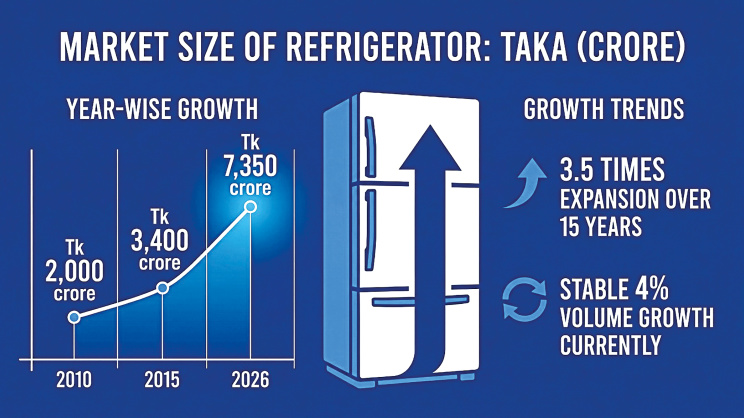
Bangladesh’s refrigerator industry has undergone a striking transformation over the past decade and a half, evolving from an import-dependent market into a predominantly local manufacturing powerhouse by 2025-26. What was once a sector reliant on foreign brands and imported components has matured into one of the country’s most promising industrial segments, with an estimated market size of Tk 7,350 crore.
The industry’s expansion has been driven by rapid urbanisation, nationwide electrification, rising per capita income and growing rural penetration. Increasing consumer awareness, improved living standards and the availability of competitively priced locally manufactured models have further accelerated adoption. Today, nearly 60 percent of Bangladeshi households own a refrigerator -- a remarkable shift from the situation a decade ago, when penetration rates were significantly lower.

In recent years, the sector has maintained around 10 percent annual growth, despite macroeconomic pressures, foreign exchange constraints and inflationary trends. This resilience has positioned it as one of the strongest performers within Bangladesh’s broader consumer electronics market.
Local manufacturers now command approximately 97 percent of the domestic refrigerator market, with Walton alone accounting for roughly 75 percent share. Annual manufacturing capacity stands at about four million units, reflecting substantial investment in production facilities and backward integration.
The refrigerator segment represents nearly half of Bangladesh’s overall electrical and electronics market, which exceeds $1 billion (approximately Tk 15,000 crore) annually. In terms of industrial promise and structural depth, it ranks among the country’s most dynamic manufacturing sectors after the readymade garments (RMG) industry.
Crucially, installed production capacity now exceeds domestic demand -- a milestone that signals both maturity and a new strategic imperative. The next phase of growth must be export-oriented.
A Structural Shift Over 15 Years
The industry’s trajectory over the past decade and a half reveals a profound structural transformation.
In 2010, the market was valued at roughly Tk 2,000 crore. Local component manufacturing was virtually non-existent, and production relied heavily on imported parts and finished products. By 2015, however, the market had expanded to around Tk 3,400 crore. That year marked a turning point: local production accounted for 58 percent of supply, overtaking imports, which fell to 42 percent.
MHM Fairoz, managing director and CEO of Singer Bangladesh Limited, observed: “The industry is now mature and locally dominated, with more than 90 percent of refrigerators produced in Bangladesh. Annual demand is approaching two million units, covering product ranges from 100 litres to 700 litres.”
Component localisation has since advanced significantly. Industry insiders indicate that approximately 97.3 percent of Walton’s refrigerator components are now manufactured domestically. This deepening of backward integration has reduced foreign exchange dependency, enhanced cost efficiency and strengthened supply chain stability.
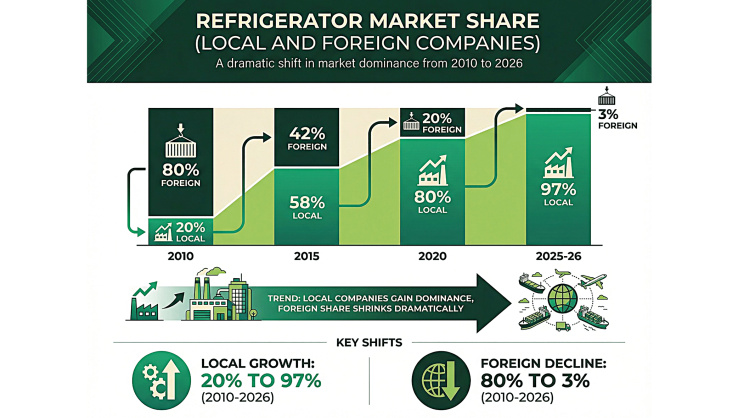
Tahsinul Haque, chief business officer of Walton Refrigerator, reflected on the transformation: “Before 2010, there was virtually no local manufacturing base. We began developing domestic production capacity in 2010 and surpassed imports by 2015. Thereafter, we progressively consolidated control over the production value chain. Backward integration has enabled us to lower costs, strengthen quality control, shorten lead times and enhance competitiveness.”
Walton’s financial performance mirrors this trajectory. The company reported Tk 3.63 billion in profit in the first half (Q1-Q2) of FY2025-26, while sales between January and July 2025 rose 30 percent year-on-year.
Nevertheless, the short-term outlook remains cautious. Fairoz noted: “Last year, the industry experienced no growth, and the current year shows no clear signs of recovery.”
Market indicators suggest that overall sales volumes may remain flat this year, reflecting subdued consumer spending and economic uncertainty.
Md Nurul Afser, deputy managing director of Electro Mart Group, highlighted evolving consumer priorities: “Consumers typically focus on three key factors -- reliable food preservation, aesthetic compatibility with their home interior, and sufficient storage capacity for family needs.”
He added that brands such as KONKA are responding through improved cooling performance, contemporary design and optimised space management, reflecting rising expectations among Bangladeshi consumers.
From Domestic Strength to Export Ambition
Over the past 15-16 years, Walton has transitioned from a fast-growing domestic brand into a regional exporter of home cooling appliances. The company aims to export more than 500,000 units by 2026, with particular emphasis on energy-efficient and eco-friendly technologies.
“We export refrigerators and components to the Middle East, Africa, Asia and Europe,” Haque said. “In 2025, refrigerator exports grew by around 37 percent compared to 2024.”
 For all latest news, follow The Daily Star's Google News channel.
 He attributes the company’s success to three pillars: manufacturing depth, value-driven innovation and an extensive distribution network supported by after-sales service.
“We were never interested in being merely an assembly-based player. Backward integration has allowed us to control essential components and maintain competitive costs. We prioritise energy efficiency, durability and design diversity, recognising that consumers value reliability and aesthetic integration alongside cooling performance.”
Products are also engineered to withstand local conditions, including voltage fluctuations, humidity and heavy daily use, factors that have helped build consumer trust.
Technological Ownership and Compressor Capability
Technological advancement has been central to the industry’s rise. Companies such as Singer and Walton now meet the overwhelming majority of domestic demand through local production. The research and development (R&D) investment has enabled the adoption of inverter technology, integration of smart features and improvements in energy efficiency.
A significant milestone came in 2017 with the establishment of domestic compressor manufacturing. As the core component of a refrigeration system, the compressor determines performance, durability and efficiency. Local compressor production marked a major step towards technological ownership and self-reliance.
Subsequent acquisition of European compressor brand assets further strengthened Walton’s technological roadmap, particularly in inverter and eco-friendly compressor development. This enhanced engineering capability and bolstered international credibility.
Walton’s long-term ambition is to become one of the world’s leading consumer electronics brands by 2030. Its strategy combines local market adaptation with strict adherence to global engineering standards for safety, reliability and sustainability.
Policy Support and the Road Ahead
Despite its achievements, the industry faces structural challenges. A strong dollar has increased the cost of imported raw materials, while potential value-added tax (VAT) adjustments could affect investment decisions. Manufacturers must also continue diversifying into inverter-based, frost-free and smart appliances to remain competitive.
Over 15 years, the refrigerator market has expanded 3.5 times from Tk 2,000 crore in 2010 to Tk 7,350 crore in 2025-26. With volume growth now around 4 percent, exports represent the most viable path for acceleration.
Industry leaders stress the importance of policy coherence. Priorities include competitive export incentives, faster duty drawback processing, simplified bonded warehouse facilities, and the development of a high-value component ecosystem, including semiconductor and electronics clusters. Strong enforcement of quality standards by regulatory authorities is equally vital to prevent substandard imports from distorting the market.
Singer’s CEO emphasised the need to remove policy barriers to attract foreign investment, strengthen local component manufacturing and enhance infrastructure, technological capability and skilled manpower.
With production capacity exceeding domestic consumption, export is no longer optional; it is strategic. If supported by stable policies and sustained technological advancement, Bangladesh’s refrigerator industry could significantly increase foreign exchange earnings and reduce import dependency, Electro Mart’s MD said.
The foundations are robust: expanding capacity, deepening localisation and rising technological sophistication. If aligned effectively, Walton’s CBO said, the sector has the potential to emerge as Bangladesh’s next major global export pillar after RMG, a testament to the country’s advancing industrial capability and economic maturity.
Comments