

What the next government must get right on national security

As Bangladesh enters a new political phase ahead of the February parliamentary election, its domestic security outlook is increasingly shaped by divisive historical baggage, competing narratives, and fragmented identity. Such a polarisation of the national imagination regarding our past has profound implications for national integration and for Benedict Anderson’s famous concept of an “imagined community.” Coupled with this, the country’s regional and global strategic environment has become more militarised, fragmented, and unpredictable.
The February parliamentary election marks more than a political transition for Bangladesh; it represents a strategic moment that will shape the country’s security trajectory for the coming decade. The post-election government will inherit a security environment shaped by accelerating militarisation in South Asia, unresolved conflicts along its periphery, and the diffusion of warfare into non-kinetic domains.
Security in today’s environment is no longer defined solely by troop numbers or territorial defence. It is shaped by air dominance beyond visual range, layered air defence, maritime control, cognitive resilience, and the capacity to deter coercion while retaining diplomatic flexibility. For Bangladesh, the challenge is to develop credible deterrence without provoking insecurity, and to modernise defence capabilities while remaining anchored to development priorities.

Regional militarisation and Bangladesh’s strategic setting
South Asia remains one of the most militarised regions globally, characterised by asymmetry, unresolved disputes, and nuclear deterrence dynamics. India’s rapid military modernisation, Pakistan’s sustained emphasis on strategic deterrence, and Myanmar’s increasing reliance on military force as an instrument of state survival collectively shape Bangladesh’s strategic environment. According to widely cited military balance assessments, Bangladesh occupies a mid-tier position, with limited power projection capability but growing responsibility for securing maritime and airspace interests. The eastern theatre is of particular concern. Myanmar’s Tatmadaw has continued its military modernisation despite internal conflict, acquiring advanced aircraft, air defence systems, and surveillance assets. Simultaneously, ethnic armed organisations such as the Arakan Army have expanded operational capacity and territorial influence along Bangladesh’s southeastern frontier. This evolving landscape complicates border security, refugee management, and counter-insurgency calculations. Bangladesh faces the challenge of managing spillover risks without becoming entangled in Myanmar’s internal conflicts. In this context, Bangladesh’s security policy must be rooted in preparedness rather than threat inflation. A clear understanding of regional military trajectories is essential not to mirror competitors, but to ensure that capability gaps do not invite coercion or strategic vulnerability.
India–Bangladesh security relations in a shifting Indo-Pacific context
India will remain a central security actor in Bangladesh’s strategic calculus, but the relationship is entering a more unsettled phase. External Affairs Minister S. Jaishankar’s recent visit to Dhaka coincided with a period when bilateral trust has been strained by political rhetoric, media-driven narratives, and an increasingly fraught information environment. In India, repeated claims regarding the treatment of minorities in Bangladesh—often amplified through partisan media without verification—have shaped public opinion and complicated diplomatic engagement. In Bangladesh, these narratives have fed perceptions of external pressure rather than partnership.
Viewed from the Indo-Pacific lens, this erosion of confidence is not a minor irritant. India’s ambition to play a stabilising role in the Bay of Bengal and its eastern maritime flank depends heavily on credible relationships with immediate neighbours. The growing gap between the language of “Neighbourhood First” and its practical execution has weakened that promise. For Bangladesh, the task is to engage India on regional stability while safeguarding strategic autonomy. Enduring cooperation will require mutual respect for each other’s sovereignty, restraint, reciprocity, and a clear separation between domestic politics and regional security imperatives.
Why the post-election moment demands a national security framework
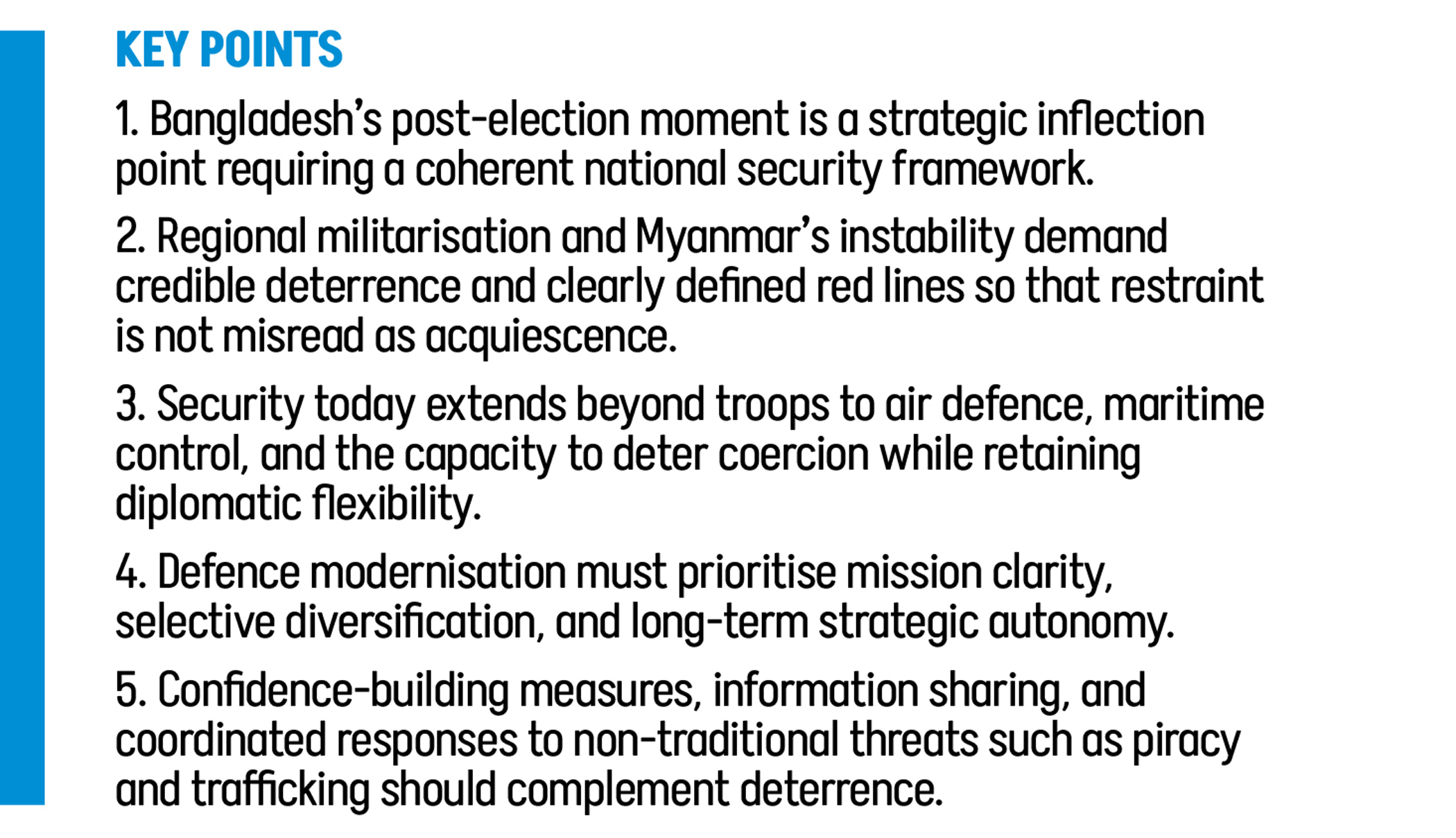
One of the most consequential tasks facing the post-February government is to formulate a comprehensive national security framework aligned with modern warfare and hybrid threat environments. Bangladesh’s existing security posture is built on sectoral policies and incremental modernisation, but it lacks an overarching doctrine that integrates military, diplomatic, economic, and societal dimensions of security.
Modern warfare increasingly hinges on beyond-visual-range air combat, integrated air and missile defence, electronic warfare, cyber operations, and real-time intelligence fusion. Bangladesh’s air defence posture remains limited, and its ability to deny airspace or protect critical infrastructure against advanced threats is constrained. Without a coherent air defence architecture, investments in air platforms risk being strategically incomplete.
A national security framework should therefore prioritise layered air defence, early warning systems, and command-and-control integration across services. These capabilities are not inherently offensive, but they are central to deterrence. A state that can credibly protect its airspace and critical nodes possesses greater diplomatic leverage and strategic confidence.
The post-election period provides political legitimacy to undertake such a strategic reorientation. A national security framework introduced early in the government’s tenure would signal intent, reassure partners, and guide resource allocation. More importantly, it would enable Bangladesh to shape its own security narrative rather than respond to external pressures.

Defence procurement, diversification, and strategic autonomy
Bangladesh’s defence procurement strategy reflects pragmatic diversification, drawing platforms and systems from China, Russia, Turkey, and selected Western suppliers. This approach has reduced overdependence on any single partner but has also generated interoperability and sustainment challenges. The dilemma facing policymakers is not whether to diversify, but how to manage diversification in a manner that supports long-term operational coherence. Procurement choices increasingly carry geopolitical implications. Suppliers offer not only hardware but also training regimes, maintenance ecosystems, and political expectations. Over-reliance on any single source risks strategic dependency, while excessive fragmentation strains logistics and doctrine. The solution lies in selective diversification guided by a long-term force development plan rather than ad hoc acquisitions. Equally important is the question of technology transfer. Without structured pathways for local assembly, maintenance, and eventually indigenous production, Bangladesh will remain locked into dependency cycles. Defence procurement must therefore be linked to industrial policy, workforce development, and research capacity.
Building a self-reliant defence industry through education and STEM
Defence self-reliance is not achievable through procurement alone. It requires an ecosystem that connects education, research, and industry. Bangladesh’s ambition to develop a domestic defence industry must be integrated with national education policy, particularly in science, technology, engineering, and mathematics. Without a skilled technical workforce, technology transfer remains symbolic rather than substantive.
Universities, technical institutes, and research centres should be aligned with long-term defence and security needs, including aerospace engineering, materials science, cybersecurity, and artificial intelligence. Defence manufacturing should be viewed not as an isolated sector but as a catalyst for broader industrial upgrading. Countries that have successfully built defence industries have done so by embedding them within civilian innovation ecosystems.
For Bangladesh, such integration would serve multiple objectives: reducing external dependency, creating high-value employment, and strengthening national resilience. It would also signal strategic seriousness to international partners without projecting militaristic intent.
Maritime security, naval power, and the Bay of Bengal
The Bay of Bengal is central to Bangladesh’s economic and security future. Its exclusive economic zone contains vital resources, while its sea lines of communication (SLOC) underpin trade, energy imports, and connectivity. Securing these interests requires a naval force capable of sustained presence, surveillance, and deterrence.
Bangladesh’s naval modernisation reflects growing awareness of maritime imperatives, but capability development must be aligned with mission clarity. The objective is not power projection but sea denial, EEZ protection, and SLOC security. A credible naval posture enhances bargaining power in diplomatic engagements and reassures commercial stakeholders.
Maritime security also intersects with regional cooperation. Confidence-building measures, information sharing, and coordinated responses to non-traditional threats such as piracy and trafficking can complement deterrence. However, cooperation is most effective when underpinned by a credible national capability.

Credible deterrence as a diplomatic asset
Deterrence is often misunderstood as inherently aggressive. In reality, credible deterrence enables diplomacy by reducing the likelihood of coercion. For Bangladesh, deterrence does not imply matching regional powers’ weapons for weapons, but rather ensuring that vulnerabilities are not exploitable.
A state perceived as militarily defenceless faces constraints in negotiation, whether on border issues, maritime rights, or humanitarian crises.
Conversely, a state with credible defensive capability can engage diplomatically from a position of confidence. Deterrence and diplomacy are therefore mutually reinforcing rather than contradictory.
Responding to Myanmar and armed non-state actors
The idea of credible deterrence brings the Myanmar question to Bangladesh’s eastern security theatre, which demands particular attention in the post-election period, not only because of Myanmar’s unresolved internal conflict, but because the erosion of authority across its border regions has begun to test Bangladesh’s sovereignty in tangible ways. Myanmar’s conflict shows no immediate signs of resolution, and the expanding influence of armed groups such as the Arakan Army has altered the security calculus along Bangladesh’s southeastern frontier. These actors are no longer peripheral insurgent formations; they are increasingly capable, territorially embedded, and transnational in outlook.
For the incoming government, the challenge lies in managing instability without normalising violations of sovereignty. While restraint has been a defining feature of Bangladesh’s approach, restraint must be clearly bounded. Drawing and communicating red lines is essential to prevent ambiguity from being misinterpreted as acquiescence. Incidents such as the abduction of Bangladeshi fishermen in coastal waters, disruptions to maritime activity, and the rerouting of tourist vessels between Teknaf and Cox’s Bazar due to security concerns illustrate how non-state violence and cross-border instability can directly affect livelihoods, commerce, and public confidence.
Airspace violations originating from Myanmar during periods of heightened conflict further underscore the risks of spillover. Even when unintentional, such incidents carry symbolic and strategic significance, as they challenge the state’s control over its sovereign domain. If left unaddressed, they risk establishing precedents that weaken deterrence and invite further encroachment.
The post-election government must therefore adopt a calibrated approach that combines enhanced border security, intelligence coordination, and sustained diplomatic engagement, while making clear that certain actions will not be tolerated. A purely militarised response would risk escalation and humanitarian consequences, particularly in a region already burdened by refugee pressures. Yet excessive restraint carries its own dangers, potentially emboldening armed actors and complicating future crisis management.
Managing this balance will be among the most complex security tasks facing the new administration. It will require institutional clarity, rapid decision-making mechanisms, and credible signalling—both domestically and internationally—that Bangladesh remains committed to peace while remaining equally resolute in exercising its sovereignty.
Non-traditional security threats and cognitive vulnerability
Beyond kinetic threats, Bangladesh faces a growing array of non-traditional security challenges that directly affect social cohesion and institutional strength. Cognitive warfare, misinformation, and disinformation campaigns exploit societal fault lines and undermine trust in institutions. Distorted historical narratives, identity fragmentation, and norm erosion can polarise society and weaken democratic resilience.
These threats are particularly insidious because they operate below the threshold of armed conflict. They do not trigger conventional defence responses, yet their cumulative impact can be destabilising. Addressing them requires strategic communication, media literacy, institutional credibility, and political restraint.
Internal security concerns further complicate the picture. The emergence of armed groups such as the Kuki-Chin National Front in the Chittagong Hill Tracts highlights the enduring challenge of managing peripheral regions where governance deficits, identity grievances, and transnational linkages intersect. Militarised responses alone risk aggravating tensions; sustainable solutions demand political engagement, development, inclusion, and intelligence-driven law enforcement.
A strategic window that will not last
The post-February election period offers Bangladesh a rare strategic window. The new government begins with political legitimacy, regional attention, and relative internal stability. Whether this moment is used to articulate a coherent national security framework or allowed to pass through incrementalism will shape Bangladesh’s security posture for years to come. In an era of militarised competition and hybrid threats, security is no longer a background concern. It is a central function of statecraft. The choices made in the early months of the new administration—on doctrine, deterrence, resilience, and institutional coherence—will determine whether Bangladesh remains merely stable or becomes strategically secure.
ASM Tarek Hassan Semul, Research Fellow, Bangladesh Institute of International and Strategic Studies (BIISS) and Cohort of the Indo-Pacific Young Leaders Program, Asia Pacific Foundation (APF), Canada. He can be reached at tarek@biiss.org.
Send your articles for Slow Reads to slowreads@thedailystar.net. Check out our submission guidelines for details.