


Tea cultivation takes root in Gazipur plains
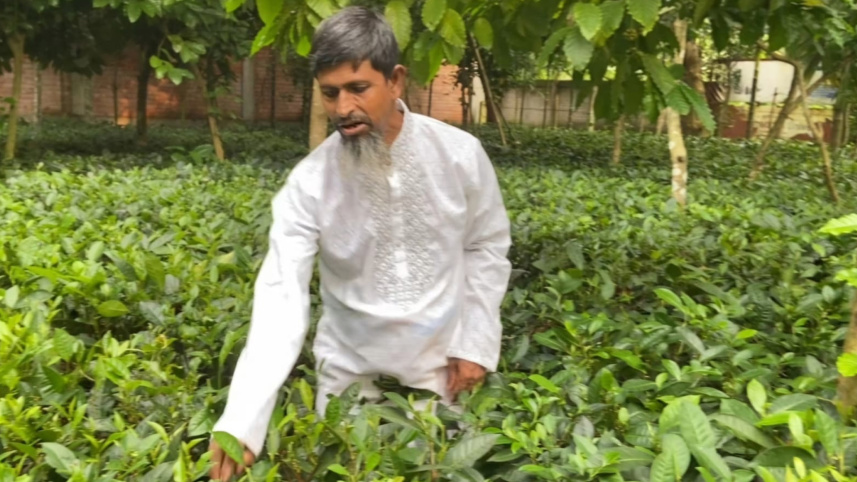
Breaking away from the long-held notion that tea thrives only in hilly regions, a pioneering initiative in Gazipur’s Kapasia upazila is reshaping prospects for cultivation in Bangladesh’s plains.
Prof Md Lutfar Rahman, a faculty member at the International University of Business Agriculture and Technology (IUBAT), has successfully established a tea garden on one hectare of land in Chinaduli village, proving that favourable conditions for tea cultivation extend beyond Sylhet’s hills.

Drawing on nearly four decades of experience in the tea industry, Rahman launched the project in 2019 after observing similarities in rainfall and topography between Kapasia and Sylhet. “Although I have not yet analysed the soil composition here in the laboratory, I decided to try it as the topography seemed favourable,” he said.
He initially planted 20,000 saplings collected from Srimangal across five plots. Over time, the gardens, now ranging from two to five years old, have begun yielding results. Production started from the older plantations, with around 100kg of green tea harvested in 2022 and 2023. Output dipped to 60kg in 2024, while 2025 has so far produced 76kg.
Rahman currently produces green tea manually using a Chinese technique learned online. “After picking the leaves, I process them by heating them in very hot water for two minutes,” he said, adding that mechanised production and branding are future goals. He expects to reach 150kg of production by 2026.
The initiative has sparked interest among locals and visitors alike, turning the garden into a growing attraction. Many see it as a potential driver of rural employment and economic diversification.
Local resident Monir Hossain said, “Tea cultivation will reduce unemployment in our area. The cost is less than other crops, and the profit is higher.” Echoing similar optimism, neighbour Asma Khatun noted, “We can work now. In the future, my children will also be able to work here.”
Kapasia Upazila Agriculture Officer Aulia Khatun described the soil as suitable for tea cultivation and said authorities are ready to support aspiring farmers.
With its early success, the Kapasia tea garden is not only challenging traditional boundaries of cultivation but also opening a new frontier for agricultural innovation in Bangladesh’s plains.
 For all latest news, follow The Daily Star's Google News channel.
Comments