


Budget offers scant cure

The proposed FY2026–27 budget presents a stark assessment of the financial sector’s long-running weaknesses but offers limited detail on how the BNP-led government plans to reform it.
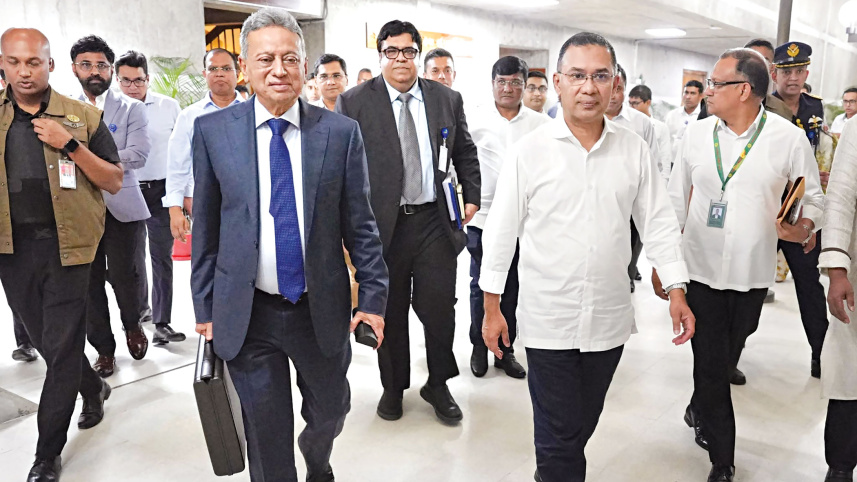
Finance Minister Amir Khosru Mahmud Chowdhury yesterday placed his maiden national budget, proposing a Tk 9.38 lakh crore outlay for FY2026–27.
 For all latest news, follow The Daily Star's Google News channel.
 In his budget speech, the minister described a financial sector weakened by years of irregularities, politically influenced lending, weak oversight, opaque lending practices, misuse of loan rescheduling facilities, and the concealment of bad loans.
“The financial sector we have inherited is a matter of serious national concern,” he said.
According to the minister, the banking sector’s non-performing loan (NPL) ratio stood at 13.6 percent of total loans in December 2005 but surged to 35.73 percent by the first quarter of FY2025–26, equivalent to more than Tk 6.44 lakh crore.
He said the deterioration has left several banks facing acute liquidity shortages, eroded public confidence, and, in some cases, required emergency intervention and institutional consolidation.
The minister also highlighted weakening capital strength, noting that the capital adequacy ratio (CAR), which stood at 7.3 percent in 2005, had fallen to negative 2.64 percent by the end of 2025.
He said these developments have undermined trust in the banking system and made it difficult for ordinary depositors to access their savings on time.
After the fall of the Awami League-led government in August 2024 through a mass uprising, the full extent of the sector’s problems became visible.
The interim government and Bangladesh Bank subsequently launched a series of reform initiatives, including amendments to financial sector laws.
These included enactment of the Bank Resolution Ordinance and the Deposit Insurance Ordinance, alongside efforts to amend the Bangladesh Bank Order, 1972, the Bank Company Act, and the Money Loan Court Act. Other measures included removing the Financial Institutions Division from the finance ministry.
However, those initiatives were largely absent from the current budget speech.
Instead, the finance minister said the government is spending around Tk 40,000 crore in FY2025–26 to recapitalise weak banks and is working to reduce NPLs, increase transparency in loan approval and rescheduling, and strengthen accountability in bank management.
He said a risk-based supervisory framework would be introduced to restore weak banks, alongside recapitalisation and management reforms where necessary.
The government has also initiated bank restructuring to ensure depositors recover their funds and launched efforts to recover money laundered abroad, he said.
The minister added that political appointments and interference in banking operations have been halted and that laws have already been amended to reduce undue familial influence and control in the sector.
Economic analysts, however, said the reform agenda remains too broad and lacks timelines.
Ahsan H Mansur, economist and former Bangladesh Bank governor, told The Daily Star that while the budget correctly identifies the sector’s problems and includes some positive governance proposals, it does not set out a clear or specific reform roadmap.
Statements alone would not be enough, he said, adding that meaningful reforms must begin immediately even if their benefits take years to materialise.
Mansur also questioned the absence of several previously discussed measures, including reforms related to financial institutions, tax administration, and greater independence for Bangladesh Bank.
Comments