


95% of Bangladeshi farmers use unbalanced fertilisers: WB report

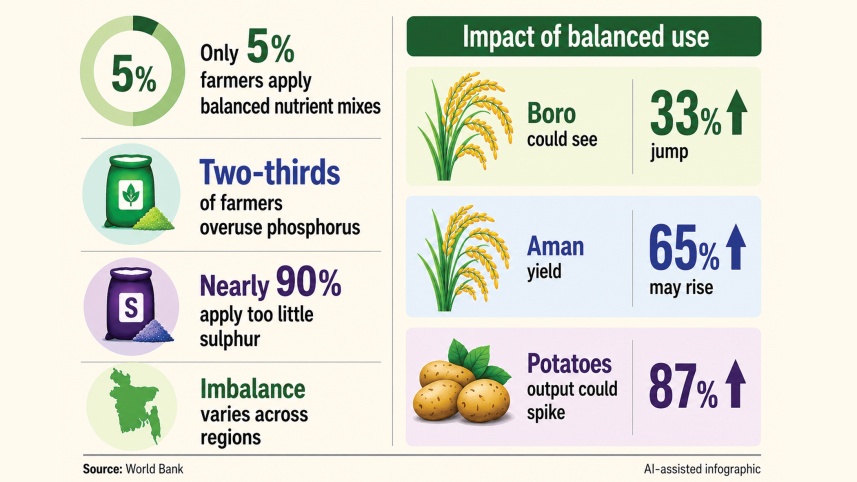
Around 95 percent of farmers in Bangladesh use unbalanced combinations of nitrogen, phosphorus, potassium and sulphur, raising concerns over soil health, crop productivity and the long-term sustainability of agriculture, according to a recent World Bank report.
Only 5 percent of farmers apply nutrients in balanced proportions, according to the report, “Repurposing Agricultural Public Spending for Quality Growth and Jobs in Bangladesh’s Agrifood System”, launched on June 15.

The study found that about two-thirds of farmers overuse phosphorus, nearly nine in ten apply too little sulphur, and six in ten fall short on potassium.
Nitrogen use is also uneven, with underapplication among rice growers and excessive use in onion and vegetable cultivation.
Nutrient imbalances vary significantly across regions. Underdosing is more common in Barishal and Sylhet, while excessive application is more prevalent in Khulna and Rajshahi.
Correcting these imbalances could increase yields by 33 percent for Boro rice, 65 percent for Aman rice and 87 percent for potatoes, the report said.
BRIDGING THE KNOWLEDGE GAP
Jonaed Shohol, a research analyst at the World Bank, told The Daily Star that the low adoption of balanced nutrient practices stems largely from farmers’ limited awareness of scientifically developed recommendations.
Although the Bangladesh Agricultural Research Council (BARC) has established guidelines, these are not being effectively communicated to growers. As a result, many continue to rely on traditional methods rather than scientific advice.
Shohol identified weaknesses in the Department of Agricultural Extension (DAE) as a key factor behind the information gap. According to him, the agency is responsible for equipping farmers with the knowledge needed to adopt recommended practices, but current efforts remain inadequate.
THREAT TO SOIL AND YIELDS
Beyond reducing crop yields, improper application is accelerating soil degradation, Shohol warned.
He said soils are becoming more acidic and less capable of retaining water, trends that could undermine fertility and future agricultural production.
Agriculture Minister Mohammed Amin Ur Rashid told The Daily Star that the average soil pH in Bangladesh is around 4.5, whereas a level above 6.5 is needed to improve soil quality.
Excessive use of chemical inputs has increased acidity and reduced fertility, he said, adding that the government is conducting extensive soil testing nationwide to assess conditions.
At a recent event, Md Abdur Rahim, director general of the DAE, said continuous cropping has depleted soil organic matter, with some land now producing up to four crops a year.
Organic matter, which should ideally account for around 5 percent of soil composition, averages just 0.5 percent to 1.7 percent in Bangladesh, he added.
“To achieve optimum yield capacity, at least 2 percent organic matter is required. Because of this deficiency, expected crop yields are not being achieved,” Rahim said.
“If we cannot increase organic matter content in the future, sustainable agriculture will not be possible.”
RETHINKING RECOMMENDATIONS
 For all latest news, follow The Daily Star's Google News channel.
 The World Bank report said farmers could raise output by about 25 percent through more efficient use of existing land, labour and agricultural inputs.
To improve awareness, Shohol suggested greater use of social media, television and radio programmes, as well as billboards carrying area-specific recommendations.
Moin Us Salam, a former professor in the Department of Agronomy at Bangladesh Agricultural University, said the widely held belief that farmers use excessive inputs warrants closer examination.
He explained that recommendations are generally developed by BARC through research station trials and consultations. However, their effectiveness depends on how well the underlying data represent conditions in specific fields or upazilas.
Referring to Bihar in India, Salam said soil nutrient mapping is being carried out at the level of individual plots, with about half the work already completed.
Such an approach allows for plot-specific recommendations, whereas Bangladesh does not yet tailor guidance to individual plots, he said.
The agriculture minister said limited awareness among field-level government officials regarding soil health has also contributed to the widespread use of unbalanced nutrient mixes.
He added that under the government’s proposed policy approach, input use could be reduced by more than 23 percent while yields increase, lowering production costs and improving productivity.
Comments