


BB rules exist, but are they protecting bank MDs?

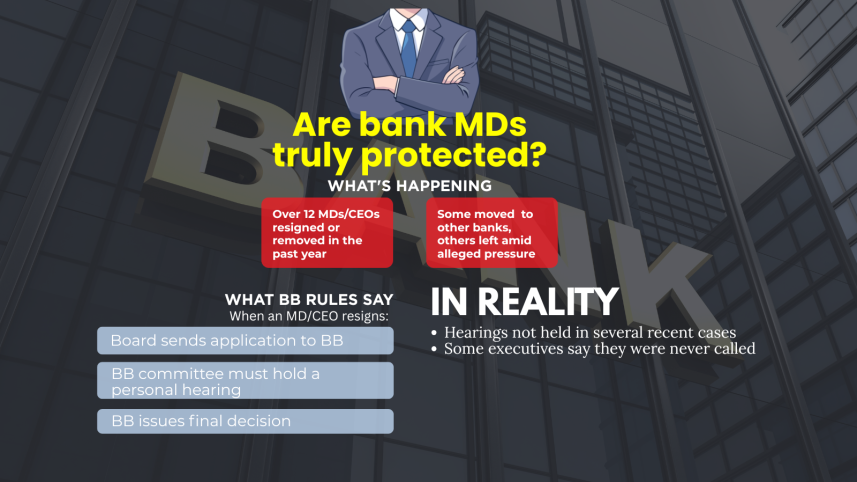
When a managing director or chief executive officer of a bank applies to resign, the Bangladesh Bank (BB) is supposed to call them for a hearing before taking a final decision, as per the existing regulations.
However, in more than a year up to this month, more than a dozen managing directors and chief executive officers of private commercial banks have resigned or been terminated. In many of these cases, personal hearings were not held by the banking regulator.

This has raised a key question: while rules exist to protect bank executives from leaving under internal pressure, are they being properly enforced?
Take the case of Kimiwa Saddat, who resigned as acting managing director of Community Bank Bangladesh PLC on May 6, citing personal reasons. His departure came before he was formally confirmed in the full-time role.
Contacted, he told The Daily Star that the central bank had not called him regarding the matter till yesterday.
There have been media reports suggesting he resigned amid pressure from the board of directors at the bank owned by the Bangladesh Police Welfare Trust. However, Saddat did not confirm the claims.
When asked whether there was any pressure behind his resignation, he said, “I do not know much about it. A member of the board had hinted at it. I resigned citing personal reasons to preserve my own dignity.”
Unlike Saddat’s case, the resignation of Md Omar Faruk Khan, managing director of Islami Bank Bangladesh PLC, drew widespread attention.
Khan resigned on May 24, a day before the country entered a nearly week-long Eid holiday. At the time, he was on one and a half months of leave.
On the same day, the bank’s chairman and independent director, M Zubaidur Rahman, also stepped down. The BB later appointed Md Khurshid Alam, a former BB deputy governor, as chairman of Islami Bank.
The leadership changes triggered protests from customers and disrupted operations for around two weeks. The issue was also debated in parliament between members of the ruling party and the opposition.
The central bank eventually dissolved the entire board, including the chairman. Protesters under the banner of the customers’ forum alleged that the regulator had forced the managing director and chairman to resign. However, BB denied the allegation.
Nearly a month after Khan’s resignation, the central bank had not called him for a hearing, according to BB officials speaking on condition of anonymity.
The Daily Star tried to reach Khan by phone until the filing of this report yesterday, but he did not respond.
NOT ALL RESIGNATIONS LINKED TO PRESSURE CLAIMS
Not every departure in the past one year has been linked to allegations of internal pressure.
Some executives said they left to take up roles at other banks, while others said they were contacted by the BB after resigning.
Selim RF Hussain resigned as managing director of BRAC Bank in May last year. He told The Daily Star that the central bank contacted him after his resignation.
In February this year, Hassan O Rashid, chief executive officer of Prime Bank, resigned to join Eastern Bank as its managing director.
Earlier, in August last year, Sheikh Mohammad Maroof, managing director of Dhaka Bank, resigned citing personal reasons. He told The Daily Star that Bangladesh Bank had called him regarding his resignation.
 For all latest news, follow The Daily Star's Google News channel.
 Separately, several managing directors and chief executive officers, including those at Premier Bank, First Security Islami Bank, EXIM Bank, Union Bank and Global Islami Bank, were placed on forced leave and later terminated.
Arief Hossain Khan, executive director and spokesperson of the BB, said the regulator usually calls managing directors for a hearing when they resign.
However, he said he was not aware whether the managing directors of Community Bank and Islami Bank had been called.
RULES EXIST, BUT DOUBTS REMAIN
The BB introduced a policy in 2014 on the appointment and responsibilities of chief executives of banks. It was followed by a master circular in 2024.
According to the guidelines, if a managing director or chief executive officer resigns before completing their contract, the application must be forwarded to the BB with the board’s recommendation.
A high-level BB committee is then required to hold a personal hearing with the concerned official before making a recommendation. The central bank takes a final decision based on that recommendation.
Speaking on condition of anonymity, a senior managing director of a private commercial bank said the MD sits at the centre of a bank’s operations, while the board sets policy.
“Any proposal that requires the board’s approval must be presented by the MD. Once an agenda is approved by the board, the responsibility for its implementation also falls on the MD. As a result, the relationship between the board of directors and the MD often becomes a mix of cooperation and tension.”
He said this tension often leads to pressure on managing directors to resign.
He added that despite existing regulations, the BB is not effectively safeguarding senior executives.
Toufic Ahmad Choudhury, former director general of the Bangladesh Institute of Bank Management (BIBM), said boards of many banks place heavy pressure on management and managing directors.
“As a result, if an MD does not comply with the board’s wishes, he or she may be removed or forced to resign.”
He said the central bank needs stronger safeguards to protect MDs, but added that institutional independence is also essential. “A weak central bank cannot effectively safeguard MDs. This is precisely why greater autonomy for the central bank is essential.”
Comments