


Can data annotation for AI solve the unemployment crisis?

The July uprising did not emerge from ideology alone; it reflected a deeper structural frustration: large numbers of educated and semi-educated young people facing narrowing pathways into stable work. And no side yet has provided a clear way out of this.
But there is a eureka moment to be had to this conundrum in this era of artificial intelligence.

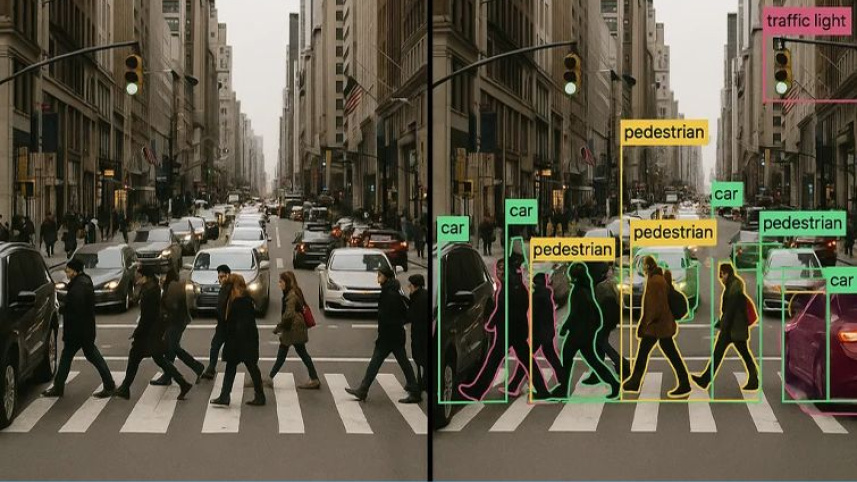
Every model that now excites policymakers and investors learns through millions of small, human decisions called annotation. The messy world needs to be translated into structured signals for AI to function.
‘This image is rice, not road; this sound is a disease, not noise; this sentence is context, not spam,’ -- is what annotation trains the algorithm.
This work has already become a global industry worth tens of billions of dollars, expanding quietly beneath the more visible stories of large models, supercomputers and headline-grabbing valuations.
Every new AI application -- healthcare diagnostics, agricultural monitoring, logistics optimisation, surveillance systems, financial risk scoring -- multiplies the demand for labelled data.
The irony is that as AI scales, its dependence on human judgment increases, not decreases. The smarter the system, the more carefully curated its training must be.
In India, this shift is already visible -- not in glossy labs but in small towns, as depicted in a recent Netflix film named Humans in the Loop.
The film follows a woman from rural Jharkhand who finds work at a data-labelling centre training AI systems for international clients, reminding us that intelligence today is literally coded far from urban tech hubs.
Alongside this, thousands of gig workers across Indian districts annotate images, audio and text for global models, earning livelihoods that did not exist a decade ago.
By the end of the decade, this segment could reach a $40-plus-billion market, with close to a million workers participating across microtasks and contracts.
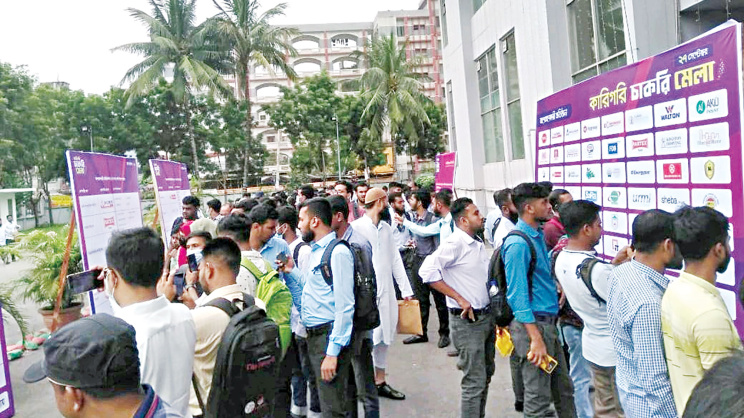
Photo: Star/file
If neighbouring India can become a vital cog in the global AI supply chain, why not Bangladesh?
Annotation is not capital-intensive. It does not require frontier research, proprietary chips or billion-dollar labs. It rewards scale, coordination, consistency and cost efficiency.
In other words, it behaves like an industry designed for countries with large youth populations, expanding digital connectivity and decentralised labour pools. These are not incidental traits. They are structural endowments. Bangladesh has all three.
Unlike startup-centric visions of AI that concentrate opportunity in a few urban clusters and a narrow elite, annotation distributes work.
It can operate from districts, distant towns or even homes. A laptop, a stable internet connection and basic training are sufficient to enter the market.
For a country struggling to absorb new entrants into formal employment, this matters more than ambition, narratives or speculative promises of innovation-led growth.
There is a historical parallel here that Bangladesh understands better than most. The garments sector did not begin as a high-technology industry or a prestige export. It began as a coordination problem -- large numbers of workers, basic training, quality control and reliable delivery to global buyers.
Over time, what looked like low-skill work became a complex industrial ecosystem: compliance systems, export financing, logistics, buyer trust and global integration. The sector did not leap into sophistication; it accumulated it.
Annotation follows a similar logic, but without factories, without physical congestion and without the environmental costs that accompanied earlier industrialisation.
 For all latest news, follow The Daily Star's Google News channel.
 It is labour-intensive but digitally portable. It scales horizontally rather than vertically. And like garments, its real strength lies not in novelty, but in reliability.
Imagine five young people in a district town working on agricultural image data one month, Bangla speech data the next and medical records after that.
Over time, workflows stabilise, quality improves and contracts grow in size and complexity. What begins as task work turns into firms. What begins as firms turns into clusters. This is not a leap into the unknown; it is an accumulation of capability, trust and reputation over time.
The question, then, is not whether Bangladesh can lead in annotation, but whether it chooses to.
Crucially, Bangladesh does not need to invent an institutional architecture from scratch. Much of the scaffolding already exists.
The previous government invested heavily in digital training and decentralised infrastructure -- digital labs, ICT training centres, union digital centres (UDC) and various youth skill programmes that were designed to familiarise young people with basic digital tools.
Many of these initiatives struggled to find sustained market linkages. The infrastructure remained; the demand did not.
Annotation offers that missing demand. These labs can be repurposed as entry-level annotation and quality-assurance training hubs. UDCs can function as distributed coordination points.
Existing public–private training pipelines can be aligned with global data-labelling standards rather than generic “ICT literacy”. What was once framed as employability training can become export-oriented service preparation.
Other middle-income economies are already positioning themselves quietly in this space. They are not branding themselves as AI pioneers, nor are they announcing grand national strategies. They are becoming reliable suppliers in the intelligence supply chain, embedding themselves where global demand is steady and recurring.
Bangladesh risks arriving late, not because of a lack of talent or effort, but because of hesitation to recognise annotation as a legitimate economic category rather than a temporary or transitional activity.
The policy requirement here is not visionary. It is administrative. Recognition, standards, contracts and export pathways. Once those are in place, scale follows naturally.
Bangladesh has done this before -- quietly, imperfectly, but effectively -- when garments moved from dispersed units into a globally competitive industry. Annotation offers a second such opening, adapted to a digital economy rather than a manufacturing one.
Bangladesh will not define the future of AI by building the most advanced models. That race is already crowded, capital-heavy and structurally skewed.
But Bangladesh can define its position in the AI economy by becoming indispensable to how intelligence is trained.
The author is an assistant professor at North South University and member of UNESCO AI Ethics Experts Without Borders. He can be reached at zulkarin@gmail.com
Comments