


Economic outlook fragile as country faces three-pronged crisis: PRI
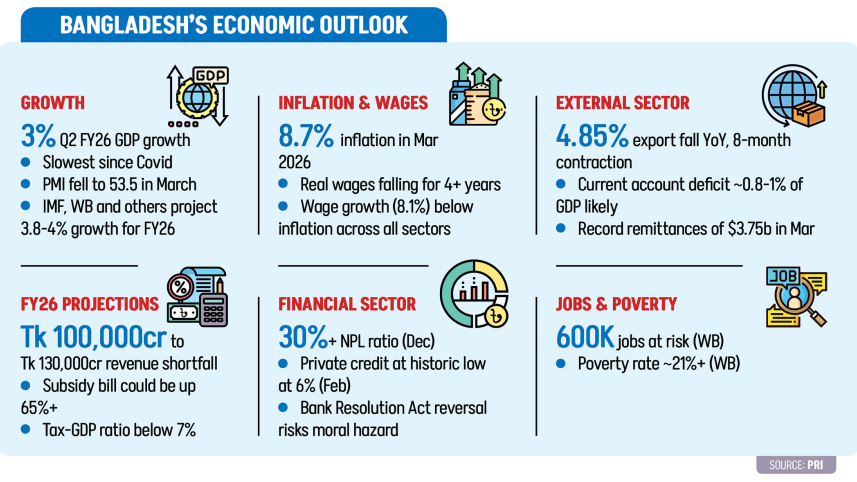
Bangladesh’s macroeconomic outlook is fragile as it faces three concurrent adverse external headwinds, including the Middle East crisis and the country’s impending graduation from the least developed country (LDC) category, said the Policy Research Institute (PRI) of Bangladesh yesterday.
Presenting the institute’s Monthly Macroeconomic Insights at its Dhaka office, Principal Economist Ashikur Rahman said uncertainty around US tariff policies is another factor casting a shadow over the economy’s prospects for a faster recovery.

“These shocks are feeding through energy prices, weakened trade flows, and supply chain disruptions, with broad economy-wide implications,” he said.
At the same time, pressure is building on the balance of payments amid weaker exports and higher energy costs, with limited policy buffers heightening overall vulnerability amid the US-Israel war on Iran.

Rahman noted that around 31 percent of Bangladesh’s energy imports originate from the Middle East, largely transiting the Strait of Hormuz. A study by Zero Carbon Analytics found that severe price shocks could raise the country’s energy bill by 40 percent to $16-$17 billion in the ongoing fiscal year 2025-26 (FY26).
The PRI economist noted that Bangladesh has seen a fragile recovery over the 18 months to February 2026, with reserves rising from about $18 billion to $30 billion, inflation easing to 8-9 percent, and deposit growth strengthening.
“Yet, this recovery was underpinned by core vulnerabilities,” said Rahman, noting growth slowed to 3 percent in the second quarter of FY26, the weakest since Covid. Non-performing loans stand at around 30 percent, dampening private credit growth to 6 percent, while limited fiscal space is pushing the government toward costly bank borrowing.
Against this backdrop, Rahman warned that rolling back reforms now would be self-defeating. “If we step back from economic reforms at this stage, it would be an economically suicidal decision. It must be treated as a national economic imperative.”
The reforms, he stressed, should not be framed as conditions set by the International Monetary Fund (IMF). “These are essential for strengthening our own economy and ensuring long-term growth.”
ICC Bangladesh President Mahbubur Rahman, speaking as the chief guest, said persistent uncertainty is making it harder for businesses to plan.
He pointed to a disconnect between policy direction and business expectations as a drag on private investment — and, by extension, on foreign direct investment. “In Bangladesh, politics and business often operate in parallel rather than in coordination. In reality, they should be deeply interconnected. Government, businesses, and investors are part of the same ecosystem.”
Besides, he said weak domestic investment is also constraining foreign direct investment inflows. “Local investment is not picking up, and naturally that raises a question: how will foreign direct investment come if domestic investors themselves are hesitant? Even machinery imports are declining because investors lack confidence.”
Uncertainty over energy supply and financial sector risks are key concerns, he said. “There is deep uncertainty among investors about whether they will get gas or electricity tomorrow. This lack of predictability is holding back decisions.
“On top of that, fears of becoming loan defaulters and difficulties in accessing finance are further increasing risk perception.”
Khondokar Shakhawat Ali, a visiting research fellow at the BRAC Institute of Governance and Development at BRAC University, stressed that economic stability requires structural reforms rather than short-term fixes.
He also pointed to the close nexus between political actors, bureaucrats, and sections of the private sector, saying, “It has blurred lines of responsibility and made reform more urgent.”
With Bangladesh facing both internal and external shocks, he cautioned that without prudent fiscal management, the country risks sliding into a deeper economic crisis.
Meanwhile, highlighting rising external risks, PRI Chairman Zaidi Sattar said geopolitical tensions, particularly around the Strait of Hormuz, are posing systemic risks to global supply chains and fertiliser trade.
“Rising food, fuel, and fertiliser prices are pushing up import costs and intensifying inflationary pressures,” he said.
 For all latest news, follow The Daily Star's Google News channel.
 On Bangladesh’s LDC graduation, he said preparedness remains limited due to gaps in export diversification and competitiveness.
He also noted slow reform progress, stressing that “comprehensive tax reform is essential to strengthen domestic resource mobilisation.”
Former National Board of Revenue (NBR) chairman Muhammad Abdul Mazid said revenue reform is essential for economic stability, warning that delays will deepen fiscal risks.
“We must stop thinking that reforms are imposed from outside; these are reforms we need for our own survival,” he said, adding that continued failure to meet revenue targets is pushing the government into a cycle of borrowing that weakens the financial system.
“You cannot fix the economy without fixing the revenue system. This is where the foundation lies,” he said, noting that while reforms take time, postponing them will only raise long-term costs.
“If the economic ‘bleeding’ continues and we fail to act, recovery will become extremely difficult,” he added.
Comments