


Ensure predictability, fix tax system to attract foreign investment
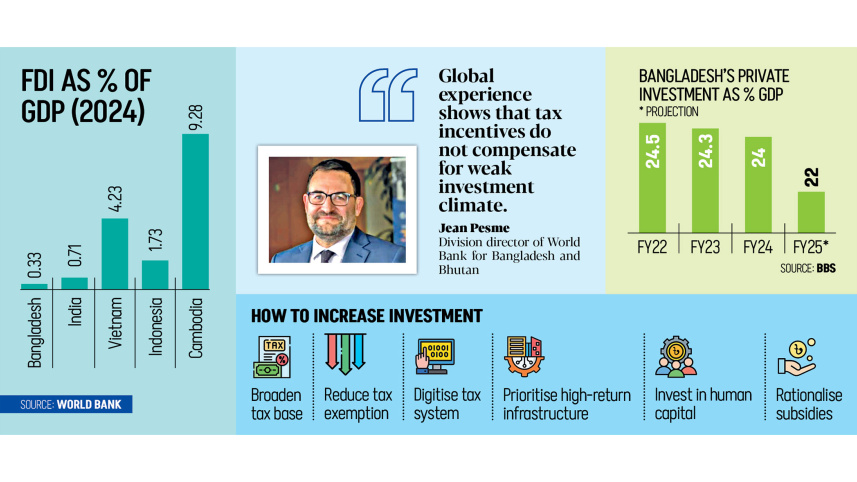
Bangladesh will not be able to realise its ambition of becoming a trillion-dollar economy by 2034 unless it revives investment, foreign investors and development partners said yesterday.
Without a turnaround in the investment climate, the country also risks falling short on other goals, such as sustained economic growth and job creation, said Jean Pesme, division director of the World Bank for Bangladesh and Bhutan.

At a meeting of the Foreign Investors’ Chamber of Commerce and Industry (FICCI) in Dhaka, he said attracting investment requires coordinated reforms in revenue policy, the financial sector and the wider business environment.
He said implementing only one reform in isolation would deliver limited results.
Foreign direct investment stood at just $1.6 billion in the fiscal year 2024-25, or around 0.33 percent of GDP, well below regional peers. Private investment was projected at 22 percent of GDP in FY25, the lowest level in 11 years, according to official data.
Pesme said global experience shows that tax incentives alone cannot offset a weak investment climate.
“Even where governments reduce the marginal effective tax rate and see an increase in foreign direct investment (FDI), the inflow is eight times higher when strong institutions, macroeconomic stability and rule of law are already in place,” he added.
He commented that Bangladesh’s revenue challenge lies less in tax rates and more in weak administration, governance shortcomings and extensive tax expenditures, which are almost as large as total collections.
According to the World Bank’s regional division director, the country depends heavily on tax holidays and sector-specific exemptions, especially for the ready-made garment sector. This creates distortions, opens the door to rent-seeking and increases resistance to reform, as changes inevitably produce winners and losers.
He highlighted the need to work on the investment climate and fiscal reform simultaneously so that they combine and reinforce each other.
“And when you look at the experience globally, the countries that really try to attract FDI through incentives are the ones that already have strong macro stability, rule of law, efficient administration and strong infrastructure.”
He also emphasised broadening the tax base and introducing greater uniformity by eliminating rent-seeking behaviour, reducing distortions, improving compliance and limiting incentives to game the system.
Predictability and credibility, he said, are essential.
“Improving tax administration can really bring results. We think revenue collection, as well as managing tax expenditure and services, is very important as it is about the quality of public spending.”
The results are not coming immediately, but the earlier you start, signal where you want to go, and then implement, in a systematic way, the better, he added.
Chandan Sapkota, country economist at the Asian Development Bank (ADB) resident mission in Bangladesh, said investors consistently raise concerns about taxes, especially the role of the National Board of Revenue (NBR).
“When we meet investors, everybody talks about taxes because their investment decisions are being impacted by NBR,” said Sapkota.
He said NBR often overrides investment promotion agencies. For instance, they introduce an investment facilitation programme, but in the middle of the year, NBR can issue a regulation that effectively nullifies it.
“Basically, there is no predictability of what is going to happen. So, I can see a reason why everybody says NBR,” said Sapkota.
Drawing on his experience in five countries, he said, “I think no other country has this kind of system, where you have agency that supersedes pretty much everything.”
 For all latest news, follow The Daily Star's Google News channel.
 To raise tax collection, he emphasised digitisation and stronger compliance.
The ADB economist said, “Even if you increase taxes, if the compliance regime is not tackled, your tax will not actually increase that much, but then people who are already paying taxes will be burdened more.”
He said the tax administration system must make it very difficult to avoid paying taxes. For example, it’s impossible to evade taxes in India, because everybody has a Aadhaar Card without which none can do anything.
In Bangladesh, he said, the national ID card should be linked with TIN and bank accounts to close that loop. He also suggested reducing multiple VAT rates to two or three to reduce leakages.
“The incentive mechanism, when they rationalise the taxes, should be designed in such a way that this is growth enhancing, productivity enhancing, rather than helping some sort of zombie firms to sustain operation for the sake of employment,” said Sapkota.
Fahmida Khatun, executive director of local think tank Centre for Policy Dialogue (CPD), said tax exemptions in Bangladesh continue indefinitely despite limited fiscal space. “If you really want to incentivize, there should be a sunset clause. But, once an exemption is in place, that goes forever,” she said.
AK Khan, chairperson of Business Initiative Leading Development (BUILD), said local investors face similar frustrations.
As a local investor, we also feel that there are a lot of constraints when we do or think of investments, which shows a huge gap between policy and practice, said Khan.
He pointed to weak coordination among ministries. NBR, the commerce ministry and other ministries often adopt separate policies on the same subject, leading to conflict and uncertainty.
And there is a serious conflict in policies that frustrate investors. He suggested running institutional reform, institutional coordination, and policy consistent and predictable.
M Masrur Reaz, chairman and chief executive of Policy Exchange Bangladesh, presented a paper at the event. He said higher corporate taxes raise the effective cost of investment and cited the Organisation for Economic Co-operation and Development (OECD) data showing that FDI falls 3.7 percent for every 1 percent rise in the tax rate.
Bangladesh ranks 105th out of 141 countries in the Global Competitiveness Index due to weak business dynamism, poor product market conditions, low skills performance and infrastructure deficits, he said.
To build an investment-enabling fiscal framework, Reaz called for tax reform, greater efficiency in the annual development programme, institutional reform, improved budget credibility and fiscal consolidation.
Rupali Huque Chowdhury, president of FICCI, and Shams Zaman, a FICCI director, also spoke at the event.
Comments