


Family card can cut poverty, but targeting remains key
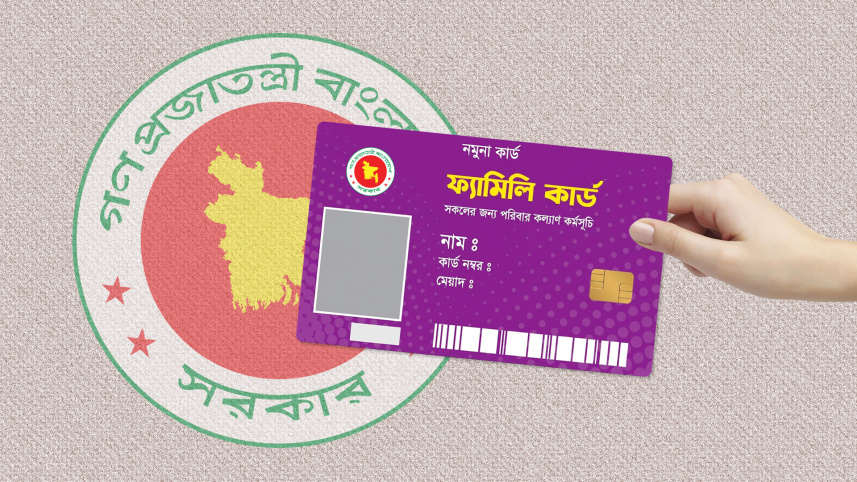
While the proposed Family Card programme could substantially reduce poverty, economists cautioned that accurately identifying beneficiaries will be its biggest challenge.
“Bangladesh’s track record in targeting social protection recipients has been weak, with many eligible households left out while ineligible beneficiaries are included,” said Abdur Razzaque, chairman of Research and Policy Integration for Development (RAPID).

Speaking at a discussion on “The New Government’s First Budget and the Road to a Welfare State: How Important Is Social Protection?” organised by Voice for Reform at its Karwan Bazar office yesterday, he said accurate beneficiary selection would be critical to the success of the proposed Family Card programme.
“If we fail to identify the right households, the programme could suffer from significant leakage,” he said.
Razzaque said that the proposed monthly benefit of Tk 2,500 is substantially higher than existing social safety net allowances, which typically range between Tk 600 and Tk 700, making targeting errors even more costly.
According to RAPID estimates, the programme could reduce the poverty rate from around 18 percent to 11 percent if all poor households are covered.
However, he cautioned that even advanced statistical methods cannot guarantee perfect targeting, warning that implementation failures could quickly turn a popular initiative into an unpopular one. Fahmida Khatun, executive director of the Centre for Policy Dialogue, said social protection should not only support vulnerable groups but also help reduce inequality through redistribution.
She noted that Bangladesh has more than 100 social protection programmes, yet many fail to reach intended beneficiaries due to persistent targeting errors.
“Those who are supposed to receive benefits are often left out, while some who are not eligible continue to receive support,” she said.
Khatun argued that a welfare state is about more than cash allowances. It requires investments in education, healthcare and skills so people can better withstand economic shocks and improve their livelihoods.
She also pointed to structural challenges, including low tax collection and limited fiscal space, which constrain public spending on social protection and essential services.
According to her, social protection programmes should be streamlined to reduce duplication and improve efficiency. While technology can improve delivery, strong institutions and good governance are equally important to ensure benefits reach the right people.
“Targeted social protection remains our only realistic option at this stage,” she added.
Md Rubaiyat Sarwar, managing director of Innovision, said the government’s welfare-state ambition is understandable given rising inequality, slowing poverty reduction and the growing vulnerability of workers in the informal sector. But he cautioned that the vision could falter without stronger institutions and a realistic financing plan.
Bangladesh’s tax-to-GDP ratio remains among the lowest in the region, while spending on health and education lags behind neighbouring countries, he noted. “The question is whether the state has the fiscal capacity to sustain a welfare model.”
He also stressed that welfare programmes should be targeted and time-bound, helping households move out of poverty rather than creating long-term dependence.
“A welfare state is not built overnight,” he said. “It requires stronger revenue collection, better governance and gradual expansion over many years.”
Sharif Ahmed Chowdhury, former director general of Palli Karma-Sahayak Foundation (PKSF), said one of the biggest weaknesses of Bangladesh’s social protection system is poor targeting.
“People facing different risks cannot be treated the same way,” he said, noting that the needs of households in coastal, haor and flood-prone areas differ significantly from those in less vulnerable regions.
He argued that mis-targeting is built into the current system, with many deserving households excluded while others receive benefits to which they are not entitled. Drawing on PKSF’s experience during the pandemic, he said household-level targeting helped keep leakage close to zero.
 For all latest news, follow The Daily Star's Google News channel.
Comments