


Farmers pay more for fertilisers despite no major shortage



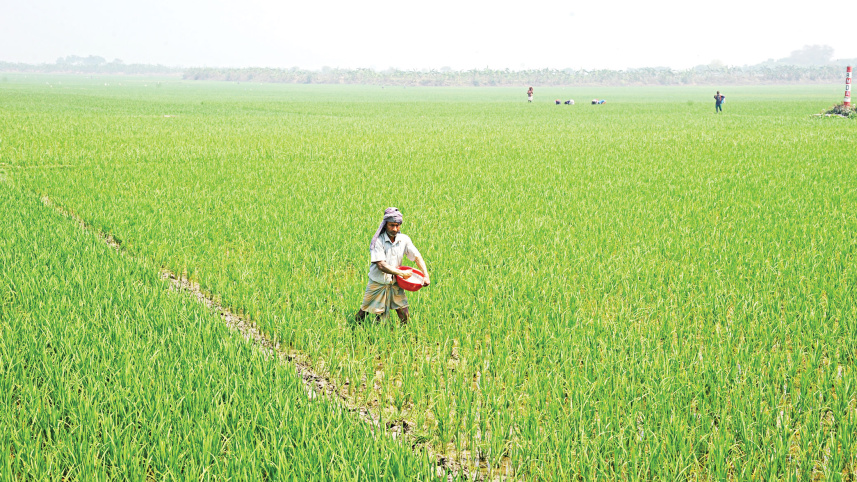
Mamunur Rashid expects to harvest his Boro paddy and maize in the coming months. The crops need no more fertiliser before reaping, and so far, he has not faced any major supply problem.
Now he is preparing plots for green chillies, brinjal and two hybrid varieties of paddy. Those crops will require different nutrients.

The farmer in northern district Kurigram said there have been no supply disruptions or price hikes for high-nitrogen urea or muriate of potash (MOP), a concentrated potassium fertiliser.
But phosphate fertilisers are another matter. Rashid said supplies of both di ammonium phosphate, known as DAP, and triple superphosphate, or TSP, are thin on the ground and prices are higher than usual.
The US-Israel’s war on Iran and the wider Middle East conflict have rattled global fertiliser supply chains, pushing up prices and fuelling food security concerns worldwide. In a recent report, the UN Food and Agriculture Organization (FAO) said Bangladesh faces an “extreme risk profile” in fertiliser supply.
Officials, however, reject the idea of an imminent crunch. They say urea stocks will last until June and non-urea supplies until October.
However, The Daily Star, after speaking to farmers in at least 10 districts across the country, found instances of overpricing linked to supply shortages, which officials attributed to attempts to cash in on war-driven disruptions.
Zahurul Haque, a farmer at Aditmari upazila of Lalmonirhat, said the local authorised dealer could not provide enough phosphate fertiliser. He bought TSP and DAP from retailers instead, paying more.
Phosphate fertilisers are vital for strong plant growth and better yields. Without them, productivity suffers.
According to the Bangladesh Agricultural Development Corporation, the government-fixed retail price per kilogramme is Tk 27 for TSP, Tk 21 for DAP and Tk 20 for MOP.
But Rafiqul Islam, from Moghalhat village in Lalmonirhat Sadar upazila, said he paid Tk 8 to Tk 10 more per kilogramme for TSP and DAP.
In Rajshahi, Muktar Ali of Damkura in Paba upazila said DAP prices have been elevated for some time. A sack officially priced at Tk 1,050 is selling for Tk 1,300 to Tk 1,350, and in some areas as much as Tk 1,400.
In Khulna, Md Ibrahim at Masalia village at Batiaghata upazila cultivated Boro paddy on one and a half bighas this year. He bought urea at Tk 1,455 per sack. For watermelon, he paid Tk 1,850 for small-grain urea.
“They [sellers] never give a receipt. Besides, when we go to buy fertiliser, we are forced to buy pesticides. If we don’t buy those, they refuse to sell fertiliser,” he added.
GOVT SAYS FERTILISER STOCKS SUFFICIENT
Shaikhul Arifin, deputy director of Department of Agricultural Extension (DAE) in Lalmonirhat, blamed unscrupulous dealers for hoarding fertiliser and creating artificial crises to make a quick buck.
He said mobile courts are carrying out drives against overpricing and artificial shortages.
Abdullah Al Mamun, deputy director of DAE in Kurigram, said there is no significant shortage in his district. However, he acknowledged reports of higher prices in remote areas without authorised dealers.
Sirajul Islam, additional director of the Rangpur regional office of DAE, pointed to local demand patterns.
“The tendency of tobacco cultivation is higher in Rangpur, Lalmonirhat and Nilphamari districts. In areas where tobacco is cultivated, the demand for fertiliser increases and shortages sometimes occur.”
 For all latest news, follow The Daily Star's Google News channel.
 “We are identifying the causes of the fertiliser shortage and will send a report to the ministry,” he said.
Md Rafiqul Islam, additional director of DAE in Khulna, said officials are monitoring the market. “If anyone charges higher prices, dealers are punished through mobile courts, and in some cases, their licences are cancelled.”
Md Aminul Islam, deputy director for fertiliser management at the field service wing of DAE, said there is currently no shortage of urea or other fertilisers nationwide. There is, therefore, no justification for higher prices, he said, describing the situation as an artificial scarcity.
Agriculture Minister Mohammed Aminur Rashid told The Daily Star that stocks of both urea and non-urea fertilisers are sufficient for the coming months.
The minister acknowledged complaints of overpricing at the local level and said authorities are investigating. Action has already been taken in several cases.
He added that field officials have been instructed to address irregularities swiftly and assured that specific complaints will be resolved within 48 hours once detailed information is provided.
[Our Rajshahi correspondent Shohanur Rahman Rafi contributed to this report.]
Comments