


Gas crisis biggest hurdle to investment: Bida chief
Energy shortages, particularly the scarcity of natural gas, remain the single biggest challenge facing both local and foreign investors in Bangladesh, Ashik Chowdhury, executive chairman of Bangladesh Investment Development Authority (Bida), said yesterday.
“The problems faced by foreign investors are very similar to those faced by domestic investors. The biggest issue is energy, especially gas,” he said in response to questions from reporters at a workshop on the state of Bangladesh’s investment at Bida’s office.
 For all latest news, follow The Daily Star's Google News channel.
 Chowdhury said gas shortages have hit factories the hardest, while investors also continue to face challenges related to electricity supply and regulatory complexities at the National Board of Revenue (NBR).
Bida has been spending a significant portion of its time on energy-related initiatives because energy constraints have become a major bottleneck to investment and economic growth, he added.
The energy challenge sits at the core of a broader investment push the government has outlined in the proposed budget for FY2026-27
“No matter how many investment summits we organise, investors will not come if they find they cannot run their factories,” he said.
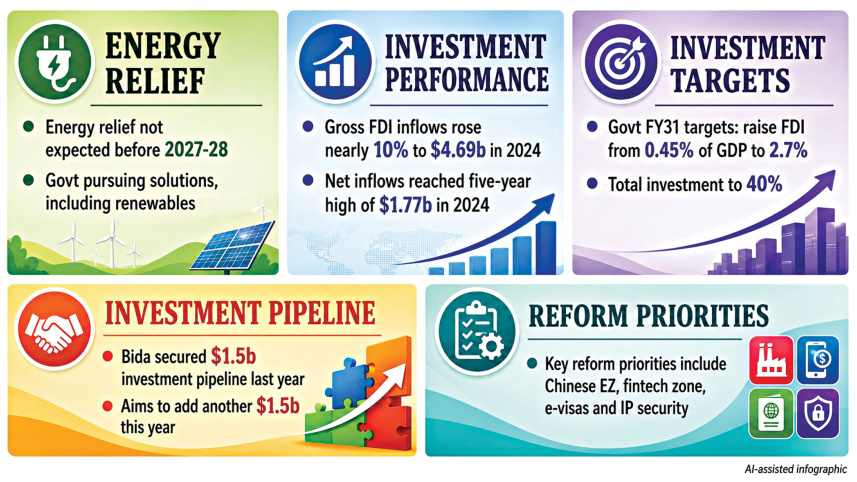
The government is actively pursuing solutions, including renewable energy projects and measures to strengthen gas supply infrastructure, the Bida chief said, but acknowledged that the energy crisis cannot be resolved quickly.
Installing a new floating storage and regasification unit (FSRU) alone would take at least 18 months from the date work begins, he said, adding that projects initiated now are expected to ease the energy crunch by 2027-28.
He also flagged structural limits in existing gas infrastructure. Even if private investors set up gas-fired power plants in economic zones, fuel supply would still depend on the government’s capacity to import and distribute gas.
“The challenge is not who brings the gas. The challenge is that we do not yet have the infrastructure to handle additional supplies,” he said.
The energy challenge sits at the core of a broader investment push the government has outlined in the proposed budget for FY2026-27. It has set a target of raising foreign direct investment from the current 0.45 percent of GDP to 2.7 percent by FY31 as part of its medium-term strategy. It also plans to substantially raise total investment to 40 percent within the next five years.
Meanwhile, also speaking at the event, Nahian Rahman Rochi, executive member of Bida, said the agency has structured its work around the full investment lifecycle, covering promotion, policy support, approvals, service delivery and aftercare.
He informed that Bida has adopted a one-year work plan built around 25 initiatives under three pillars -- infrastructure development, investment facilitation and investment development.
Of the initiatives, 13 focus on infrastructure, seven on investment facilitation and five on pipeline development. Key priorities include industrial park development, progress on the Chinese Economic Zone, intellectual property reforms, overseas BIDA offices and industry mapping.
Mentioning that Bida secured a $1.5 billion investment pipeline last year, Rochi said the agency aims to add another $1.5 billion this year, bringing the two-year total to around $3 billion.
Stating the recent milestones on attracting investment, he mentioned that the cabinet has approved the Chinese Economic Zone and a fintech zone, while work is continuing on e-visas, intellectual property reforms and Bida’s planned office in Guangzhou, China.
Nurjahan Akter, additional director of the Bangladesh Bank, said Bangladesh reports FDI on a net basis, which often understates actual inflows.
She noted that FDI consists of equity capital, reinvested earnings and inter-company loans, with the latter helping foreign-owned firms manage liquidity pressures through support from parent companies.
In 2024, gross FDI inflows rose nearly 10 percent year-on-year to $4.69 billion, while net inflows reached a five-year high of $1.77 billion, stated the BB official.
Md Humayun Kabir, secretary at Bida, said the government is implementing reforms to improve the investment climate, including simplifying visa, work permit and business registration services through the Bangladesh One Stop Service platform.
A new investment incentive policy and ongoing reforms are expected to encourage greater investment, including from non-resident Bangladeshis, he added.


Comments