


Govt names 44 public factories for private investment
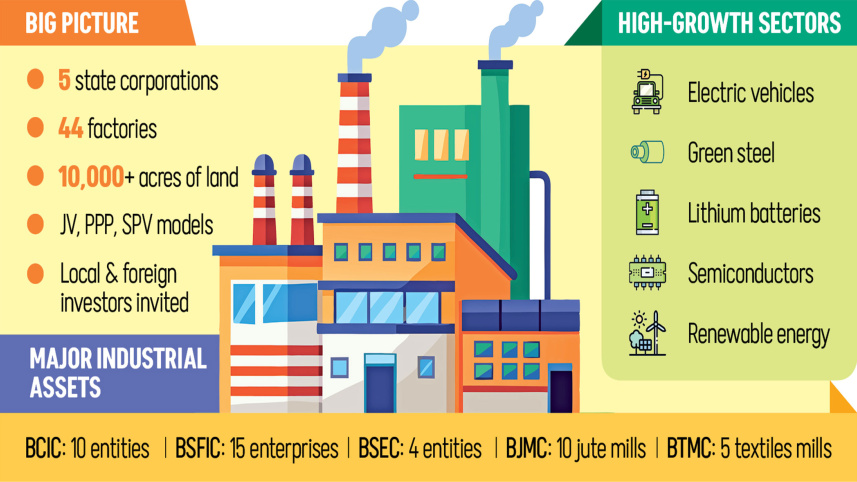
As many as 44 closed, loss-making or partly operational state-owned enterprises are ready to welcome private investors as the government seeks to revive idle industrial assets and attract fresh investment.
“We are inviting investors to partner in reviving state-owned enterprises through private sector investment,” Ashik Chowdhury, executive chairman of the Bangladesh Investment Development Authority (Bida), announced yesterday as the authority unveiled details of the factories.

The sites cover about 10,000 acres, and most already have gas, electricity and other essential infrastructure in place.
Businesses will be able to use idle land and underused assets through a range of investment models, including local and foreign investment, joint ventures, public-private partnerships and other strategic arrangements.
Officials said the sites offer opportunities for investment in electric vehicles, green steel, lithium batteries, packaging paper, agro-processing, textiles, chemicals, logistics and renewable energy.
“This offers a win-win opportunity: businesses can expand using ready industrial facilities, while the government benefits from increased employment and reduced fiscal pressure,” said Bida Executive Chairman Ashik.
At a meeting with prominent industrialists and business leaders last month, Prime Minister Tarique Rahman assured both domestic and foreign investors of full cooperation and policy support to revive the factories.
The factories fall under five state corporations -- Bangladesh Chemical Industries Corporation (BCIC), Bangladesh Sugar and Food Industries Corporation (BSFIC), Bangladesh Steel and Engineering Corporation (BSEC), Bangladesh Textile Mills Corporation (BTMC) and Bangladesh Jute Mills Corporation (BJMC).
They span major industrial sectors and are spread across the country’s major industrial belts.
Under the Bangladesh Steel Engineering Corporation, there are four industries, with three being operational but having unused land.
Of the 10 units under the Bangladesh Chemical Industries Corporation (BCIC), four factories are closed and two have become sick.
Of the 13 mills under the BSFIC, five are closed while the rest are operational.
In the case of the 13 mills under the BTMC, the tender process is underway for running most of the factories under a public-private partnership. The BJMC has five closed mills that have investable land with old structures.
The premises of two factories -- Latif Bawany Jute Mills Ltd and Karim Jute Mills Ltd -- are being converted into economic zones under the BEZA. The areas of two mills could be used for urban development, according to Bida.
Of the investment opportunities identified so far, only BCIC has disclosed a quantified investment pipeline, estimated at Tk 54,685 crore. The Ministry of Industries says the total investment potential across all state-owned enterprises runs into several billion dollars.
According to Bida, some assets could be revived for their original purpose, while others may be repurposed for industries that reduce import dependence or boost exports.
Ashik said investors would be offered transparent investment structures, faster approvals and coordinated government support.
He said the government believes the private sector is better placed to operate commercial enterprises efficiently, while the state should focus on facilitating investment rather than competing with private businesses.
Officials said ownership of the industrial units would remain with the government, with private sector participation taking place through lease and rental arrangements.
Mohammad Sabbir Awwal, additional chief engineer of Bangladesh Steel and Engineering Corporation, said the government plans to attract private investment to make productive use of idle land and underused assets while retaining public ownership of the enterprises.
 For all latest news, follow The Daily Star's Google News channel.
 He acknowledged that private investment procedures are often lengthy but said efforts are under way to speed up approvals.
According to Awwal, Steel and Engineering Corporation has identified investment opportunities at three operating enterprises: Progoti Industries Limited, Eastern Cables Limited and Atlas Bangladesh.
Around 10 acres at Progoti’s Sitakunda facility and more than 6 acres at Atlas have remained unused for years, while Eastern Cables also has substantial idle land.
The corporation is also seeking investors for a proposed green steel mill in Bogura through joint venture or public-private partnership arrangements, said Sabbir. Several business groups have expressed preliminary interest, although no formal commitments have yet been made.
Selim Raihan, executive director of the South Asian Network on Economic Modeling (Sanem), said Bangladesh’s previous experience with public asset disposal and privatisation underscored the need for a transparent process.
“I believe there is a need to put unused land to more productive use. However, the process must be transparent, especially given that our past experience has not been very encouraging,” he said.
According to Raihan, industrial land has often been diverted to purposes unrelated to industrial development, undermining the original objectives of such initiatives.
He argued that investors should be selected through a competitive process based on efficiency, capability and long-term business plans, and that investment decisions should align with a broader national strategy for industrialisation.
“In many countries, public sector enterprises operate efficiently through innovative management practices and public-private partnerships. These are areas we should explore,” he said.
Khodaker Golam Moazzem, research director at local think tank Centre for Policy Dialogue (CPD), said the initiative could attract investors because many state-owned industrial sites already have land, gas, electricity and other essential infrastructure.
However, he cautioned that investors would need long-term policy certainty before committing capital.
He also noted that much of the infrastructure at state-owned industrial enterprises is outdated and may have to be demolished or modernised to accommodate new investment.
Rather than requiring investors to revive closed factories, the government should allow them to establish industries that are economically viable and environmentally sustainable, he said.
Moazzem pointed out that many industrial sites, once located outside urban centres, are now surrounded by densely populated areas, making commercial or alternative industrial uses more practical in some cases.
He said the government must ensure that the assets offered are free from legal disputes, financial liabilities and outstanding obligations to banks, workers and other stakeholders.
“Without such assurances, private investors are unlikely to show interest,” he said.


Comments