


Govt takes twin-track approach to retain EU duty-free access

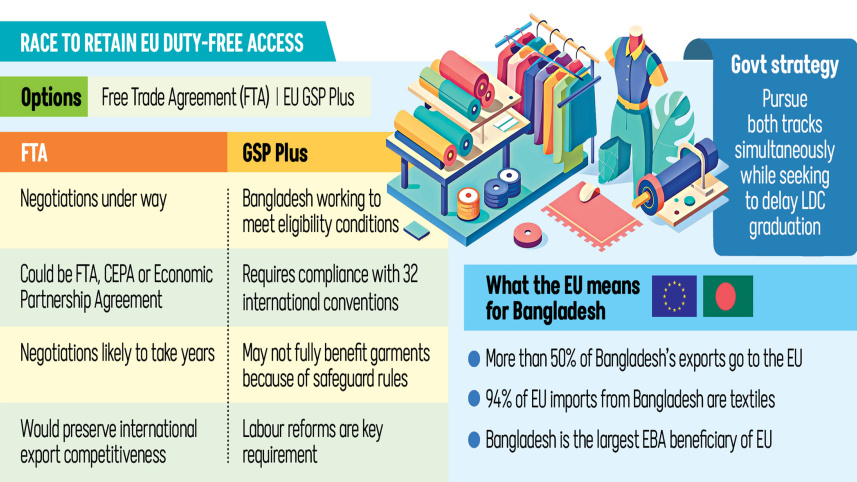
Bangladesh is pursuing a dual-track strategy to retain duty-free access to the European Union after graduating from the least developed country (LDC) category, negotiating a free trade agreement (FTA) with the bloc while also seeking to qualify for its GSP Plus trade preference scheme.
With the clock ticking towards the end of its LDC trade privileges, businesses say that failing to secure an alternative arrangement could dent the country’s export competitiveness in its largest overseas market and hurt the overall economy.

The stakes are high as nearly half of Bangladesh’s merchandise exports are shipped to the EU. To the European market, they currently enjoy duty-free and quota-free access under the Everything But Arms (EBA) scheme for least developed countries.
The pressure is greater because the two biggest competitors of Bangladesh in the apparel market, India and Vietnam, already have trade agreements with the EU. Once Bangladesh loses its LDC preferences, exporters fear the market peers will gain a further competitive edge.
Bangladesh is scheduled to graduate from LDC status in November this year. The government has, however, sought a three-year postponement, and officials say the response from the relevant UN body has so far been positive.
Even if the graduation goes ahead as scheduled, the EU has agreed to continue its trade preferences for Bangladesh for another three years. That means regular tariffs will come into effect from 2029 under the current timeline.
Studies have estimated that Bangladesh could lose exports worth as much as $17.5 billion a year after graduation, as around 73 percent of the country’s exports currently benefit from LDC-related preferences.
“Eventually, we are heading towards signing an FTA with the EU, but it may take a long time because of the negotiations by both parties,” Commerce Minister Khandakar Abdul Muktadir told The Daily Star over the phone.
Negotiating an FTA, however, is rarely a quick process. India, for example, took around two decades to conclude its trade agreement with the EU.
Referring to the lengthy process, the commerce minister said, “But at the same time, we should not keep the EU market as a vacuum as it is the largest export destination for Bangladesh.”
That is why Bangladesh is pursuing both options at the same time, while giving priority to concluding an FTA as early as possible, Muktadir said.
FTA or GSP Plus?
Bangladesh has been negotiating with major trading partners to secure duty-free market access after LDC graduation, either through free trade agreements or preferential trading arrangements such as GSP Plus.
With the EU, discussions are at an early stage. Both sides have been exchanging letters to prepare the ground for formal negotiations, whether for an Economic Partnership Agreement (EPA), a conventional FTA or a Comprehensive Economic Partnership Agreement (CEPA).
Recently, the European Commission replied to a commerce ministry letter sent last October, saying it was carrying out an internal assessment before deciding whether to launch formal negotiations with Bangladesh.
At the same time, Dhaka is continuing its efforts to qualify for GSP Plus, which offers tariff preferences to developing countries that meet a series of international standards on labour rights, human rights, environmental protection and good governance.
Speaking on condition of anonymity, a senior commerce ministry official said Bangladesh has already fulfilled most of the requirements under the 32 international conventions linked to GSP Plus eligibility.
The official said recent labour reforms have strengthened Bangladesh’s position.
Parliament amended the labour law last year in line with recommendations from the International Labour Organisation (ILO). Bangladesh has also ratified three ILO conventions covering occupational safety, workplace health and protection from violence and harassment.
“We are continuing negotiations with the EU for both GSP Plus status and FTA signing as we know the importance of the EU markets,” the official said.
 For all latest news, follow The Daily Star's Google News channel.
 The ministry is also closely watching the outcome of Bangladesh’s request to defer its LDC graduation. The proposal is expected to go before the UN General Assembly in September after a recommendation from the UN Economic and Social Council (UN ECOSOC).
Officials believe that if Bangladesh’s graduation is postponed, the EU grace period could also be extended.
‘FTA OFFERS MORE DURABLE SOLUTION’
Mohammad Abdur Razzaque, chairman of the Research and Policy Integration for Development (RAPID), said Bangladesh’s progress on labour reforms would support both GSP Plus and FTA negotiations.
However, he said the government should focus more on securing an FTA because it offers a more durable solution for retaining preferential access to the European market.
Razzaque also questioned how much Bangladesh would ultimately gain from GSP Plus.
Under the EU GSP rules for 2024-34, clothing exports from a GSP Plus beneficiary country would lose preferential treatment if they exceed 6 percent import thresholds.
Bangladesh already accounts for nearly 20 percent of the relevant clothing imports into the EU, well above the threshold.
The EU GSP rules also mention that clothing imports from a GSP Plus beneficiary should not account for more than 37 percent of all GSP-covered clothing imports into the EU. Bangladesh’s current share is close to 50 percent, raising questions over how much of its apparel exports would actually qualify for zero-duty treatment even if it secures GSP Plus.
Bangladesh has been a member of the World Trade Organization (WTO) since 1995 and currently enjoys duty-free, quota-free access to the EU market under the Everything But Arms (EBA) arrangement, which covers all products except arms and ammunition.
THE TRADE PICTURE
The EU began enhanced engagement with Bangladesh under the EBA arrangement in 2017 to monitor compliance with international conventions on labour rights and human rights.
In 2025, Bangladesh was the EU’s 35th largest trading partner, accounting for 0.5 percent of the bloc’s total goods trade. For Bangladesh, however, the EU was its largest trading partner, representing 21.5 percent of the country’s total export.
Trade in goods between Bangladesh and the EU reached €23.3 billion in 2025, with the EU running a trade deficit of €19.1 billion.
Textiles dominated Bangladesh’s exports, accounting for almost 94 percent of EU imports from the country. EU exports to Bangladesh were led by machinery and appliances, which made up 36 percent of shipments, followed by chemical products at 24 percent.
Trade in services stood at €1.5 billion in 2024, while total trade in goods and services reached €23.8 billion.
Bangladesh is the largest beneficiary of the EU Everything But Arms scheme. In 2024, exports worth €19 billion entered the bloc under the arrangement, with a utilisation rate of 96 percent.
EU’s foreign direct investment stock in Bangladesh stood at €2.5 billion in 2024, while Bangladesh’s investment stock in the EU totalled €86 million, according to the European Commission.
Faisal Samad, a director of the Bangladesh Garment Manufacturers and Exporters Association (BGMEA), said exporters are concerned about retaining duty-free access to their largest market after LDC graduation.
“We are also working with the government by giving recommendations for retaining the zero-duty market access to the EU in the post-LDC period,” Faisal Samad told The Daily Star over the phone.
“But at the same time, we should keep open all of the avenues of negotiation with the EU so that we do not miss any opportunities,” he said.
Comments