


Govt’s debt burden crosses Tk 22 lakh crore


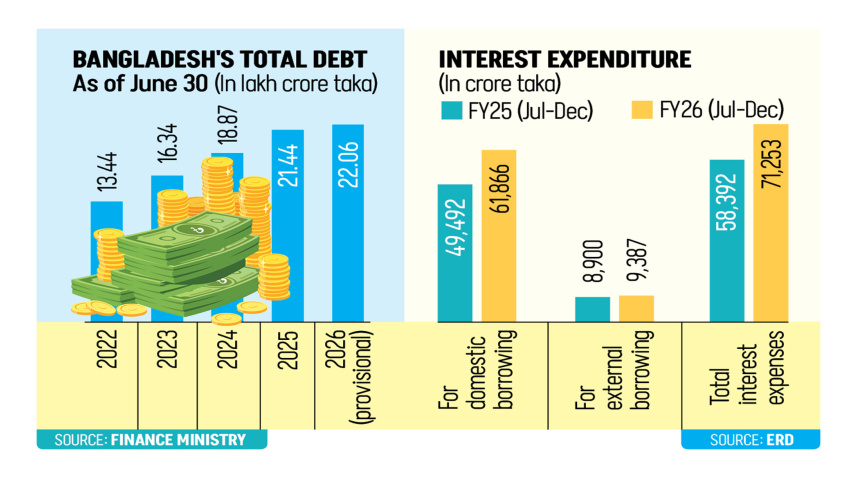
- Public debt crosses Tk 22 lakh crore milestone
- Domestic borrowing rises to "insulate the economy"
- Interim government adds Tk 3 lakh crore debt
Bangladesh’s total public debt burden has crossed Tk 22 lakh crore by December 2025 with a growing reliance on domestic sources as the government looks to “insulate the economy from foreign currency risks”.
Of the total debt, Tk 3 lakh crore was borrowed during the interim government period, according to the finance ministry’s latest quarterly bulletin.

The bulletin states the public debt stood at Tk 18.9 lakh crore at the end of June 2024, just a month before the interim administration assumed power. The figure was Tk 13.44 lakh crore at the end of June 2022.
During the interim period, domestic debt rose by Tk 1.70 lakh crore, reaching Tk 12.5 lakh crore by December. Foreign loans increased by Tk 1.47 lakh crore to Tk 9.59 lakh crore in the same period.
Domestic borrowing dominates the government’s overall debt portfolio. As of December 31, 2025, the domestic and external liabilities constituted 57 percent and 43 percent of the total government debt stock, respectively.
“By focusing on the local market, the government is deepening domestic liquidity while reducing its exposure to exchange rate fluctuations,” said the bulletin.
During the July-December period of the current fiscal year, the government’s total borrowing rose by Tk 62,428 crore, or 13 percent, compared to the same period a year earlier.
During the period, loans from the foreign sector dropped by 59 percent to Tk 10,130 crore, while domestic borrowing surged 70 percent to Tk 52,298 crore.
Of the domestic borrowing, Tk 19,470 crore was borrowed from the central bank alone.
Most of the domestic loans were raised through government securities. “A key feature of the government’s approach was a clear shift toward long-term debt,” the finance ministry said.
Meanwhile, total interest payment during the July-December period rose by 22 percent to Tk 71,253 crore. Of these, interest payment for domestic borrowing stood at Tk 61,866 crore, a 25 percent surge from the same period a year ago.
While increased domestic borrowing often raises concerns about “crowding out,” the current landscape suggests a unique window of opportunity, said the ministry.
It argued that ample liquidity in stronger banks, falling yields on government securities, and subdued private-sector credit demand create conditions for sustainable domestic financing without crowding out private borrowers.
By leveraging this internal liquidity, the state is building a more resilient and self-reliant fiscal framework that maintains stability without straining the private credit market, it added.
 For all latest news, follow The Daily Star's Google News channel.
Comments