


Landmark customs bond reforms to boost competitiveness

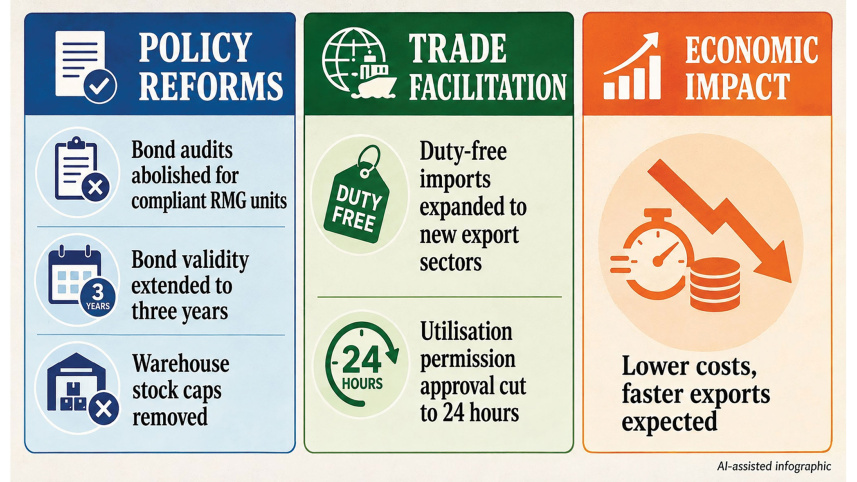
The government has proposed a landmark overhaul of the customs bond regime in the fiscal year 2026-27 budget, extending duty-free import facilities to emerging export sectors and easing compliance requirements for garment factories -- steps exporters say will significantly boost trade competitiveness.
Officials and analysts, however, warn the reforms risk being undermined by existing patterns of abuse unless accompanied by stronger enforcement.

The proposed changes amend several key regulations -- the Bonded Warehouse Licensing Rules 2024, the Bonded Warehouse Management Rules for export-oriented industries, the General Bond Rules 2024, and provisions governing annual import entitlement and warehouse operations.
The most significant proposals include scrapping annual bond audits for fully compliant garment factories, extending general bond validity from one to three years, removing stock limits in bonded warehouses and cutting the approval window for utilisation permission to 24 hours.
New rules would also allow bonded raw materials to be transferred among licensed warehouse operators and export-oriented industries.
The reforms extend beyond RMG to the leather, footwear, terry towel, pharmaceuticals and jewellery sectors. A separate bonded facility framework has been proposed for importing gold bars and gold scrap to support jewellery exports.
Business leaders say the measures could shorten production lead times and reduce the cost of doing business.
“The abolition of bond audits and removal of bonding capacity limits will strengthen the competitiveness of exporters,” said Nasir Uddin Chowdhury, managing director of an export-oriented business and a director of the Chattogram Chamber of Commerce and Industry (CCCI).
M Masrur Reaz, chairman and CEO of Policy Exchange Bangladesh, said reducing the capital burden at the initial stage would encourage investment and help new sectors expand export capacity.
“Most entrepreneurs in Bangladesh have limited initial capital. As a result, many are unable to make large-scale investments even when they want to,” he said.
Entrepreneurs from pharmaceuticals, leather goods and footwear welcomed the extension of bonded warehouse facilities.
Many of these industries export products manufactured from imported raw materials while also serving the domestic market, but have until now received duty drawbacks only after completing exports. Under the proposed changes, they would be able to import raw materials duty-free from the outset, easing cash-flow pressures.
Some industry representatives, however, cautioned against a uniform approach.
“Treating every export-oriented industry in the same way as the RMG sector may not produce the desired results. Each industry has its own production process, raw material requirements and market dynamics,” one industry leader said.
Mohammad Zakir Hossain, managing director of Delta Pharmaceuticals, said the bonded warehouse facility may have limited immediate benefits for his sector.
The proposed changes amend several key regulations -- the Bonded Warehouse Licensing Rules 2024, the Bonded Warehouse Management Rules for export-oriented industries, the General Bond Rules 2024, and provisions governing annual import entitlement and warehouse operations.
“To fully utilise the scheme, pharmaceutical companies would need separate bonded facilities and dedicated export markets. Achieving those conditions will take time,” he explained.
“Obtaining regulatory approvals can take three to five years. Even after securing approval, there is no guarantee that demand for a particular product will remain strong,” he added.
Noting that companies manufacture medicines for both local and foreign markets using the same imported raw materials, he also said, “Although we do not receive bonded benefits at the import stage, we are eligible for duty refunds and related facilities after exports are completed.”
Zahid Hussain, former lead economist of the World Bank’s Dhaka office, backed the direction of the reforms. “Duty-free concessions are a natural policy instrument to promote investment and exports.”
 For all latest news, follow The Daily Star's Google News channel.
 MISUSE A PERSISTENT CONCERN
The National Board of Revenue extends bonded benefits worth nearly Tk 35,000 crore annually to export-oriented industries. NBR officials estimate that misuse through irregularities, false declarations and diversion of imported inputs may be causing revenue losses of Tk 5,000 crore to Tk 7,000 crore every year.
CCCI’s Chowdhury said stronger digital monitoring would be essential to prevent bonded goods from being diverted into the domestic market under the guise of exports.
“If backed by effective automation and enforcement, these reforms could help Bangladesh achieve higher export earnings, greater product diversification, higher employment and stronger FDI inflows,” he said.
Economist Hussain echoed the concern. “Unless misuse of bonded privileges is effectively checked, genuine businesses will not receive the full benefits. There is no alternative to automation within the NBR.”
Former NBR member Kazi Mostafizur Rahman said the reforms should be accompanied by immediate technological upgrades.
He suggested real-time tracking of bonded consignments from ports to factories, integration of utilisation declaration and utilisation permission into a single digital platform, and automated risk-based audit systems.
“Companies or officials found to be involved in irregularities should face strict legal action,” he said.
Trade analysts said the ultimate success of the reforms would depend on the NBR’s ability to balance trade facilitation with enforcement.
As Bangladesh prepares for LDC graduation, a modern, technology-driven bonded warehouse regime will be critical to maintaining export competitiveness.
Comments