


One Bank targets digital growth

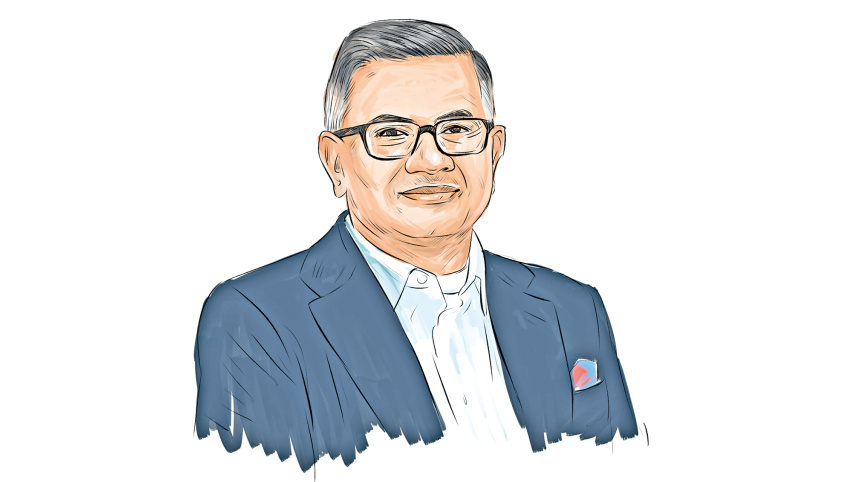
Private commercial ONE Bank plans to expand digital banking and strengthen engagement with small and medium enterprises (SMEs) and foreign trade.
“ONE Bank currently has strong corporate clients, but there is significant room for growth in retail, SME, and digital services,” said Muhit Rahman, managing director of the bank, in an interview with The Daily Star.

He added that future banking will not rely solely on expanding branches, as digital platforms and fintech will play a major role.
Rahman, a former foreign bank executive with more than three decades of international banking experience, joined the local commercial lender as managing director in November 2025.
He previously worked at American Express and Standard Chartered Bank. He said his long career with global financial institutions convinced him that a mid-sized Bangladeshi bank could improve significantly with focused reforms.
Discussing digital expansion and SME lending, he said the new strategy includes expanding retail and SME banking while building on the bank’s traditional strength in corporate banking.
The bank plans to introduce more digital solutions in corporate banking, including cash-management systems, payment solutions, payroll services, and distributor financing for corporate supply chains. He said the bank also plans to deepen partnerships with fintech companies to expand financial inclusion.
ONE Bank already operates more than 160 locations and around 260 agent outlets, but these services require stronger promotion and better digital integration, he added.
The bank is also studying nano-loan products, which some banks have recently introduced through mobile financial service platforms.
FOREX MARKET AND EXTERNAL RISKS
Regarding the forex market, Rahman, an MBA graduate from the Institute of Business Administration at the University of Dhaka, said ONE Bank has maintained strong foreign currency liquidity and did not delay international payments even during the dollar shortage over the past years.
He said many Bangladeshi banks faced overdue import payments mainly because of temporary dollar shortages and exchange rate distortions rather than loan defaults.
“Bangladesh has never defaulted on international payments,” he said.
However, the ongoing war in the Middle East could pose risks if the conflict drags on, particularly through higher energy import costs and possible shipping disruptions. He suggested maintaining strong foreign currency liquidity and prioritising essential imports if global tensions intensify.
ADDRESSING NON-PERFORMING LOANS
On the non-performing loans (NPLs) situation, Rahman said NPLs in the banking sector generally come from three sources: legacy loans, business downturns with weak monitoring, and, in some cases, loans taken under questionable circumstances.
However, he said ONE Bank has not found any fraudulent lending cases in its portfolio. He expressed hope that stronger governance, better monitoring, and an economic recovery could gradually improve asset quality.
Pointing to governance issues in some local banks, he said, “In multinational banks, decisions follow strict processes, and credit approvals go through multiple committees. Boards set strategy but do not approve individual credit proposals.
“In many local banks, accountability gaps exist. Strengthening accountability is essential before driving business growth.”
He also said that ONE Bank’s board has been supportive of improving governance and strengthening management structures.
 For all latest news, follow The Daily Star's Google News channel.
 NEED FOR STRONGER CAPITAL MARKET
Rahman said Bangladesh needs to develop its capital market to reduce heavy reliance on banks for financing.
“Almost everything in Bangladesh depends on bank lending. In developed markets, companies raise funds through bond markets and capital markets,” he said.
He added that Bangladesh could attract foreign portfolio investment and tap global funding sources such as green, sustainable, and Islamic finance.
The managing director of the third-generation bank also proposed organising an international banking forum in Dhaka to present Bangladesh’s economic story and attract foreign lenders and investors.
“Many global banks already take part in trade finance linked to Bangladesh, but they rarely come together on a single platform to discuss opportunities. Such engagement could help increase trade finance flows, foreign investment, and international confidence in Bangladesh’s financial sector,” he said.
LENDING STRATEGY AND OUTLOOK
Regarding ONE Bank’s lending strategy, Rahman said the private bank plans to increase its exposure to Bangladesh’s key export sector -- ready-made garments -- as well as pharmaceuticals, commodities, and infrastructure-related industries such as steel.
He said future lending will increasingly depend on cash-flow-based credit assessment rather than collateral-based lending.
“If banks focus more on cash-flow-based lending instead of relying only on collateral, asset quality will improve,” he said, adding that weak collateral execution has contributed to the country’s high level of non-performing loans.
While discussing the outlook, Rahman remained cautiously optimistic despite challenges such as high interest rates, slow private sector credit growth, and global uncertainties.
“Economic activity could gradually recover if business confidence improves and reforms in the banking sector continue. With stronger governance, digital transformation, and support for SMEs, banks can play a bigger role in employment generation and economic growth,” he said.
Comments