


RMG exports brace for a gathering storm

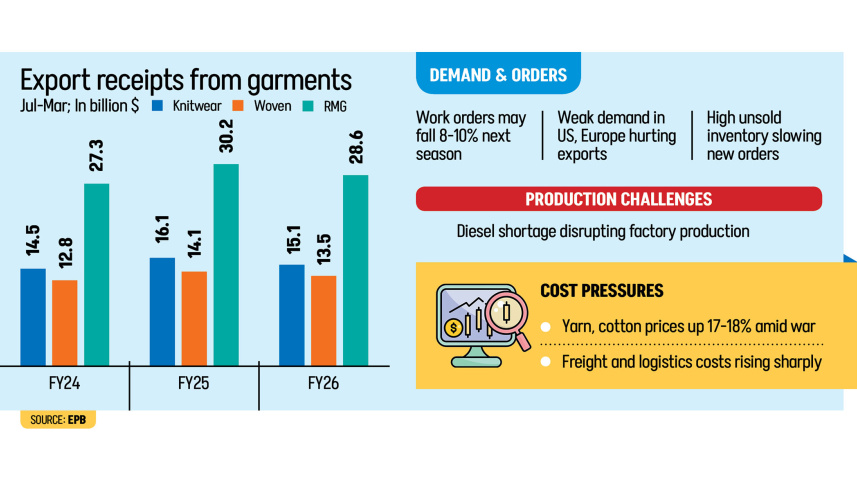
Bangladesh’s garment sector is going through a period of sustained pressure as the war in the Middle East disrupts production and international retailers scale back orders.
Western retailers are expected to cut apparel orders by up to 10 percent next season, as higher clothing prices dampen demand and unsold stock piles up in stores.

The latest setback is another blow for local manufacturers, who are already dealing with frequent load shedding, rising transport costs and a deepening fuel crunch following the US-Israel war on Iran.
Exporters say the war has already driven up raw material import bills and freight charges for shipments abroad.
The readymade garment sector, which accounts for more than 80 percent of national export earnings, had only just begun to steady itself after reciprocal tariff turbulence.
But now, conditions are combining to create a perfect storm for the readymade garment sector. Many fear the combined effect could lead to a decline in future orders.
Preferring anonymity, a senior official of a leading European buyer said that overall, 8 percent to 10 percent of garment work orders will be cut for the next season as buyers begin placing orders.
He said retailers and brands across the West are still burdened with unsold winter merchandise, while goods for the current season have already arrived. As a result, orders for the next cycle have slowed.
Amid the fuel crisis, the official said freight costs inside Bangladesh have also climbed. The fare of goods-laden trucks plying between Dhaka and Chattogram has risen, despite no official increase in petroleum prices.
Truck operators, citing fuel rationing, have raised per-truck charges to Tk 50,000 from Tk 38,000. On average, he said fares have increased by around 20 percent since the outbreak of the war.
Moreover, factories that depend on diesel generators are facing mounting disruption. Many report delays in getting adequate supplies, while cotton prices have risen, pushing yarn costs up by 17 percent to 18 percent.
“But buyers are reluctant to absorb higher prices,” said the official. “The consumers will not pay higher prices during the bad times because of an increase in the cost of production. So, at the end of the year, the overall export growth in the garment sector may be much lower than last year.”
Another European buyer, also requesting anonymity, said that the war has slowed down the business and the recovery is still very uncertain.
He added that demand for outerwear in Europe could rise next season as higher energy prices prompt consumers to buy warmer clothing. However, inventories are still elevated.
Ramzul Seraj, managing director of Elite Garments Ltd, which exports to the United States, said demand for garment items in the US has weakened, while factory output in Bangladesh has been hit by diesel shortages.
Delays in production could force some exporters to use more expensive air shipments to meet delivery deadlines, he added.
Masud Kabir, managing director of Motex Fashion, a Gazipur-based sweater factory, said he receives diesel using a special card introduced by the Bangladesh Garment Manufacturers and Exporters Association (BGMEA). But the supply falls short of covering nearly eight hours of load-shedding.
He can run the factory with the diesel collected from a nearby petrol pump for three and a half hours, he said. As a result, production has suffered.
Anwar Ul Alam Chowdhury, chairman of Evince Group, said the government is supplying diesel, but factories require larger volumes to operate generators smoothly.
 For all latest news, follow The Daily Star's Google News channel.
 Md Fazlul Hoque, managing director of Plummy Fashions, said inadequate diesel supplies have also disrupted his operations. At the same time, freight charges for sea shipments have increased, along with prices of cotton, yarn and polyester.
The combined effect, Hoque said, is a likely decline in future orders.
Mohammad Hatem, president of the Bangladesh Knitwear Manufacturers and Exporters Association (BKMEA), said some competing countries such as Turkey are expanding exports despite the war, helped by their proximity to Europe and the United States and more reliable energy supplies.
He also expressed concern that recurring two-to-three-hour power cuts could lead to greater reliance on costly air freight.
BGMEA Director Faisal Samad said the association is in contact with buyers, urging them to take into account the exceptional circumstances created by the global oil crisis. Since April 13, member factories have been able to access diesel on a priority basis through a special card facility.
“Even so, overall productivity has declined because of insufficient fuel supplies,” he said.
BGMEA President Mahmud Hasan Khan said buyers also want factories to keep running as this is a global crisis.
Comments