


US meat, dairy and biotech to enter on easier terms

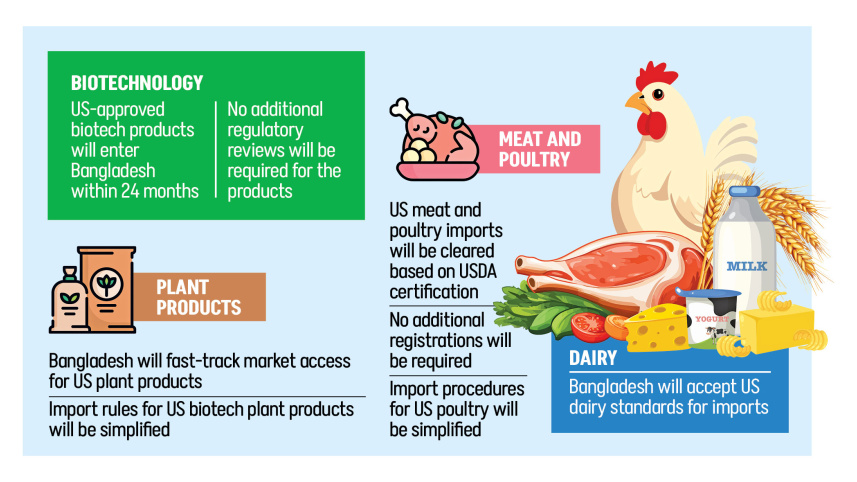
Bangladesh has long imported agricultural commodities from abroad. Last year, it became the eighth-largest market for US wheat. Under a reciprocal trade agreement signed on February 9, American dairy, meat and poultry producers will get sweeping access to Bangladesh’s market.
It also widens the door to agricultural biotechnology products without requiring labelling for genetically modified organisms, a provision that has alarmed Fisheries and Livestock Adviser Farida Akhter.

Domestic producers, already struggling to compete, fear they will be overwhelmed.
US MEAT, MILK AND MORE
The agreement represents a sweeping deregulation of Bangladesh’s food-import regime. Bangladesh will recognise America’s dairy-safety system as providing protection “at least equivalent” to its own domestic standards.
The country will allow imports of American dairy products from cattle (for instance, buffalo), sheep and goats when accompanied by an Agricultural Marketing Service (AMS) certificate of the US Department of Agriculture (USDA), and has committed not to impose facility registration requirements.
The recognition extends to meat and poultry, including offal, processed products, catfish and egg items.
Bangladesh will accept oversight by the USDA’s Food Safety and Inspection Service (FSIS) of American production facilities. The FSIS directory will serve as the official list of eligible establishments, eliminating the need for individual American plants to seek separate Bangladeshi approval.
The agreement stipulates that Bangladesh shall “impose no additional product registration or facility registration requirements” on American meat and poultry. It will recognise the USDA’s Animal and Plant Health Inspection Service as the sole authority to determine disease-free statuses.
Additionally, the agriculture ministry will fast-track market access requests for US plant products.
In effect, Bangladesh is outsourcing significant elements of its food-safety regulation to American agencies.
LOCAL FEARS
The agreement has provoked alarm among domestic producers.
Mohammad Shah Emran, general secretary of the Bangladesh Dairy Farmers’ Association, argued that the introduction of foreign products on a big scale “could undermine the growth of our domestic dairy sector, which is already struggling to remain competitive.”
“We urge the government to provide necessary support, including incentives and infrastructure development, so that local dairy farmers can improve production standards and compete effectively,” he said.
Adviser Farida also warned of a potential influx of cheaper meat products that could disrupt local industries.
Not all industry figures are pessimistic. Tanvir Ahmed, managing director of Sheltech Group, which operates Bengal Meat, sees opportunity in American technology, particularly large breed cattle such as Brahma, that could improve yields.
“While we are in the early stages, there is a clear opportunity to improve meat production through better breeding techniques and advanced farming practices,” he said.
“With the right support, we can reduce our reliance on imports and strengthen our domestic meat production,” he added.
Whether such support will materialise remains an open question.
 For all latest news, follow The Daily Star's Google News channel.
 Bapon Dey, a professor of poultry science at Bangladesh Agricultural University, said the trade agreement with the US offers significant opportunities for the poultry industry, but it also presents considerable challenges.
Bangladesh must upgrade its poultry management systems, improve biosecurity and meet international standards. The lack of coordination between the government, the private sector and research institutions is a key barrier.
“If these gaps are bridged,” he added, “Bangladesh’s poultry sector can unlock the full potential of such an agreement.”
BIOTECH WITHOUT BORDERS
Perhaps the most significant shift concerns agricultural biotechnology.
Bangladesh will recognise the effectiveness of America’s regulatory system in ensuring the safety of agricultural biotechnology products. Within 24 months, it must frame a policy allowing the import and marketing of American agricultural biotech products legally approved in the US.
Bangladesh will not require any separate pre-market review, additional labelling or local approval.
Products that have completed American pre-market processes will face no additional scrutiny in Bangladesh.
The agreement clarifies that processed food and agricultural products derived from biotechnology, including those subjected to heat treatment or grinding, do not contain living modified organisms and are exempt from local authority approval.
In other words, Bangladesh is adopting American regulatory standards wholesale.
The absence of labelling requirements is particularly contentious.
Adviser Farida pointed out that biotechnology products such as soybeans and oil are already being imported without proper labels.
“The absence of genetically modified organisms’ labels on these products raises concerns, as consumers are not fully informed about what they are consuming,” she said. The demand for proper labelling would provide transparency and allow consumers to make informed decisions.
Comments