


Climate actions need less talk, more work


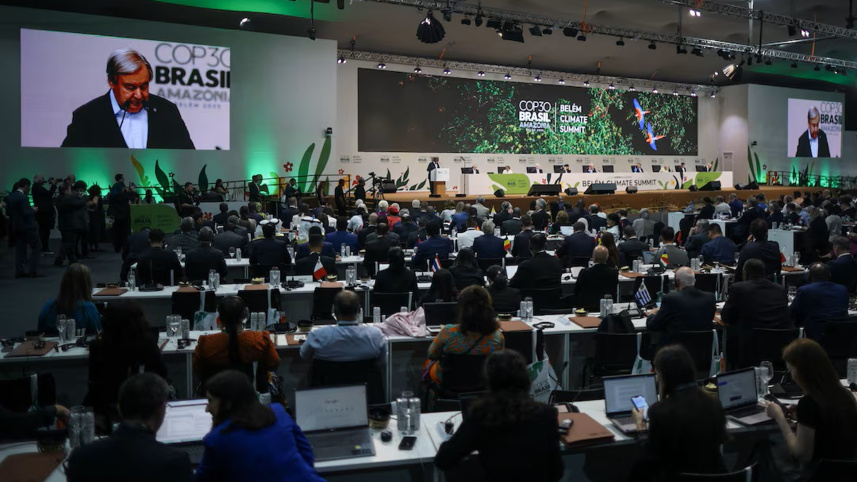
At a recent climate adda hosted by the Power and Participation Research Centre (PPRC), participants including COP30 returnees, local youth climate activists, researchers, engineers, and policy thinkers gathered to reflect on the COP experience and draw lessons on how climate engagement can be meaningfully taken forward. What emerged from the discussion was neither cynicism nor grand wisdom, but a healthy dose of clarity.
Participants of the Belem COP convening spoke of a sense of impasse that masked a crisis of language and power, and of a negotiation landscape increasingly shaped by ambiguity. Wealthy nations continue to dilute commitments through carefully crafted language. “Phase out” becomes “transition away.” Timelines become “pathways.” Responsibilities become “shared aspirations.”

The COP28 Dubai declaration’s reference to transitioning away from fossil fuels was welcomed globally. But without binding mechanisms and clarity on financing, such phrases risk becoming diplomatic poetry. The questions remain: how will funds be mobilised? Who will pay? And under what accountability structure?
Bangladesh, despite being one of the most climate-vulnerable countries in the world, still struggles with consistent representation in these global rooms. Its delegations often lack institutional memory due to bureaucratic turnover. Critical thematic areas such as gender, just transition, and sexual and reproductive health rights frequently lack specialised negotiators. That weakens our ability to shape definitions before they are finalised. At the same time, fossil fuel lobbyists—numbering in the thousands at recent summits—continue to influence outcomes. If COP processes are to succeed, a support constituency hitherto less in focus for Global South activists must become central to engagement—namely, the citizenry of developed countries. Without domestic political pressure in the Global North, international climate agreements will continue to stall.
Looking domestically, there is progress, but it is episodic and fragmented. The whole has yet to become greater than the sum of its parts. But we must acknowledge that Bangladesh is not standing still. Youth engagement has increased markedly in recent years. Climate discussions have also entered school curricula. Media coverage has expanded. Solar expansion is visible. Local innovation is happening. Yet, something remains disconnected. Policies exist in abundance, as do strategies, frameworks, action plans, and adaptation blueprints. But implementation continues to lag. Communities often see seminars, but not solutions. The gap between “bags of documents” and lived experience persists.
Another crucial missing element is data. Participants in the climate adda spoke candidly about the lack of reliable, standardised climate data repositories. In some cases, data are apparently manipulated to strengthen funding appeals. While this may bring short-term relief, it erodes scientific credibility in global negotiations. A country that cannot present transparent, validated evidence weakens its moral and technical standing. If climate justice is our demand, data integrity must be our discipline.
There is another problem, too: the tokenistic inclusion of youth. Bangladesh frequently celebrates youth participation, but effective inclusion remains uneven. Climate-vulnerable youth—particularly those from coastal belts, char areas, and agrarian communities—are often absent from policy rooms. Urban-based advocacy networks sometimes operate in silos. Multiple youth platforms exist, yet coordination is limited. Collaboration is episodic rather than institutionalised.
The adda highlighted an important shift in thinking: youth engagement must move from participation to co-design. Young climate leaders do not simply want seats at the table; they want roles in shaping funding models, piloting innovations, and designing accountability frameworks.
While the discussion was informal in spirit, there was surprising consensus on several interlinked priorities for the country going forward. The first is partnership and collaboration. The youth present in the room brought forward an important conclusion: horizontal linkages between organisations must replace siloed activism. Universities, think tanks, grassroots groups, engineers, agricultural innovators, and policy advocates must operate within shared frameworks, rather than in parallel spaces.
The second priority concerns solutions and innovation. The discourse must pivot from problem-recitation to solution-scaling. Bangladesh already hosts grassroots adaptive practices: climate-resilient agriculture, floating cultivation, localised construction innovations, etc. But they remain scattered. As one participant observed, many grassroots communities have adapted ingeniously, but there is no systematic consolidation of these practices. Pilot, document, evaluate, scale—that must become the model.
The third priority relates to governance and transparency. Climate finance is flowing globally, but fund utilisation remains opaque. Greenwashing is under increasing scrutiny. The adda participants proposed mechanisms such as dedicating a percentage of corporate social responsibility funds to structured climate risk pools. Governance systems must ensure that resources reach communities efficiently and transparently.
The fourth priority is capacity-building. Leadership development cannot remain confined to conference circuits. Technical skills—data management, climate modelling, resilient engineering—must reach vulnerable districts. Bureaucratic reshuffles often derail institutional continuity; capacity must therefore be distributed, not centralised.
Data and knowledge infrastructure are also central if climate engagement is to gain serious traction. A standardised, validated climate data network, potentially community-based, holds great promise. It is not enough just to produce data; evidence must be untampered, accessible, and policy-relevant. Without credible data, both domestic policy and international negotiating positions get weakened.
A lesson emerging from COP participation is that for advocacy to deliver results, it must be married to strategy. Advocacy must move beyond statements and hashtags to link knowledge with policy pathways. It must connect with civil society actors in the Global North to create transnational pressure. It must also translate technical climate debates into electoral issues within Bangladesh.
The discussion challenged the conventional framing of climate vulnerability. Bangladesh’s climate discourse often centres almost exclusively on coastal and char regions. Yet, vulnerable inland locations and our expanding urban centres constitute a new climate vulnerability map. Air quality, heat stress, and waterlogging—these must enter the climate conversation. Climate resilience is not only about embankments; it is also about urban governance, agricultural systems, labour transitions, and educational reform.
The PPRC adda resisted simplistic binaries. The private sector is often treated solely as a polluter or adversary. But small-scale farmers, entrepreneurs, and even engineering firms are potential partners in innovation and financing. Structured engagement, rather than suspicion alone, could unlock scalable solutions.
Perhaps the most important ingredient of the solution is commitment—to produce “schools of practice” rather than merely convening talk shops. A new generation of climate-literate youth, unwilling to accept symbolic inclusion, represents a potential force for shifting the country from reactive vulnerability to proactive resilience. Whether the global climate architecture remains fragmented, regional coordination weak, international finance politically entangled, or domestic implementation constrained by bureaucratic inertia, it is crucial to empower young people to co-design climate actions grounded in lived realities. We cannot allow the next COP communiqué to become just another document in the bag.
Namira Shameem is senior research associate at the Power and Participation Research Centre (PPRC).
Dr Hossain Zillur Rahman is executive chairman at the PPRC.
Views expressed in this article are the author's own.
Follow The Daily Star Opinion on Facebook for the latest opinions, commentaries, and analyses by experts and professionals. To contribute your article or letter to The Daily Star Opinion, see our guidelines for submission.
 For all latest news, follow The Daily Star's Google News channel.
Comments