


Balancing revenue goals with housing affordability
A few days ago, one of our landowners called me with a concern that has become increasingly common in recent weeks.
His project is currently under development through a joint venture arrangement. Upon completion, he is expected to receive ten apartments as his share of the developed property. Having learned about the proposed 15 percent capital gains tax on landowners’ shares, he wanted to understand what it would mean for him.

His voice reflected genuine anxiety.
“Why should I have to pay another tax?” he asked. “I already paid taxes when I purchased and registered the land years ago. Isn’t this double taxation?”
Whether one agrees with his interpretation or not, his concern highlights a larger issue that deserves careful consideration. Beyond the technicalities of taxation, it raises important questions about housing affordability, investment incentives, and the future of Bangladesh’s real estate sector.
The government’s objective of expanding the tax base and increasing revenue collection is both understandable and necessary. A growing economy requires public investment, and public investment requires revenue. However, the challenge for policymakers lies in striking the right balance between revenue generation and economic activity.
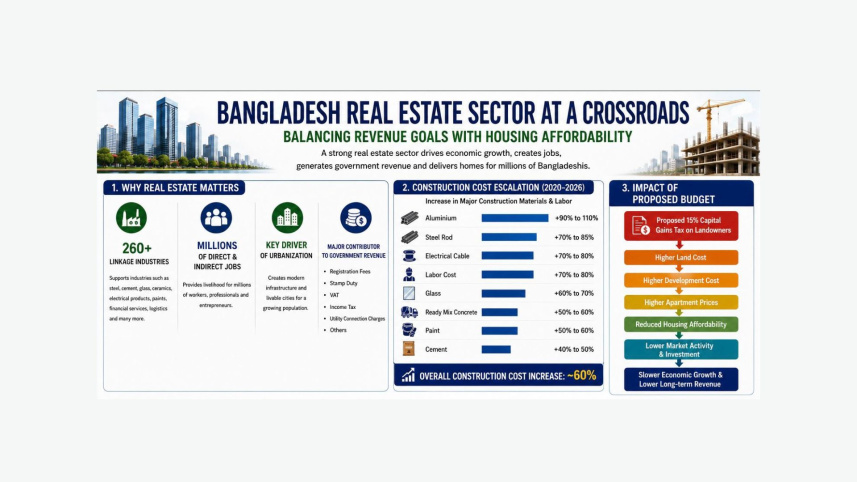
The real estate sector occupies a unique position in Bangladesh’s economy. It is not merely a business sector; it is an economic ecosystem that supports more than 260 backward and forward linkage industries.
Yet the industry is currently navigating one of the most difficult operating environments in recent history.
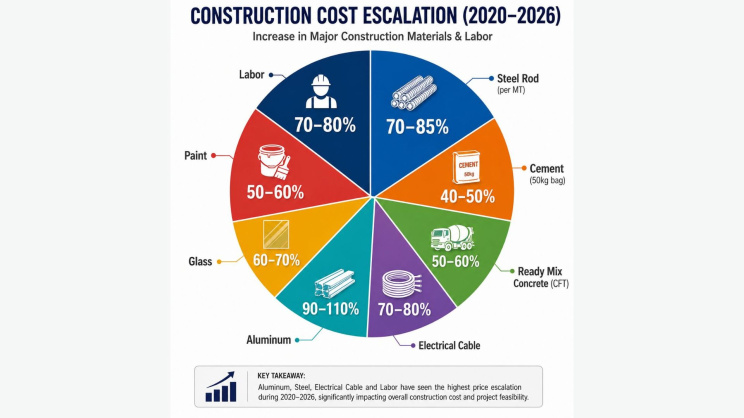
Over the past six years, construction costs have increased by nearly 60 percent. Major construction raw materials have experienced unprecedented price escalation. Aluminium prices have increased by 90-110 percent, steel rod prices by 70-85 percent, electrical cable prices by 70-80 percent, labour costs by 70-80 percent, glass prices by 60-70 percent, while ready-mix concrete and paint prices have increased by 50-60 percent. Cement prices have risen by 40-50 percent.
At the same time, the depreciation of the Bangladeshi Taka against the US Dollar has significantly increased the cost of imported and import-dependent products such as elevators, generators, heating, ventilation, and air conditioning systems, electrical equipment, fire safety systems, aluminium profiles, and various finishing materials.
Developers have absorbed much of these cost increases because market conditions have not allowed them to pass on the full burden to buyers.
The proposed 15 percent capital gains tax on landowners must therefore be evaluated within this broader economic context.
In Bangladesh, a substantial portion of urban real estate development takes place through joint venture arrangements between developers and landowners. If landowners perceive that they will incur additional tax liabilities on their share of developed properties, many are likely to demand higher compensation or higher land valuations to offset the impact.
The economics are straightforward. Increased land acquisition costs ultimately become part of the final apartment price paid by consumers.
If housing affordability is to remain a national priority, policy interventions should focus not only on revenue collection but also on reducing structural costs throughout the housing value chain.
One area deserving immediate attention is housing finance. Bringing home loan rates into single digits would stimulate demand and improve accessibility for thousands of aspiring homeowners. Lower development financing costs would encourage new investment and increase housing supply.
Property registration costs should also be revisited. Reducing overall registration and transfer costs to a range of 5–7 percent could encourage formal transactions, improve compliance, and potentially generate greater revenue through increased transaction volumes.
Similarly, Bangladesh has an opportunity to accelerate sustainable urban development through targeted incentives. Developers investing in green-certified buildings, renewable energy systems, rainwater harvesting, energy-efficient technologies, and environmentally responsible construction practices should be encouraged through reduced corporate tax rates, holding tax rebates, and other fiscal incentives.
The real estate sector is not seeking preferential treatment. It is seeking a policy framework that promotes investment, supports affordability, encourages sustainability, and expands economic activity.
As policymakers finalise fiscal measures, the objective should be to expand the tax base through economic activity rather than increase the burden on an already stressed housing market.
 For all latest news, follow The Daily Star's Google News channel.
 Bangladesh’s urbanisation journey is far from over. Millions of families will continue to aspire to homeownership in the decades ahead. The challenge before us is ensuring that those aspirations remain within reach.
Balancing revenue goals with housing affordability is not simply an industry concern. It is a national imperative.
The author is a sustainability advocate, and the CEO of Rancon (real estate division). The views expressed are his own.
Comments