


Bangladesh, China push for technology transfer to boost ceramics industry
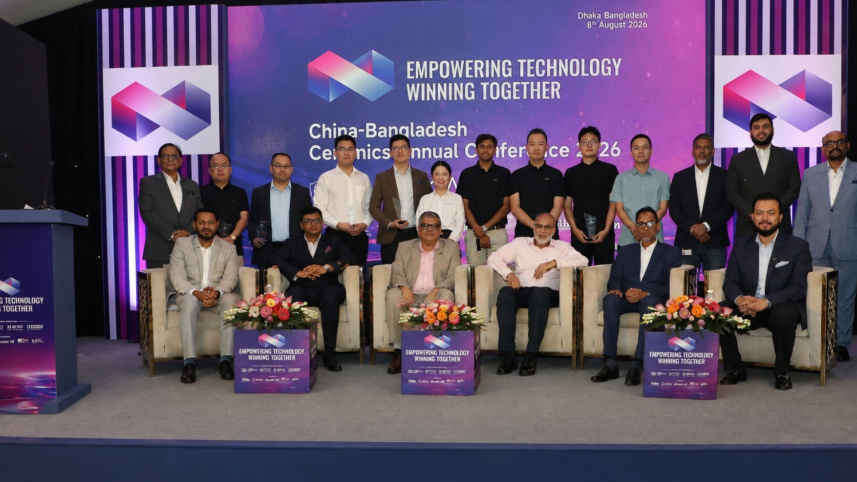
Bangladesh and China have stressed the need for stronger technology transfer, knowledge sharing and investment in innovation to help Bangladesh’s ceramics industry overcome rising energy costs and improve its competitiveness in global markets.
Industry leaders and experts made the observations at the China-Bangladesh Ceramics Annual Conference 2026, jointly organised by the Bangladesh Ceramic Manufacturers and Exporters Association (BCMEA) and Foshan Uniceramics Expo in Dhaka on August 8.

Speaking at the conference, Moynul Islam, president of BCMEA, called for greater adoption of Chinese technologies and innovative solutions to address the industry’s energy challenges.
He particularly highlighted technologies such as electric kilns and hydrogen-enriched heating systems.
Irfan Uddin, general secretary of BCMEA, said meaningful collaboration, knowledge exchange and innovation were essential for building a stronger and more competitive industry.
“No industry can grow alone” in today’s interconnected world, he said, stressing the importance of partnerships in driving technological progress.
Eva Chan, overseas business department manager of Uniceramics China, said Bangladesh’s ceramics market has significant growth potential, noting that the country’s per capita ceramic consumption is about one square metre, compared with 6.9 square metres at China’s peak.
She urged Bangladeshi manufacturers to move away from price-based competition and focus more on quality, design and branding to capture both domestic and international markets.
Mohammad Khorshed Alam, president of the Bangladesh China Chamber of Commerce and Industry, said stronger cooperation between businesses of the two countries could create new opportunities in local and international markets.
He also stressed the importance of technology transfer and skills development.
Md Mamunur Rashid FCMA, senior vice president of BCMEA, said the ceramics industry had emerged as one of Bangladesh’s promising manufacturing sectors.
Bangladesh now produces tableware, tiles and sanitaryware for export to Europe, North America and the Middle East, he said.
Abdul Hakim (Sumon), senior vice president of BCMEA, said the industry needed to explore alternative energy sources, including solar power, as it could not remain dependent solely on gas.
The conference also featured a technical session on technology, innovation and Bangladesh’s market potential, followed by discussions and presentations by Chinese technology and materials companies.
 For all latest news, follow The Daily Star's Google News channel.
Comments