


Foreign aid use hops over to a new high

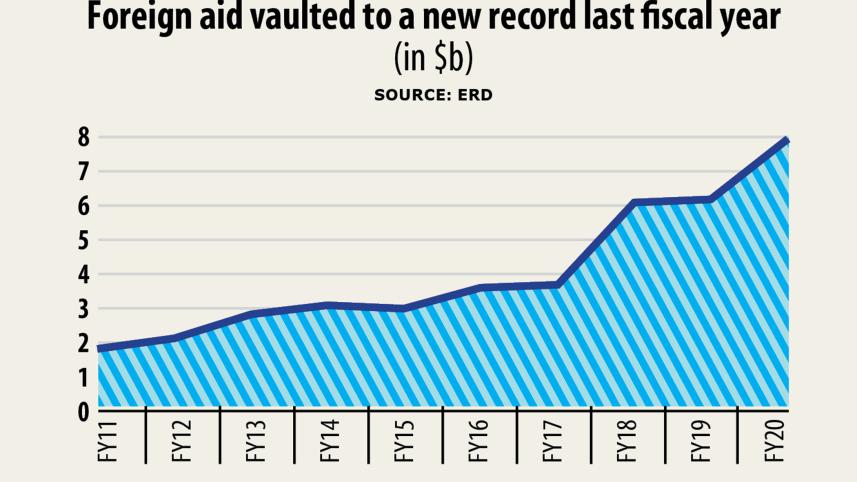
Foreign aid disbursement rose more than 28 per cent to $8 billion in the just-concluded fiscal year riding on the increased flow of budget support from development lenders to help Bangladesh ride out the coronavirus pandemic.
This is the highest foreign assistance utilisation in the country's history and up from $6.21 billion in fiscal 2018-19.

Bangladesh received $7.27 billion in development aid last fiscal year, according to the Economic Relations Division (ERD). But the government has also received $732 million from the International Monetary Fund (IMF) in emergency financing.
Though the fund from the Washington-based crisis lender usually comes as a support to meet the requirements of the balance of payments, the latest fund can be used for budget support.
This will help finance the health, social protection and macroeconomic stabilisation measures, meet the urgent balance of payments and fiscal needs arising from the coronavirus outbreak and catalyse additional support from the international community, the IMF said on May 29.
The disbursement target was $8.5 billion in the last fiscal year, according to a document of the finance ministry.
Foreign aid commitment by the development lenders, however, fell slightly to $9.55 billion in fiscal 2019-20 from $9.79 billion a year earlier. The commitment target in fiscal 2019-20 was $6 billion.
"Bangladesh has received a huge amount of budget support from development partners. As a result, the foreign aid disbursement rose," said Pear Mohammad, additional secretary of the ERD.
After the deadly pathogen arrived in the shores of Bangladesh bringing the economy down to its knees, the Asian Development Bank (ADB) has approved $500 million to meet the immediate financing requirements.
The World Bank has sanctioned $250 million, the Asian Infrastructure Investment Bank provided a similar amount and the IMF approved $732 million.
Currently, $50.39 billion in foreign aid is available for the government, the highest on record. It was $48.11 billion in fiscal 2018-19.
The support from the development lenders would continue this fiscal year. The ADB and the WB may each provide another $500 million and the Japan International Cooperation Agency $1 billion.
Before fiscal 2009-10, Bangladesh used to receive aid commitment of $1 billion to $2 billion every year. It jumped up to $5 billion from this year. Until fiscal 2015-16, the government received the highest $7 billion in aid commitment.
The record broke in fiscal 2016-17 when the commitment made reached $17.96 billion, which included the fund for the Rooppur nuclear power plant project.
Russia committed $11.38 billion for the Rooppur nuclear power plant project. Of the funds, $1 billion was spent in fiscal 2017-18 and the rest will be spent by fiscal 2023-24, when the plant is supposed to be fully implemented.
The other bilateral development partners such as India and China have also extended funds to Bangladesh in recent years, significantly raising the amount of external funds in the pipeline.
In practice, when a loan agreement is signed with a development partner it is considered commitment, meaning the fund is ready for utilisation and the unused portion of a fund is added to the pipeline.
Bangladesh has always struggled to properly use cheap foreign aid due to capacity constraints. Sluggish implementation of project results in slow disbursement of aid, leading to time and cost overruns.
Projects are often designed without proper planning or feasibility studies and people engaged in project preparation are not properly trained.
Delay in approval of awarding contracts, appointing consultants, releasing funds, as well as the lack of coordination among financiers in case of multi-donor funded projects, were in the past found to be the causes for the slow disbursement.
 For all latest news, follow The Daily Star's Google News channel.
Comments