


Sutor Golpo: Before Eid, a fair for fans of local brands

The dress caught Simum Mousumi Bristy's eye before she had even made it through the crowd.
She had gone to the Midas Center in Dhanmondi this afternoon, knowing exactly what she was looking for -- not a particular style or colour, but a particular origin. Local. Made here, by people who understood something about what it means to dress in this country.

"I have always been a fan of local brands," she said, holding the purchased dress. "They are more comfortable and unique."
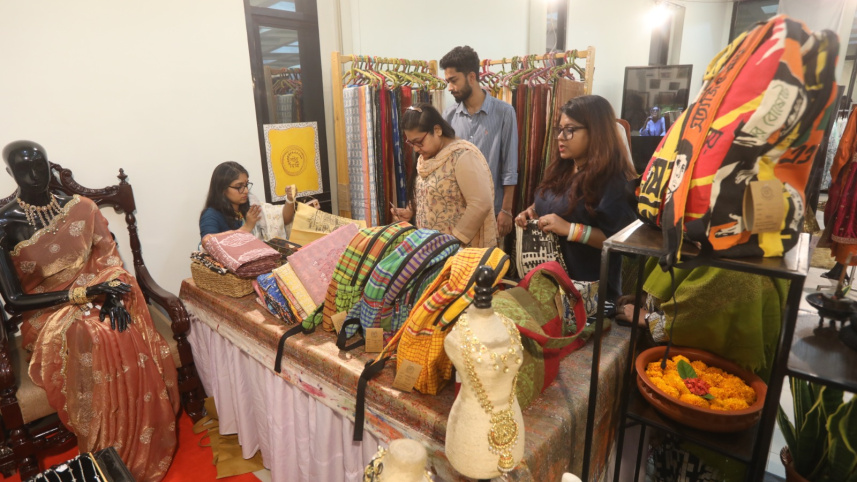
Bristy, a private sector employee, was one of dozens of shoppers who filled the Midas Center's hall for “Sutor Golpo -- Nijoshshotay Bona Utsob”, a three-day fair hosted by the Fashion Entrepreneurs Association of Bangladesh (FEAB) ahead of Eid-ul-Fitr.
Thirty-nine homegrown brands, spanning clothing, jewellery, jute, craft, leather, and organic food, gathered under one roof, turning the exhibition into something closer to a reunion than a retail event.
For many visitors, that distinction mattered.
Rumpa Farzana, a Dhaka resident, moved between stalls with the deliberate pace of someone who had been waiting for exactly this kind of occasion. Online shopping, she said, had never quite scratched the itch.
"Online purchasing does not always bring satisfaction. Such a fair creates an opportunity for shoppers to have a hands-on experience," she said. "I always try to stick with local brands."
Couples wandered through together. Schoolchildren trailed behind their parents. The crowd carried the energy of a festive shopping season.
Among the participants, Rehmuma Hossain had carved out a corner for her brand Rinki's Attire, which deals in Manipuri weaves sourced from artisans in the Sylhet region, where she has been working since 2019.
Clothing, shoes, bags, Western outfits, and short and long jackets -- all run through the same distinctive textile thread.
She noted that many of her peers work with Jamdani, the more widely recognised name in Bangladesh’s handloom tradition. “But I chose to work with the Manipuri handloom to promote this prestigious culture.”
It is the kind of decision that tends to go unnoticed in a market crowded with more recognisable names. But Hossain has built her business on exactly that wager – that there is an audience willing to look a little further.
Nearby, Munia Zaman had brought her jute creations from Kalindi: bags, wallets, objects that made a case for the material as something more than utilitarian. But it was not the products she seemed most moved to talk about.
"This is not just a fair," said the executive director of Kalindi. "It has created a reunion of clients and entrepreneurs ahead of Eid. After a prolonged period of instability, this exhibition has brought a sigh of relief for us."
Kanak Aditya, chief creative officer of Deshal, one of the fair's more established participants, spoke of a similar sentiment. “We participated in this fair to display our new products ahead of the Eid festival. Customers can purchase from here or visit our showroom.”
FEAB is hosting the exhibition for the first time. Speaking at the inaugural ceremony, the association’s President Azharul Haque Azad, who also runs renowned local fashion label Sadakalo, framed the fair as something of a call to conscience.
In a market flooded with alternatives, he said, consumers have a role to play. He urged shoppers to fill at least 30 to 40 percent of their wardrobes with domestic brands.
"This will encourage and help sustain the homegrown industry," he said.
Anwar Hossain Chowdhury, managing director of the SME Foundation, offered a more grounded note, reminding that sentiment alone cannot carry an industry.
 For all latest news, follow The Daily Star's Google News channel.
 "Patriotism alone will not protect domestic brands," he said. "We must also ensure quality products at fair prices."
Sutor Golpo -- literally, a story of threads -- will run till February 21. For Bristy, the afternoon had already delivered what she came for -- a dress, yes, but also the satisfaction of buying it from someone who made it here.
Comments