


Collaborative action urged to prevent gender-based violence in Bangladesh
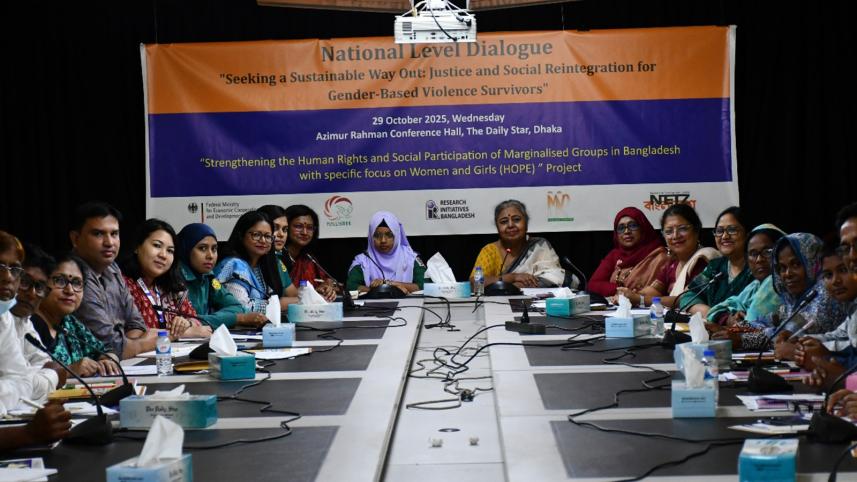
Speakers at a national dialogue have called for stronger, coordinated efforts among government agencies, civil society, and development organisations to combat the alarming rise in gender-based violence (GBV) across Bangladesh.
The dialogue, organised by NETZ Partnership for Development and Justice (NETZ), was held at the Azimur Rahman Conference Hall of The Daily Star on Wednesday. During the event, NETZ presented findings from a small-scale study conducted under the project "Strengthening the Human Rights and Social Participation of Marginalised Groups in Bangladesh, with Specific Focus on Women and Girls (HOPE)."

According to the study, conducted across 72 unions in 12 upazilas under six districts, 215 cases of child marriage and 48 incidents of violence against girls were recorded over the past year. Alarmingly, nine of the 13 reported rape cases involved children under 11, while all 14 cases of physical torture targeted married adolescent girls.
Presenting the findings, Afsana Binte Amin, Programme Manager at NETZ, said the report reveals a deeply troubling situation where victims and their families face continuing threats, social stigma, and long-term psychological trauma. She noted that even local activists, civil society groups, and NGO workers encounter pressure and intimidation when advocating for justice.
Ishrat Shermin Rahman, Clinical Psychologist at the National Trauma Counselling Centre (NTCC), stressed the importance of psychological support for survivors. Citing a Ministry of Women and Children Affairs (MoWCA) study, she said 81% of survivors struggle to recover from trauma without therapy. She called on families to stand by survivors and support their social reintegration.
Jesmin Ara, Project Director of Promoting Rights and Advancement of Women and Girls to Prevent GBV under MoWCA, highlighted government initiatives such as the Clinical Management of Rape (CMR) mobile app, One-Stop Crisis Centres (OCCs), and District Legal Aid Committees (DLACs), which aim to provide faster and more effective support to survivors.
Chairing the session, Dr. Meghna Guhathakurta emphasised that violence against women and girls (VAWG) stems from deep-rooted social, political, and economic inequalities. "It is not an individual issue — it is structural," she said. "To end VAWG, all actors must address the underlying causes while also amplifying the positive values and strengths that already exist in our society."
The event was attended by human rights defenders, students, teachers, government representatives, civil society members, law enforcement officials, and national and international NGO representatives.
 For all latest news, follow The Daily Star's Google News channel.
Comments