


The Hive and The Hymn: Tracing roots, resilience, and culture

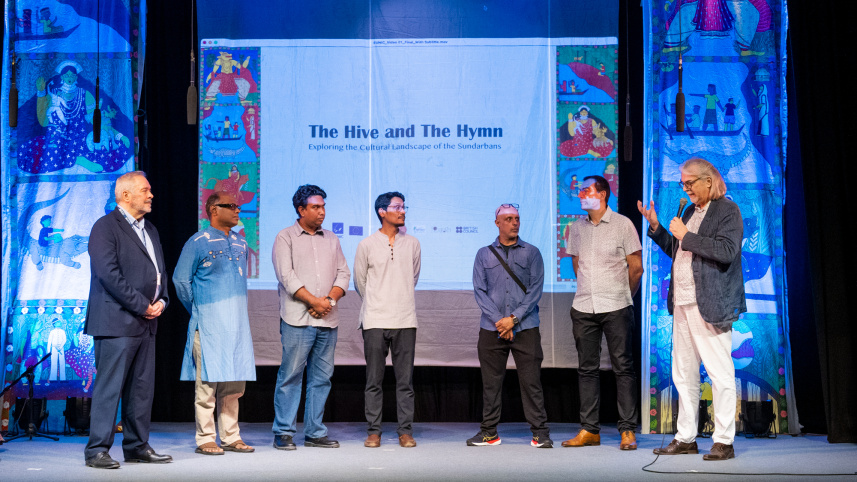
The European Union National Institutes of Culture (EUNIC) Cluster Bangladesh and EU Delegation to Bangladesh, in collaboration with HERITEiNCE DoA-BUET, Riverine People, and Team Platform, organised “The Hive and The Hymn” exhibition. The opening took place at the British Council Bangladesh on February 22, and will be open to the public from February 23 to 26 from 10:00 AM to 8:00 PM.
Described as a “cross-cultural, cross-border, multilateral project”, the exhibition showcased the cultural practices spanning the Sundarbans regions across Bangladesh and India, emphasising the shared ecosystem that is shaped by overlapping beliefs, heritage, and traditions. It explored the tangible and intangible cultural practices of the Moual (honey collector) communities living along the fringes of the Sundarbans.

The exhibition is part of the larger initiative “Sundarbans Across the Borders: The Spirit of Cultural Resilience”, which has also been developed by the EUNIC Bangladesh and Kolkata cluster.
Stephen Forbes, Country Director, Bangladesh, British Council, opened the exhibition. He outlined the importance of undertaking collaborative projects, stating that such initiatives help foster regional ties as well as empower communities.
Frank Werner, President of EUNIC Cluster Bangladesh and Director of the Goethe-Institut Bangladesh, followed. He spoke about the extensive process of putting the project together, its evolution from an academic endeavour to a cultural project, and the collaborative effort that made it possible.
Hasib Zuheri Shihan, founder of Team Platform, then expanded on the details of the project, emphasising the works on display and the performances that would follow.
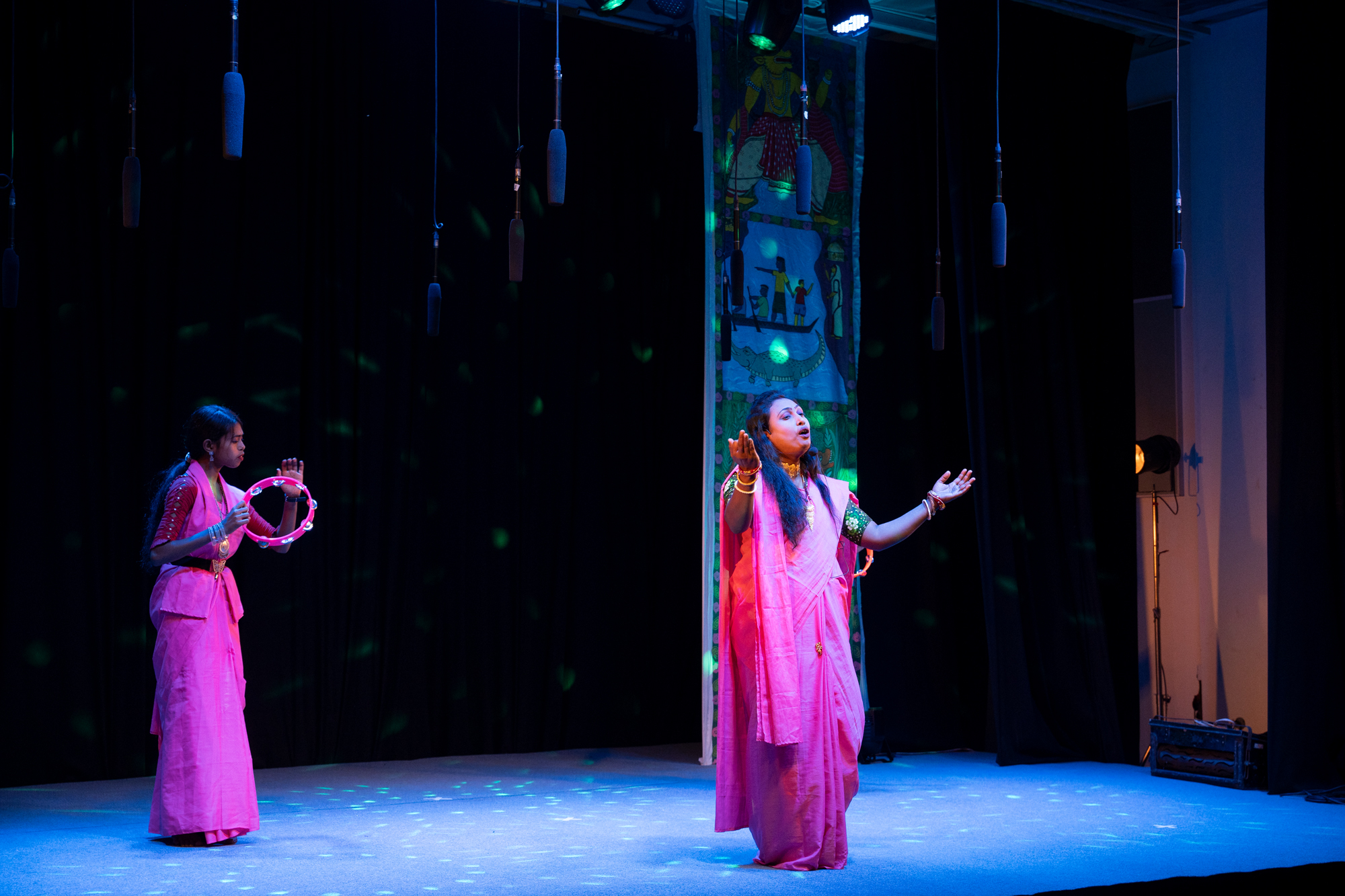
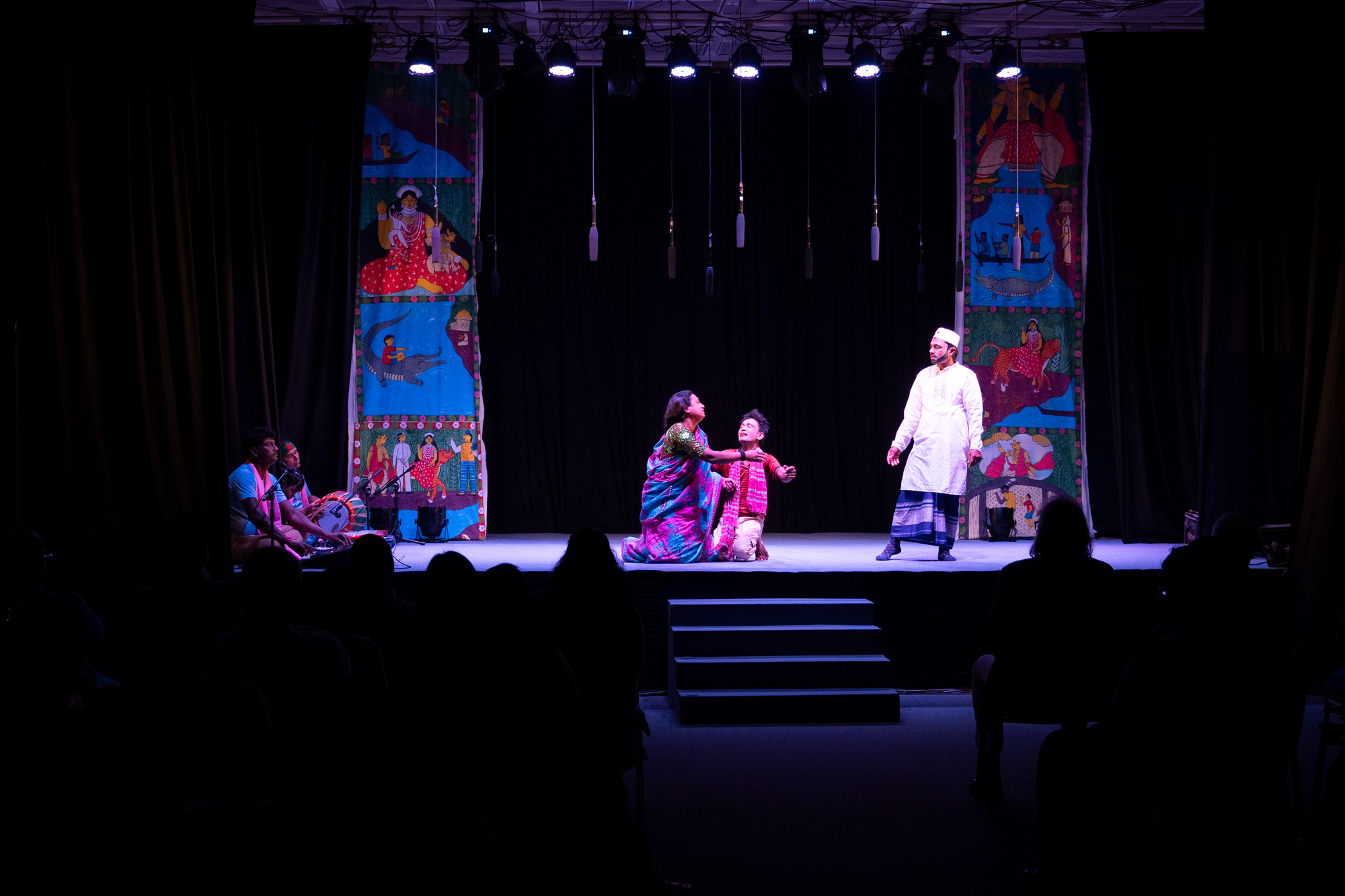
The crux of the exhibition had a pulse, one that noticeably moulded and carried the essence of the works on display. This pulse materialised through a sincere amalgamation of vulnerability and resilience. Through Patachitra scroll works as well as a live-staging of the Pala, Dukhe’r Bonobash, the exhibition rendered an enthralling depiction of the lived experiences of the locals. Although different media were explored, it all felt like a cohesive tapestry that had been woven together to tap into the economic, political, geographic, historical, and sociological realities of the region. A documentary tracing the research journey was also shown.
“It’s beautiful to see the results of a project that was a one-year journey. We were not sure what they would be, but the idea was to document Sundarbans’ honey-collecting communities and how they integrated in their neighbourhoods with their cultural heritage, the mythology of the region, as well as how they survived economically in rough environments. Additionally, we also wanted to find out how they are facing the serious impacts of climate change in the Sundarbans region. The answers we found were cultural,” expanded Frank Werner in an interview.
He emphasised that one of the goals of the project was to learn from the people themselves and then expose it to a larger audience. “What do we know here in Dhaka about the problems in Sundarbans and about its communities? Very little, because they don’t have a voice,” he added.
As for the works themselves, there were four bodies of Patachitro scroll works. These included a traditional Gazir Pat, a contemporary rendering of the honey collection cycle, a vertical depiction of the origin of the Bonbibi myth, and a collaborative scroll painted by community women and children.
“We worked around only one river, the Malancha River in Satkhira, where we worked across three villages. Of the three villages, one had a Muslim majority, one had a Hindu majority, and one had a mixed population. In the three villages, we noticed variations of rituals, practices, and faiths, but all of them were bound by one core factor. As everyone relies on the jungle, space is reserved for Bonbibi. This is what we kept in mind when we began the cultural production. So, we picked out two forms: Patachitro and Pala,” Hasib Zuheri Shihan explained.
The artists whose works were featured are: Shambhu Acharya, Kalikingkar Sardar, and Shaily Shrabonti. Each one of their pieces depicted a different iteration of the Patachitro artform, with the scrolls telling a distinct story of the Sundarbans region.
“We also wanted to explore whether or not the local community is still in touch with the Patachitro artform. When we conducted a workshop, we soon found out that there are no Patachitro artists in the region. But when they collaborated on a scroll, they began to draw in that specific style. It was proof that this was a natural form of drawing,” he said.
Perhaps the main attraction was the stage-play by SagorNodi Natyasangstha, which was equal parts gripping and spectacular. It ruminated on the legend of Bonbibi and tethered it to a moving, albeit tragic tale. The mysticism of the forest deity resides against the forces of worldly turmoil. Yet, what is worthy of note is that neither one competes against the other. The narrative allows space for both of these seemingly contradictory ideas to unravel and even complement one another. All of this is delivered with a lot of reverence by the actors, who are undoubtedly masters of their craft.
Though the Pala explores themes prevalent to the local communities residing in the Sundarbans, it is able to communicate them effectively to a contemporary, urban audience. What does warrant closer inspection, however, is that it was condensed to run for an hour and 20 minutes from its usual five-hour runtime. As a result, we may be left to wonder what exactly they were forced to do away with in order to accommodate the significantly shorter runtime.
Alongside the four artworks and the Pala, research from The Heritage and Technology Integration Cell, BUET, and Riverine People exhibited illustrations that offered insights into settlement patterns, infrastructure, myths, and ecological systems. The visualisations were executed in the style of traditional Gazir Pot scroll-painting style to pay homage to the roots of the region. Additionally, a series of photographs documented how the project came together by capturing locals and members of the project at work.
 For all latest news, follow The Daily Star's Google News channel.
 Sheikh Rokon, Secretary General of Riverine People and one of the researchers behind The Saline Quest for Honey (a publication developed under the initiative), explained the role he played: “I primarily looked at the rivers, canals, water shortage of Sundarbans, and its relationship to the environment.”
He stressed that their research work focused on three areas: the Sundarbans, its fleets, and the region’s relationship with its neighbours. “We looked at secondary data focusing on these areas. Additionally, we used Social Science methodologies such as FGD (Focus Group Discussions) and KII (Key Information Interviews) in our conversations with them. We also spoke to mobile communities about their experiences and their working process. The goal was to understand the correlation between socioeconomic, political, geographic, and environmental factors,” said Sheikh Rokon.
Grounded in reality and elevated by the transcendental, the exhibition lets visitors witness a part of the conversation surrounding climate change that is rarely, if ever, given the space it deserves. When hegemonic voices dominate the conversations, what often gets lost are age-old cultural practices that have persevered. “The Hive and the Hymn” has given it space. At its core, the project has brought to attention attributes such as the divinity of Bonbibi, the movement patterns of the harvesting methods, religious and musical reflections of the region, and historical significance.
Abir Hossain is a Sub-Editor at Campus, Rising Stars, and Star Youth.
Comments