


Strict monitoring imperative
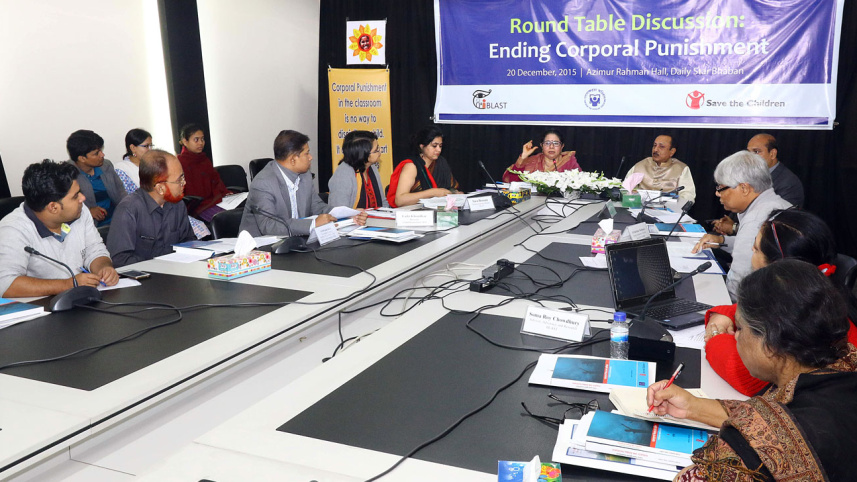
Widespread campaigning and strict monitoring are needed to stop corporal punishment of children both at home and educational institutions, said speakers at a roundtable yesterday.
The roundtable on "Ending Corporal Punishment" was organised by Bangladesh Legal Aid and Services Trust (BLAST), the Campaign for Popular Education (CAMPE), and Save the Children at The Daily Star Centre in the capital.

Primary and Mass Education Minister Mostafizur Rahman said punishing children has become a deep-seated problem in the society as it has been practised for years.
Bangladesh will have to devise an alternative way suitable for its people to discourage corporal punishment as well as inspiring children towards studies like developed countries, said the minister.
Honorary Executive Director of BLAST Sara Hossain said parents and guardians can play a vital role in ending corporal punishment by controlling themselves.
CAMPE Executive Director Rasheda K Choudhury suggested that representatives of non-government organisations should hold meetings on this matter in villages.
Director of the Child Protection Unit of Save the Children Laila Khandaker said there is a belief among people that corporal punishment is good for children's better future but researches from across the world showed such punishment put negative impacts on children in the long run.
Many students left schools because of mental and physical punishment. In some cases, they even fled home, she said, stressing that corporal punishment should be checked everywhere.
Advisor of the Advocacy and Research Section of BLAST Soma Roy Chowdhury gave a presentation on some achievements and challenges of the National Human Rights Commission in handling the issue.
Pointing to the delayed disposal of some corporal punishment complaints, she urged NHRC to ensure submission of probe reports in time and exercise its power to take disciplinary action and award interim financial relief or compensations to corporal punishment victims, where appropriate.
Corporal punishment is still practised in educational institutions because of weak legal provisions and laxity in monitoring, according to the speakers.
Soma suggested that the government hold consultations with stakeholders at divisional and national levels on the act related to education banning corporal punishment.
The BLAST advisor also advised the civil society to undertake concerted efforts to eliminate the practice through advocacy, communication and awareness campaigns.
 For all latest news, follow The Daily Star's Google News channel.
Comments