


Art brings success to student who cannot hear or speak
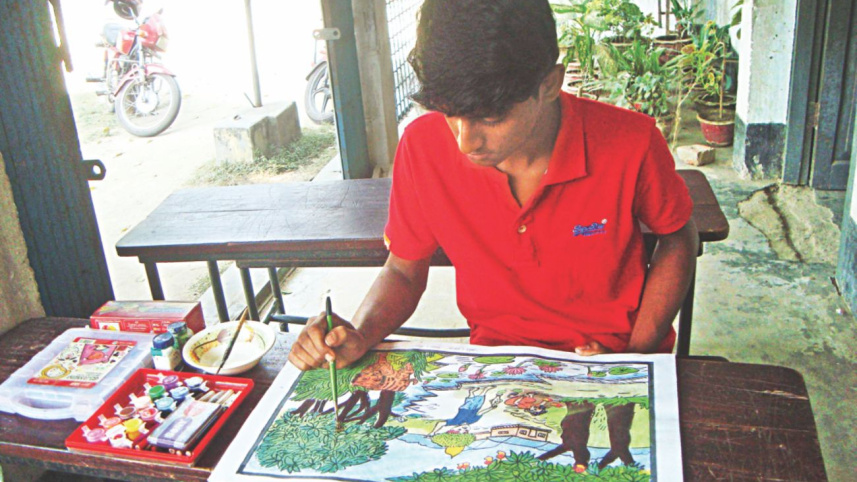
Initially Mizanur Rahman and Rekha Khatun, villagers of Jhenidah's Moheshpur upazila, weren't sure whether or not to send their son Sangram Ahmed Kabir to school. Sadly, Kabir cannot speak and is deaf, which made the parents wonder how he would manage in the classroom.
But by the time he was eight years old, Kabir had begun to show an interest in drawing, initially scratching out pictures on the ground of his home yard. He also learnt to make different toys and became adept at sewing designs on cloth. Kabir's mind and in particular his memory, is sharp.

Moreover, when inquisitive Kabir saw other children heading off to school in their uniforms, school bags in hand, he wanted to join them. On many occasions he cried from the disappointment of not accompanying the other students. So, in 2010, his parents decided to grant his wish. His mother took Kabir to Khalishpur Primary School for admission.
Kabir and his family are fortunate to have enrolled him at Khalishpur, for the headmistress Taslima Khatun, together with an assistant teacher at the school, took Kabir under their wings.
"We made every effort to teach Kabir to read," says Khatun. "It wasn't easy since he can neither speak nor hear our instructions."
Teaching aids were brought from teacher's homes, especially simple pictures like a tiger or a mango. Through a process of matching the written word with each picture, Kabir was able to memorise how each word was spelt and thereby learn to read. Now 14 years old and studying in class 6, he can write whatever he wishes.
The keen student has also learnt to make fishing implements, paper flowers, tops and model carts. He is an avid computer enthusiast. Yet his greatest enjoyment is undoubtedly in drawing and painting.
"When I first noticed Kabir's love of art I thought to encourage it," says Khatun. "Specifically my object was to train him to be able to write signboards as a possible future career."
She taught him how to mix water colours and facilitated his participation in several competitions. Kabir has already completed more than 300 drawings and paintings during his school years, and when he was in class 3 one of his pictures won first prize in an upazila-level drawing contest.
Now a confident young artist who prefers to draw landscapes, it was only natural that when Khatun heard in May 2015 that the upazila office was looking for pictures from children with disabilities, Kabir came first to mind. She duly submitted one of his pictures to the Moheshpur upazila nirbahi officer, Naima Khatun.
The best pictures of scenery were to be published as Eid cards for Eid-ul-Fitr this year, cards to be signed by the Prime Minister, Sheikh Hasina. The merit of Kabir's artwork ensured it was competitive.
Subsequently a letter arrived to inform Kabir his picture had won a 1 lakh taka award from the Prime Minister's relief and welfare fund, which requested Kabir to attend the Prime Minister's office to collect his crest and cheque. His picture would become an Eid card design.
Together with his mother, in October this year he arrived in Dhaka to receive his award and crest from the Prime Minister's assignment officer Mohammad Shamim Mushfik. Unfortunately the Prime Minister was scheduled to attend another programme that day.
Nonetheless, Kabir and his parents are rightfully proud of his achievements, which stem from his love of art.
Besides, it seems as if his school's headmistress needn't have worried much about his future career because, at his yet tender age, resourceful Kabir already draws an income from selling handmade tops and model carts to other village boys. From this endeavour he has already saved over Tk 3,500 taka, with hopes to eventually buy a computer.
 For all latest news, follow The Daily Star's Google News channel.
Comments