


'Parallels': Local contemporary architectural discourse in practice
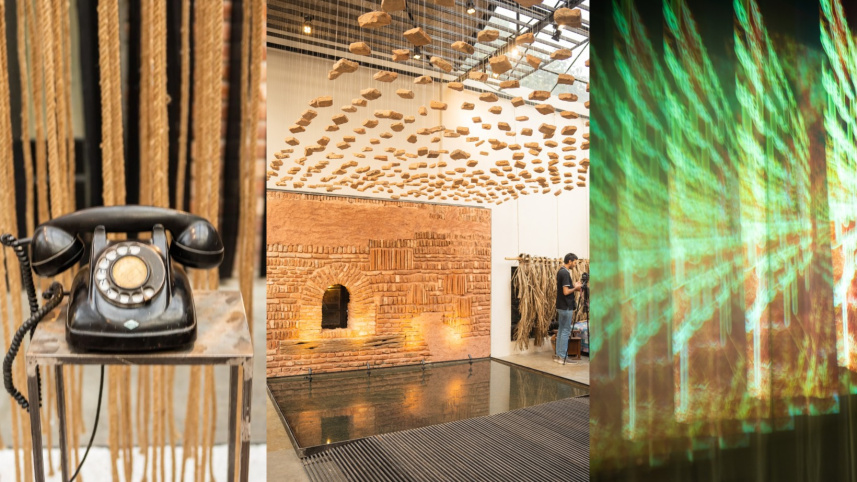
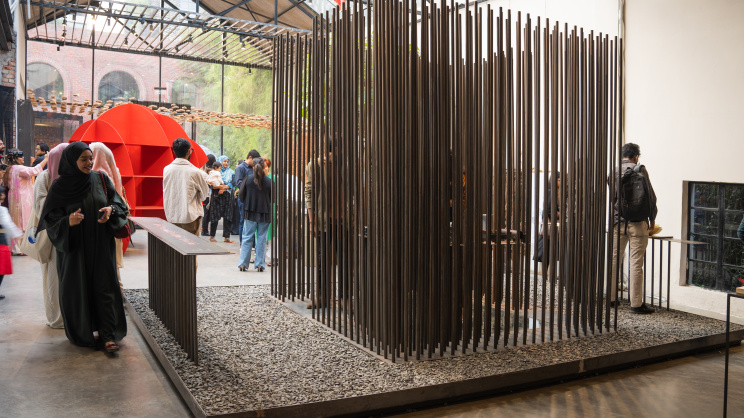
Walking into "Parallels", it becomes clear almost immediately that this is not an exhibition designed for quiet observation. It asks for involvement. Touch, movement, hesitation, return. What stands out most is the way the installations insist on participation, how they refuse to remain distant objects and instead pull you into their logic. You paint inside “Confluence”. You type on a typewriter within “A Room Without Wall”. You sit inside “The Unbearable Lightness of Being”. Looking at both sides, you walk through the “Memory Loop”. You pick up and read books from “Design Justice”. The body is never separate from the work.

That interactivity draws a quiet line between architecture and art. In galleries, art is often protected by an invisible boundary, sometimes stated outright: shilpokorme haat diben na (Do not touch the art pieces). Architecture does not have that luxury, or even wants it. It is meant to be entered, tested, and lived inside. "Parallels" leans into that truth, treating architecture as something that unfolds through experience rather than something completed at first glance.

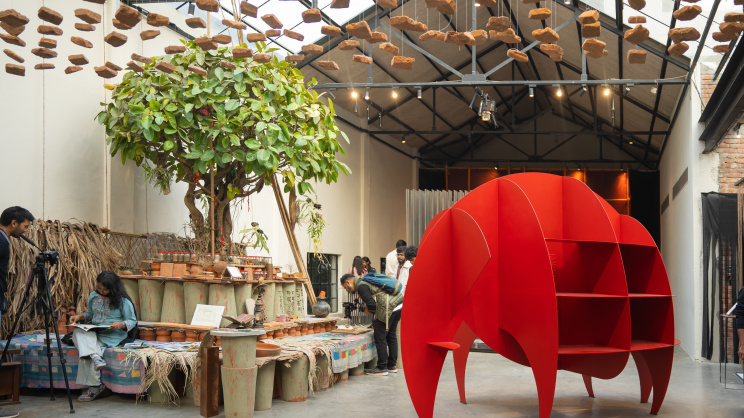
"Parallels" was held from 24 to 29 January 2026 at Aloki, Dhaka. Curated by architects Mahmudul Anwar Riyaad and Emran Hossain, the exhibition was conceived as a book of short stories, each expressed through spatial form, material exploration, conceptual installations, and three-dimensional works. Rather than presenting architecture as finished outcomes, the exhibition positioned ideas as narratives, meant to be read while moving through space.
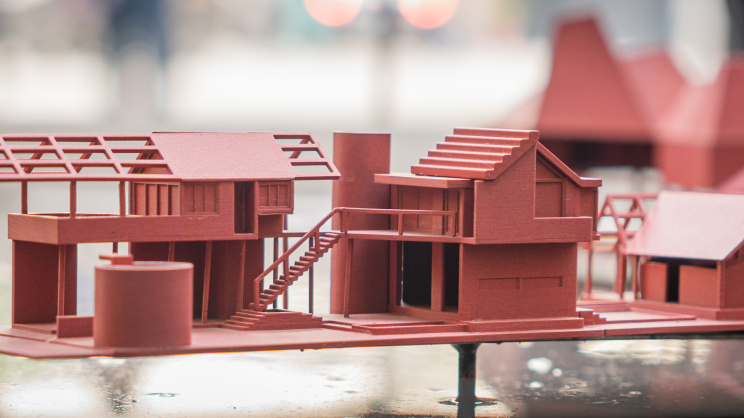
The opening day featured remarks by Ar Riyaad and Ar Hossain, followed by a keynote address from Ar Professor Shamsul Wares. An inaugural presentation was delivered by Farhan S Karim, Associate Professor of Architecture at the University of Kansas. Professor Wares described "Parallels" as an expression of modern society, where multiple voices move side by side while retaining individuality. He spoke of parallel lines that do not merge yet continue forward together, a condition he saw reflected in the exhibition’s structure and in the way the practices engaged one another.
Ar Riyaad noted how the practices drew inspiration from one another’s work and often assisted each other beyond the scope of the exhibition. Ar Hossain described "Parallels" as the beginning of a longer journey, one that opens space for architectural discourse around global issues, cultural transformation, and evolving modes of cultural engagement.
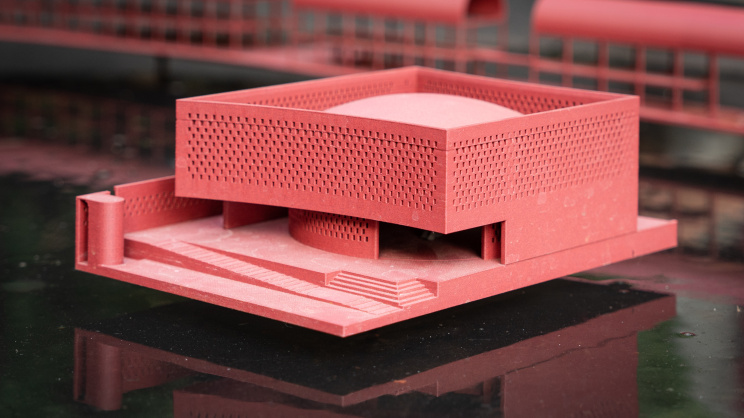
The exhibition’s structure reinforced these ideas. At the center of the hall stood eight podiums, each displaying cursory drawings and early conceptual material. As visitors moved outward, those initial sketches transformed into full-scale installations, revealing itself as a process shaped by memory, context, and lived experience before becoming material.
Many of the participating architects completed their undergraduate studies at BUET, later pursuing higher education at internationally recognised institutions. That shared academic lineage and foundation mattered. There was a visible consistency in rigor, paired with distinct individual positions. The curators themselves emerged from similar formative environments, and that background shaped the intellectual coherence of the exhibition.
Dhaka remained a constant presence across the works. Several practices spoke of the city’s chaos, while the architects of Cubeinside went further, describing Dhaka as a state of anarchy. Order, boldness, and oneness were proposed as counterimages to that anarchy. Yet the installations felt rooted in affection rather than frustration. The impulse was not to reject the city, but to respond to it, to create spaces that make living within it feel possible while keeping its charm.
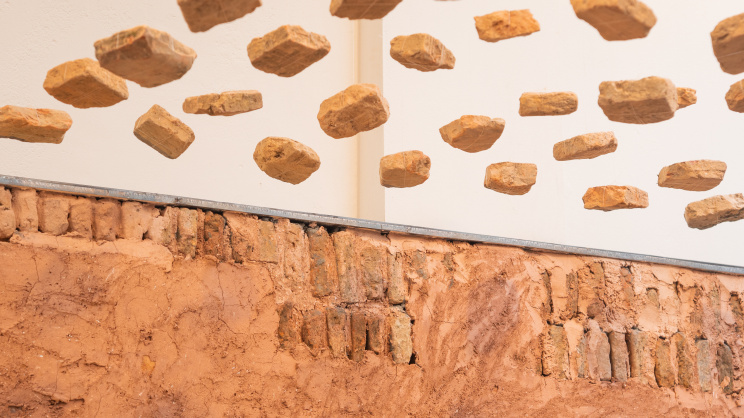
Across the exhibition, memory appeared as continuity rather than nostalgia, particularly in “Memory Loop”, where reclaimed bricks from Old Dhaka Central Jail allowed time to remain physically present. Space revealed itself as layered and negotiable in “Reading Between Time and Spaces”, where projections across translucent planes captured architecture as something shaped by environment, structure, and human presence at once. Silence and stillness became active conditions in “The Unbearable Lightness of Being”, where thresholds dissolved quietly.
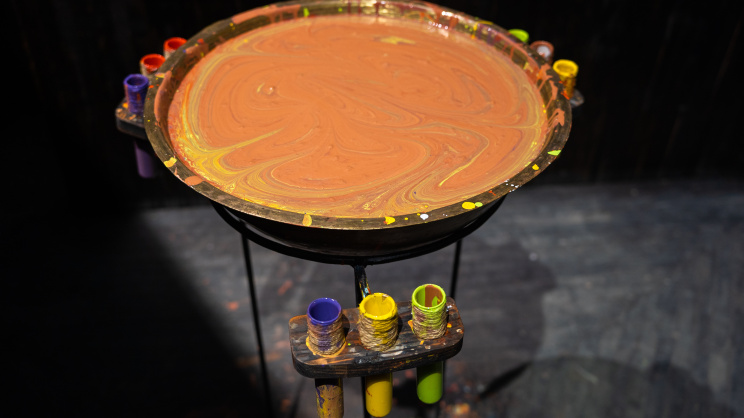
In “Confluence”, design was framed as a merging of ideas rather than individual authorship, with a pond of water and acrylic paint asking the visitors to paint and draw to create something beautiful together. “The Red Elephant” emphasised meaning built through multiple perspectives. “Time Seen from a Moving Self” presented growth as cumulative and rooted, using earthen forms and a banyan tree to suggest resilience. Even “A Room Without Walls” allowed solitude and collectivity to exist together, framing the body without enclosure.
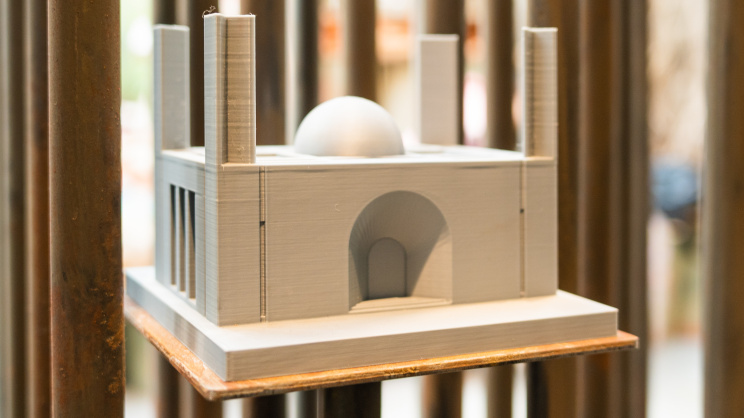
Influences surfaced subtly throughout: Corbusier, Mies, Aalto, Wright, Louis Kahn, Tadao Ando, Zaha Hadid—Bengali architects whose work shaped local thinking. They were absorbed and translated. Study appeared spatial rather than emotional, temporal rather than fixed. Each installation invited contemplation without instruction.
Throughout the six days, "Parallels" hosted talks by the participating practices, alongside sessions featuring Ar Nahas Ahmed Khalil, Ar Salauddin Ahmed, Ar Ehsan Khan, and Ar Mamnoon Murshed Chowdhury, extending the exhibition into sustained dialogue.
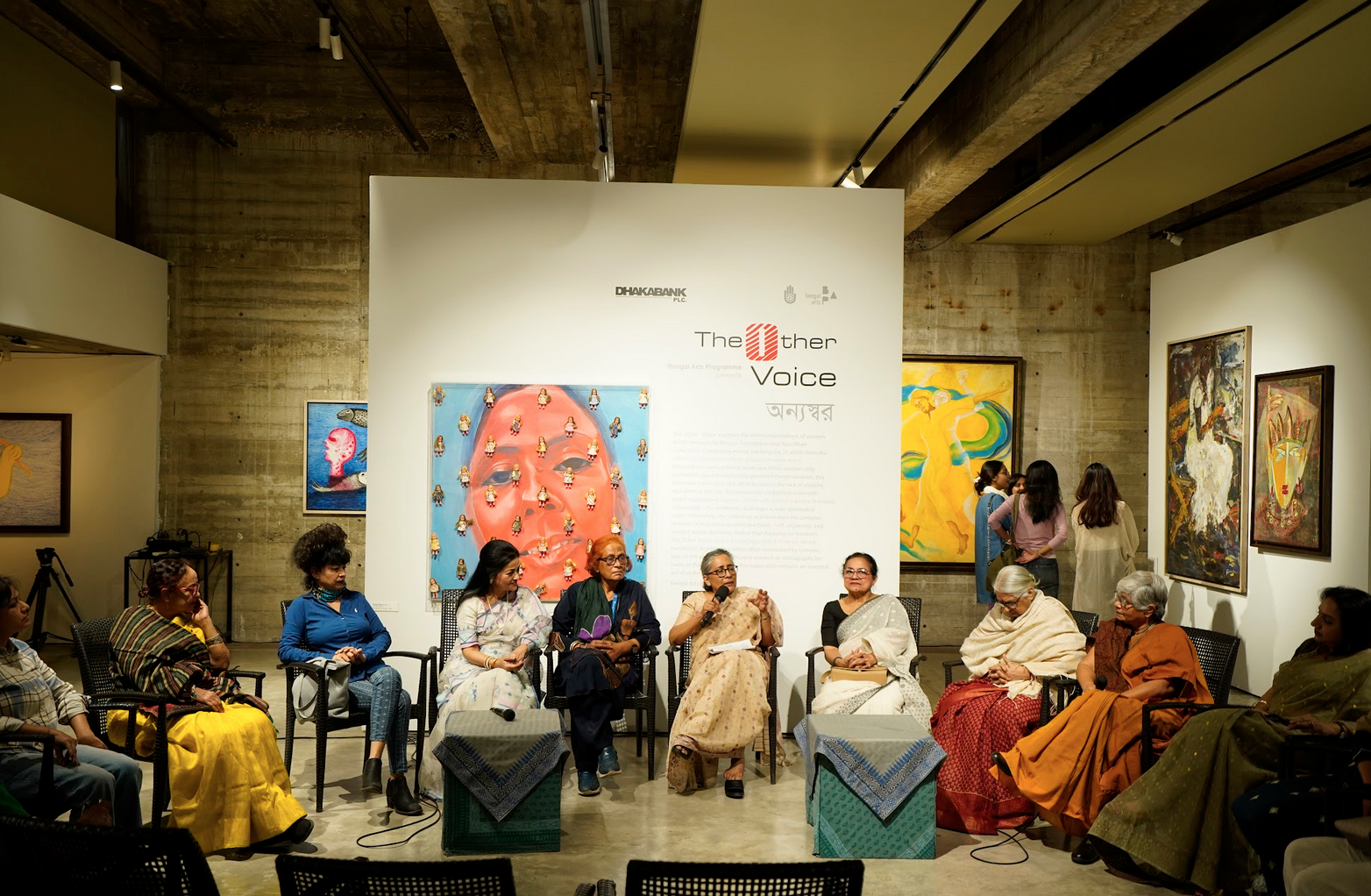
The closing day started with a conversation led by Ar Kashef Chowdhury, followed by a roundtable discussion featuring Ar Luva Nahid Choudhury, Sabyasachi Hazra, Bishwajit Goswami, and Tanzim Wahab. Moderated by Farhan S Karim and Emran Hossain, the session emphasised exchange rather than conclusion, allowing "Parallels" to remain open-ended.
"Parallels" unfolded as a conversation carried through space. Eight practices moved side by side, distinct in expression yet connected by shared concerns. Architecture here gestures toward engagement, but the real test lies beyond Aloki, in a city that rarely allows such clarity or pause, where chaos and order continue to exist in parallel. What "Parallels" succeeds in doing is naming that gap.
 For all latest news, follow The Daily Star's Google News channel.
Comments