


UN announces $5 mn flood relief for Bangladesh
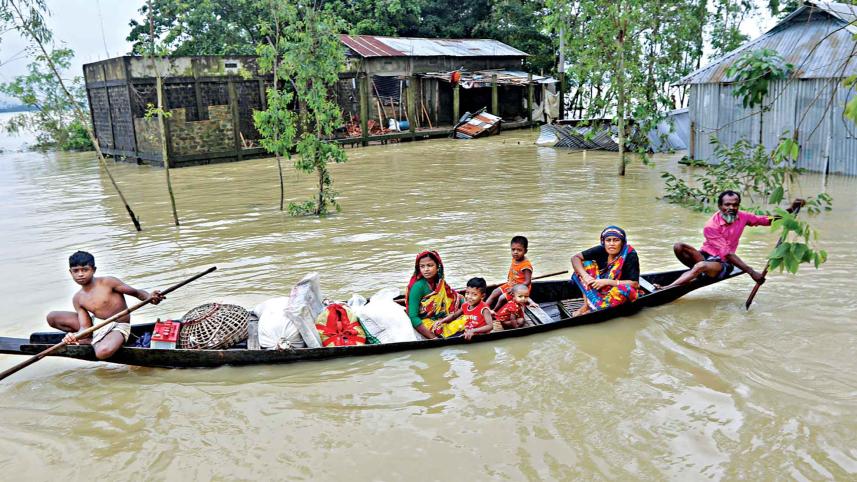
The UN has announced allocation of $5 million as relief to the victims of flash flood that affected millions and damaged infrastructure and crops in the country's northeastern region.
Martin Griffiths, Under-Secretary-General for Humanitarian Affairs and Emergency Relief Coordinator, UN, made the announcement today after a coordinated appeal by the UN country team in Bangladesh, according to a statement issued by the UN today.

Over 7.2 million people have been affected by recent floods in the North East of the country and over half of those affected need humanitarian assistance.
The funding comes from the UN Central Emergency Response Fund (CERF), which aims to kick-start relief efforts in a coordinated and prioritized manner when a new crisis emerges.
The focus of the CERF rapid response request is the provision high-impact immediate life-saving assistance to those most impacted and most vulnerable households.
The UN Resident Coordinator in Bangladesh Gwyn Lewis, spoke of how sobering her recent visit to the flood affected areas had been.
"The scale of the floods in the region are more dramatic than any that have been experienced in recent memory. Many families have literally lost everything they own. Many are still living in shelters.
"The flood waters are receding very slowly and their homes are completely destroyed. There is an urgent need to scale up our support to the government's emergency response."
This brings the current funding of the Humanitarian Response Plan to $12 million (Tk 112 crore), which is approximatively 20 percent of the necessary $58.4 million that were identified.
The Humanitarian Response Plan prioritizes life-saving assistance including emergency food security assistance water and sanitation interventions and protection interventions targeting women and girls.
The UN is supporting the government and delivering food assistance, drinking water, cash, emergency drugs, water purification tablets, dignity and hygiene kits to the affected families and education support.
The United Nations Children's Fund (UNICEF) has provided aid — including water, nutrition and protection services — to nearly 1 million people. WFP has distributed 85 metric tons of fortified biscuits to 34,000 households, while the World Health Organization (WHO) has provided 250,000 water purification tablets.
For its part, the UN Population Fund (UNFPA) has helped pregnant women to access hospitals and positioned midwives to provide emergency obstetric support. The WHO provided 250,000 water purification tablets to the affected people. 13.5 million Aquatabs and some 220,000 medical items were donated by UNHCR. IOM also provided 6 million Aquatabs and 6,000 jerrycans, and provided a 8,233 sets of tarpaulin sheets and ropes.
Key national and international NGOs are providing vital emergency response in the most-affected areas, including provision of critical cash assistance, safe drinking water, shelter, and emergency sanitation under the government's leadership.
 For all latest news, follow The Daily Star's Google News channel.
Comments