


Be patient, have faith in govt
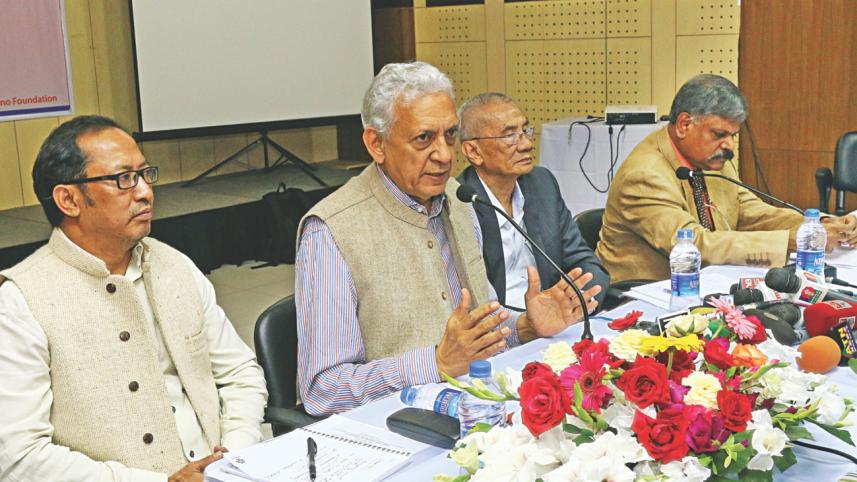
Dr Gowher Rizvi, the prime minister's international affairs adviser, has urged the indigenous community to be patient and have faith in the government about implementation of the CHT peace accord.
"I know you have already shown enough patience, but I would like to request you to keep faith in the government. This government has signed the accord and this government would implement it," he said.

Speaking as the chief guest at a discussion on the eve of the 18th anniversary of the accord signing, Rizvi said, "The implementation process is taking some time. But the government is honest about implementing the accord. Once the land commission law is amended, 90 percent complexity of implementing the accord would be solved."
Kapaeeng Foundation, a non-government research organisation on indigenous communities, organised the programme at The Daily Star Centre yesterday.
In response to indigenous people's demand for a road map to quickly implement the accord, Rizvi acknowledged the government should make a road map with a timeline that will show how and when the government would implement it.
As speakers mentioned that indigenous women and girls were being raped with impunity, Rizvi said women victims could file cases to get justice. He requested indigenous people to contact the Prime Minister's Office if local law enforcers did not take necessary steps.
Santu Larma, president of Parbatya Chattagram Jana Samhati Samity (PCJSS) and also chairman of the CHT regional council, said Ziaur Rahman had brought around half a million people into the CHT from outside for islamisation and militarisation of the region. He said those processes were still going on.
Although the government finalised the amendment of CHT land commission bill, it could not place it in parliament due to opposition from a vested quarter, Santu Larma said, adding that that vested quarter is making tourism facilities encroaching upon indigenous people's land.
Professor Mizanur Rahman, chairman of the National Human Rights Commission, said it was shameful for a government not to implement an accord after signing it.
Speaking as a special guest, he said that after detailed discussion with indigenous people, the NHRC came to know that the ownership of land was the most crucial issue there and it was seriously threatening the social harmony between the indigenous and Bengali-speaking people.
Prof Rahman requested the adviser to convey this message to the government.
Shaheen Anam, executive director of Manusher Jonno Foundation, said arrogance of the majority was increasing in the society and it would bring suffering to everyone.
"It is regrettable that violence against women was happening across the country. But raping and other forms of violence against women in the CHT were happening to actually grab their land," she said.
No development will help people if the government cannot ensure the safety and security of its citizens, she said.
Barrister Debasish Roy, king of the Chakma circle, said the government "does not have a policy for indigenous people and the CHT region."
Mangal Kumar Chakma presented the keynote paper titled "18 years of CHT Peace Accord: Rights of Local People and Realities".
Among others, Professor Dr Sadeka Halim spoke in the seminar which was moderated by Sanjeeb Drong, secretary general of Bangladesh Forum for Indigenous People.
 For all latest news, follow The Daily Star's Google News channel.
Comments