


Grief, fright take colours off Baishakh
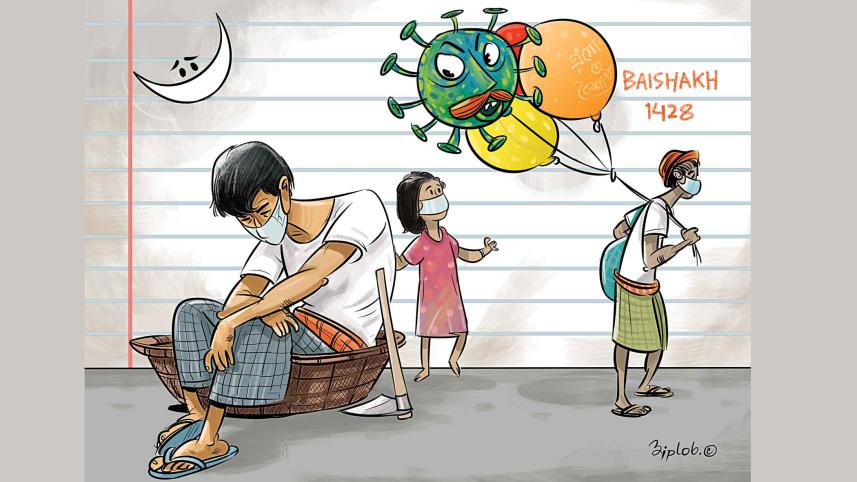
The Bangla year 1428 arrives today without the vigour and melody that comes with Pahela Baishakh.
For the second consecutive year, Bangalees will celebrate the new year at home as the day coincides with the beginning of a seven-day countrywide lockdown imposed to stem the spread of Covid-19.

Like last year, people will have to welcome the first day of the Bengali calendar amid the grim reality caused by the second wave of the deadly disease.
There will be no festivity or cultural practices, rooted deeply in secular ethos, no rendition of the song "Esho hey Baishakh, esho esho" under the banyan tree at Ramna Batamul in the capital.
And just like last year, there will be no outpouring of people on the streets or colourful festivals around Dhaka University campus through which the Bengalees will welcome the new year.
However, there will be a token Mangal Shobhajatra, a colourful, ceremonious procession, which is the mainstay of the festival, from the Dhaka University's Faculty of Fine Arts. Last year, the procession was halted due to the pandemic.
The university authorities will allow a maximum of 30 people in the rally, which would be recorded and sent to the media.
The government has already suspended all public programmes, asking all not to hold any mass gathering or outdoor celebrations for Pahela Baishakh.
The country is now seeing an alarming spike in Covid-19 cases and deaths for the last one month. In this situation, hospitals have been overwhelmed by the increasing number of patients.
The DU's fine arts faculty was found to be quiet yesterday, even though this place would be brimming with teachers and students preparing for the festival before the global pandemic began.
"It's because of the Covid-19 that we could not build the structure of the Mangal Shobhajatra," said Shakhawat Rony, a student of the Department of Drawing and Printing of Fine Art.
Another student, Tahsina Ferdous Linia, said they had been waiting for this day eagerly but culture and heritage had to take a back seat due to Covid-19.
"I'll miss the celebration," she said.
DU Vice-Chancellor Prof Md Akhtaruzzaman said they will celebrate the day on a limited scale. "There will not be any kind of public gathering," he said.
Mughal Emperor Akbar introduced the tradition of celebrating the Bangla New Year -- Naba Barsha – to mark the closing of the annual tax collection.
Traditionally, traders and shopkeepers open a new "halkhata" (account register) on this day and celebrate it by offering sweetmeat to their clients.
In the course of time, it evolved into a day of mass celebration and an integral part of the Bangalee culture. It has been considered a non-communal festival as people irrespective of religion, sect, class and creed celebrate the day as one race.
 For all latest news, follow The Daily Star's Google News channel.
Comments