


Mass graves found again in Malaysia
trafficking victims from
Bangladesh and Myanmar
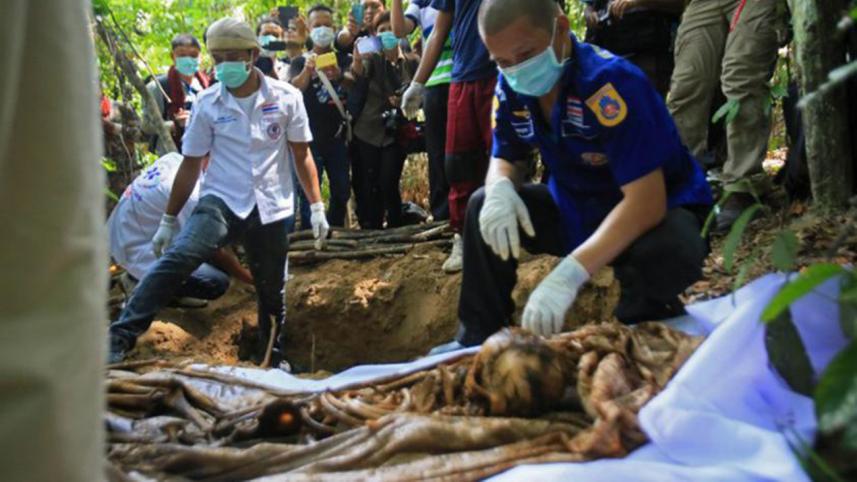
Three months after the migrant crisis in Asia, Malaysian authorities on Saturday found 24 bodies in mass graves near the country's border with Thailand.
The remains believed to be of Rohingyas from Myanmar and Bangladeshis fallen victim to human trafficking were recovered from 19 graves in Wang Burma hill area of Malaysia's northern state Perlis, reported Malaysian newspaper The Star yesterday.

They were suspected to have died of abuse or malnourishment.
The heavily forested Thai-Malaysian border has been a transit point for human traffickers bringing people to Southeast Asia by boats from Myanmar and Bangladesh.
Migrants are often held for ransom at squalid detention camps in Thailand, where they face torture and starvation. Those who can pay ransom are released in Malaysia and others are tortured to death.
In a similar but large-scale discovery in late May this year, Malaysia recovered 106 human skeletons from 139 mass graves on the forested hills of Wang Burma, close to the graves dug up this time.
Heavy downpour in recent times washed away soil revealing the remains of the bodies, said Malaysian National Security Council Chairman Shahidan Kassim.
"We don't know how long the victims were buried or if there was a transit camp there," Kassim told The Star.
Perlis Police chief SAC Shafie Ismail told Malaysian state news agency Bernama they believed the graves were older than those found in May.
The remains have been sent to Sultanah Bahiyah Hospital in Alor Setar, Kedah, for post-mortem.
Thailand discovered some 30 human remains in early May leading to a crackdown on human traffickers in the Southern part of the country.
The human traffickers then abandoned thousands of migrants on rickety boats in the Bay of Bengal and the Andaman Sea, triggering a regional humanitarian crisis that saw them land in Malaysia, Indonesia, Thailand and Myanmar.
Some 2,000 Bangladeshis have been repatriated since then while the Rohingya Muslims, who are a persecuted minority in Myanmar, were being processed for resettlement.
According to the UN Refugee Agency, 88,000 people from Myanmar and Bangladesh coasts took the dangerous sea journey on rickety boats between January 2014 and June 2015.
At least 300 of them died in the sea, but there is no estimate of the deaths in the camps on Thai-Malaysian border.
CARAM Asia, a regional NGO based in Malaysia, found that more than 500 families in Bangladesh had their relatives missing.
Meanwhile, 91 Thais, nine Myanmar nationals and four Bangladeshis are facing charges of human trafficking, partaking in a transnational crime network and assisting or bringing in aliens into Thailand illegally.
Malaysian authorities held 12 police officials on suspicion of having links to human trafficking following the discovery of mass graves in May. A probe is on but details of their involvement could not be learnt yet.
Mirza Abdullahil Baqui, special superintendent (organised crime) of the Criminal Investigation Department of Bangladesh, said they had contacted the authorities in Malaysia, Thailand, Indonesia and Philippines regarding the investigation into the trafficking cases.
"We have seen that Bangladesh is used as a source country for human trafficking from Cox's Bazar route. Now, we are trying to find out trafficking gangs active regionally," he told The Daily Star yesterday.
 For all latest news, follow The Daily Star's Google News channel.
 The CID is now investigating more than 200 human trafficking cases filed across the country, he added.
Comments