


Time for 'global response'
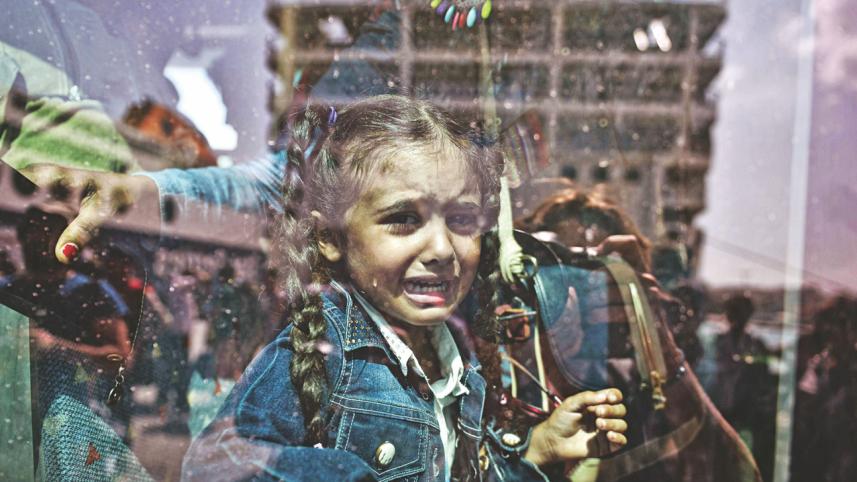
The United Nations' top official in charge of migration said yesterday the crisis rocking Europe needs a "global response", insisting that countries worldwide must be asked to do their share.
"We should have a European response as part of a global response," UN Special Representative for Migration and Development Peter Sutherland told reporters in Geneva, hinting at the need for an international conference "where every country is held up to the spotlight."
 For all latest news, follow The Daily Star's Google News channel.
 Sutherland insisted geographical proximity to a crisis should not determine who takes in refugees, pointing out that during the Vietnam War, refugees were welcomed into countries around the globe.
The same, he said, was true following the Hungarian revolution in 1956, when an international conference was held to help distribute the some 200,000 people who fled the Soviet crackdown.
He called for "a much more proactive response by the international community."
"We have to find a method, perhaps as we did in 1956 in the conference that took place then, to get specific commitments from every state in regard to taking refugees," he added.
He also insisted on a system to evaluate who constitutes a refugee that is consistent across all nations, noting that at present, different countries are using different criteria.
Europe is dealing with hundreds of thousands of migrants -- many of them fleeing violence in places like Syria -- pouring across the Mediterranean and taking a land route up through the continent.
In a preliminary emergency appeal document published yesterday, the UN refugee agency expects the number of refugees fleeing across the Mediterranean to Europe to hit 400,000 this year and could be 450,000 or more in 2016.
"In 2015, UNHCR anticipates that approximately 400,000 new arrivals will seek international protection in Europe via the Mediterranean. In 2016 this number could reach 450,000 or more," it said, adding that over 366,000 had already arrived in 2015.
Yesterday, tens of thousands of migrants massed on Greek islands as the president of the European Union warned the refugee crisis would last for years and the UN pleaded for a worldwide solution.
With Greece's migration minister Yiannis Mouzalas admitting the island of Lesbos was "on the verge of explosion", authorities opened a new centre to process the 30,000 refugees the UN said are stuck there and on other Aegean Sea flashpoints, with Athens promising more for other bottlenecks.
A handful of coastguards and riot police armed with batons had struggled to control some 2,500 migrants in Lesbos's main port, screaming "keep back" as the crowds surged towards a government-chartered ferry bound for Athens.
In a speech at the Bruegel Institute, a think-tank in Brussels, EU President Donald Tusk warned that the human haemorrhage to Europe would be long-lasting.
"The wave of migration is not a one-time incident but the beginning of a real exodus, which means that we will have to deal with this problem for many years to come."
'THE SPIRIT OF URGENCY'
Austrian Chancellor Werner Faymann called again yesterday for an EU summit, appealing for a return of the spirit of urgency and cooperation seen in the 2008 financial crisis.
"In the financial crisis of 2008 we did everything we could to prevent a collapse of banks and the financial system. We must demonstrate the same efforts now so that the right to asylum can be upheld," Faymann said in Vienna.
The remarks touched on a deep east-west division within the EU about how to respond to the crisis, with former Communist-ruled members of the 28-nation bloc, such as Hungary, taking a hardline approach.
Dramatic scenes unfolded on the Hungarian-Serbian border yesterday, as hundreds of frustrated migrants and refugees broke through police lines and ran from a holding area.
Some parents carried children on their shoulders, struggling to make their way across the rough ground near Roszke in Hungary.
As they ran across open corn and sunflower fields, police followed. But officers have not so far stopped any of the refugees.
The breakout happened suddenly and did not appear to be planned.
Earlier in the day, scuffles broke out as migrants forced to wait in the holding area expressed their frustration. Many cannot understand why, having reached the European Union, they are not receiving a warmer welcome.
Some of the migrants -- most of them from Iraq, Syria and Afghanistan -- also tussled with police on Monday. Police have been blocking a road from the holding site to a transit camp where they can register as refugees and continue their journeys.
Many of the refugees and migrants arriving there from Serbia -- having been on the road for weeks in some cases -- are afraid they will get stuck in Hungary and be unable to carry on their journey to their preferred destinations in Western Europe.
Some who have made it farther north have also complained of poor conditions in the holding areas and transit camps in Hungary.
Hungary's government has said it is just trying to enforce EU rules on the movement of migrants without proper documentation.
[From AFP, Reuters and CNN]
Comments