


Young people optimistic about future
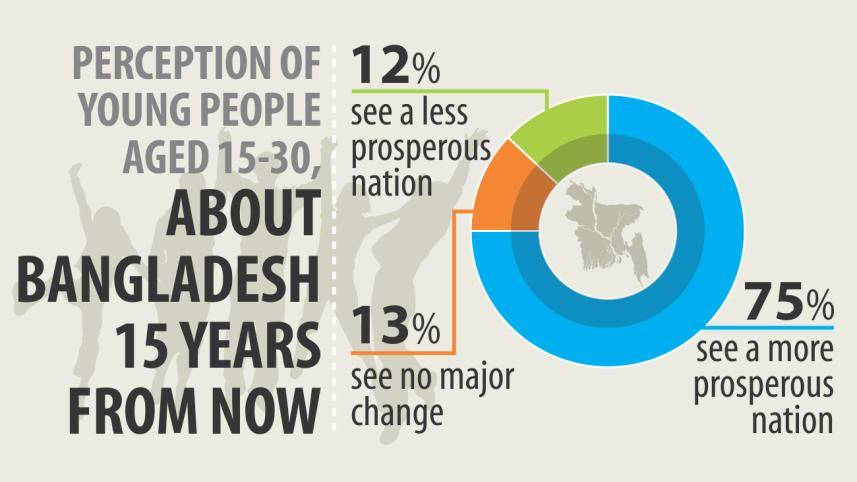
Seventy-five percent of Bangladeshi youths see the country as a more prosperous nation in the next 15 years and 60 percent think it is heading in the right direction, a survey has found.
The findings of the survey were presented at the launch of a report titled "Next Generation Bangladesh 2015 and Beyond" at the British Council Library on the city's Fuller Road yesterday.
 For all latest news, follow The Daily Star's Google News channel.
 The British Council, ActionAid Bangladesh and the University of Liberal Arts Bangladesh (ULAB) commissioned the report.
Speaking at the launch, Tomas Doherty, assistant director of programmes at the British Council, said 94 percent of Pakistani youths in a similar survey conducted in 2013 said their country was not going in the right direction.
The research conducted by the Nielsen Company (Bangladesh) surveyed 5,000 youths between August 2014 and April 2015. It was also based on 15 in-depth interviews and 18 focus group discussions held in different districts.
Among the respondents were equal number of men and women. Seventy-six percent of them came from rural, 20 percent from urban and the rest from semi-urban settings.

The survey was a "follow-on" of the 2010 report published by the British Council on the status, aspirations and attitudes of the country's youth. This year's report looked into governance, law and order, education and employability, environment and health affecting young people's lives.
According to the study, the major problems faced by Bangladeshi youths are political instability (54 percent), poor transport system (41 percent), electricity crisis (39 percent), inflation (33 percent), increasing corruption (32 percent) and lack of job opportunities (32 percent).
Youths also identified unemployment (69 percent), poverty (54 percent), demand for more money (30 percent), pressure from friends (29 percent) and political beliefs (22 percent) as the top five reasons for the young people to get involved in violent incidents.
The report said 48 percent youths aged between 25 and 30 did not have any income between April 2014 and April 2015.
Sixteen and 28 percent of the urban and rural youths said they were affected by environmental changes.
Mentioning that 87 percent of the youths want to vote in the next general election, Tomas said democracy still has a huge influence on young people.
The study also found that 98 percent youths considered an honest and responsive government as important. Security was considered as a key important issue by 96 percent and finding employment by 95 percent.
A discussion was held after the presentation of the report. Among the three youth panelists of the discussion was Musabber Ali Chisty, member of Active Citizens, a youth programme of the British Council. He stressed the need for ensuring proper education, qualification and opportunities for youth development.
"The report launched today [Wednesday] provides a snapshot of the mood of the nation's youth," said Mark Clayton, deputy British high commissioner to Bangladesh.
State Minister for Youth and Sports Biren Sikder said there should be uniformity between various education systems to make sure that the same level of standard is maintained in all the systems.
The full report will be made available by the end of this month, said Barbara Wickham, country director of the British Council, Bangladesh.
Farah Kabir, country director of ActionAid Bangladesh; and Imran Rahman, vice-chancellor of ULAB, also spoke.
Comments