


Families struggle with rising dengue cases and costs

Fifteen-year-old Rahat Miaji, who was recovering from severe electrocution near a madrasa in Chauddogram, Cumilla, has fallen into danger once again after contracting dengue.
Rahat has been undergoing treatment at Dhaka Medical College Hospital (DMCH) since Wednesday. He was referred from the district hospital after two days of treatment due to the deterioration in his condition.

"It is a severe blow for us," said his mother, Aysha. "My son had been improving for the last 15 days after remaining in critical condition due to electrocution three months ago. Apart from him, two others were electrocuted, one of whom died after touching the same flagpole that had injured him. Now dengue has put him in danger again."
She said they had already spent around Tk 4 lakh on his treatment, most of it borrowed from relatives. Dengue fever has now forced the family to take additional loans.
"We are already in debt of about Tk 1 lakh, and now dengue has forced us to borrow another Tk 30,000 for treatment. We are in serious trouble," she said.
Aysha said her husband permanently shut down his tea stall two months ago to care for their son, and the family is now surviving on support from relatives.
Like Aysha, many families are already struggling to make ends meet due to various hardships, and the ongoing dengue crisis has only added to their burden.
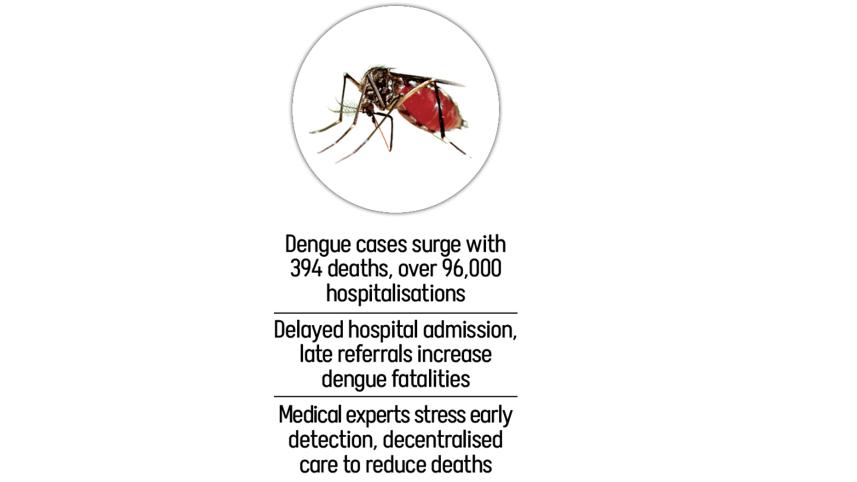
According to the DGHS, at least 394 dengue patients have died, while 96,627 others have been hospitalised nationwide as of Thursday morning.
Among the deaths, 181 were reported in Dhaka South City Corporation, 67 in Dhaka North City Corporation, 47 in Barishal, 31 in Chattogram, 24 in Mymensingh, 20 in Rajshahi, 20 in Rangpur, 9 in Dhaka division and 2 in Sylhet division.
In terms of infections, the highest number of cases were reported in Barishal division (20,865), followed by Dhaka division (16,435), DNCC (15,692), Chattogram (13,875), DSCC (13,730), Rajshahi (5,552), Khulna (5,138), Mymensingh (3,919), Rangpur (1,030) and Sylhet (391).
Medical experts say early hospitalisation for high-risk groups -- including elderly people, pregnant women and patients with chronic diseases -- could significantly reduce deaths.
Patients with complications such as severe bleeding, multi-organ failure, or illnesses like diabetes, kidney disease or heart problems face a much higher risk.
"Those with multi-organ failure or comorbidities have a much higher mortality rate," said HM Nazmul Ahsan, associate professor at Shaheed Suhrawardy Medical College Hospital.
He advised patients at home to drink plenty of fluids, including oral saline, coconut water, soups, rice starch and fresh fruit juice to prevent dehydration.
Experts also blamed delayed hospital admission as a major reason behind the high death toll, as many critically ill patients are referred from outside the capital.
Nazmul Ahsan also said most deaths occur among patients who reach hospitals in extremely critical condition.
"Many die within a few hours of arrival," he said. "They usually come in severe shock -- with almost no blood pressure, no pulse, cold limbs and chest fluid. At this point, treatment often becomes ineffective."
ferred.
Public health expert Mohammad Mushtuq Husain said early detection and decentralised healthcare are essential to reducing dengue fatalities.
"If affordable dengue testing were available near people's homes, cases could be detected earlier," he said.
 For all latest news, follow The Daily Star's Google News channel.
 Many patients who only need observation are being admitted, while critically ill patients wait four to five hours for a bed. Without decentralisation, the death toll will not fall, he warned.
Comments