


Argentina vs Brazil: The history behind the rivalry
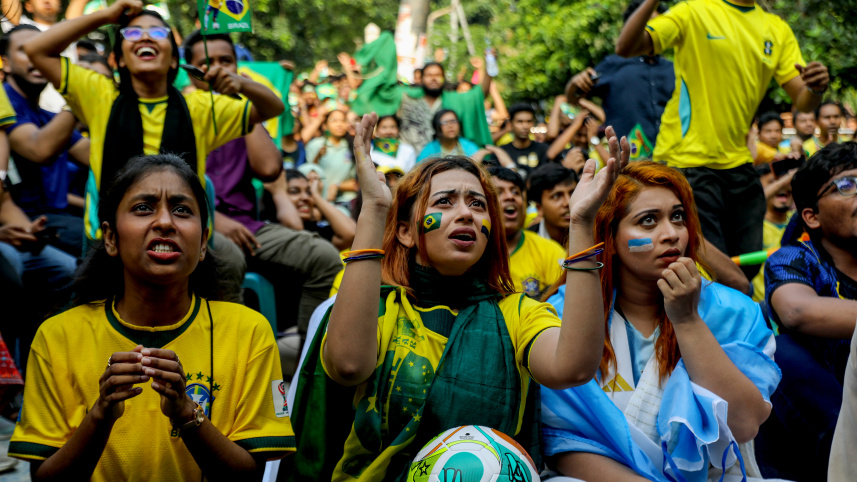
In Bangladesh, the first sign that the World Cup is coming is not on television. It is on the rooftops. A month before the tournament, your horizon is draped. Sky-blue and white over one house, yellow and green over the next, strung between bamboo poles and draped down four-storey walls until the sky over a whole lane belongs to one country or the other. Some run seventy feet. The length is the point. Every year, the same quiet arms race plays out, street against street, over a few metres of dyed cloth.
"We have put up a forty-foot flag, like every year," said 27-year-old Raju, an Argentina fan. "Brazil will try to beat it. I think they are too late," snickered Raju as he kissed the three stars on the Argentina jersey

A flag is never only a flag here. It is a declaration, and behind it sits a story the person hauling it up could tell you by heart.
The Brazilian flags came first. In the 1970s, a country fresh out of war went looking for something to believe in and found Pelé and found a team that played like the game was meant to be fun.
Mokhlesur Rahman, 68, still describes that side like someone he loved. "I chose Brazil in 1970, watching Pelé on a borrowed television," he reminisced. "Nobody told me to. You see football played like that once, and you stop looking."
Then a single tournament rewrote half the rooftops.
In 1986, Maradona dragged Argentina past England almost on his own with the infamous “Hand of God” goal, and for a country that had lived under empire, watching a small man from a poor nation humble the English meant far more than a quarter-final.
Anwar Hossain, 72, switched that week and never looked back. "We were a colony of the British. "It was almost as if we had defeated the English in war again," he recalls. “My brother is still a Brazil fan. "We have not agreed on football in forty years."
For Jahanara Begum, 84, memory holds no pictures at all. "We had the radio. I supported Argentina before I ever saw them play," she says.
The next split came slower.
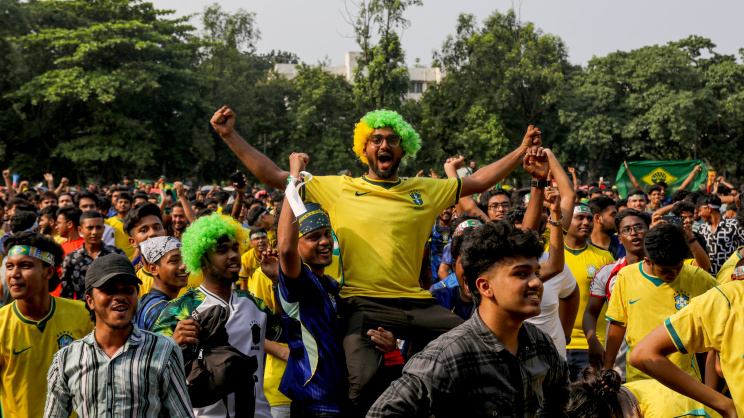
Messi, Ronaldinho, and Ronaldo Nazario handed a younger crowd their own faces to paint and their own argument to win.
Rifat, 19, inherited none of it. "I started in 2014. I watched Messi almost win the whole thing, and that was it," he says.
Nahian, 30, was drawn to a hairstyle rather than a particular play style or colour. He says Ronaldo Nazario's 2002 final haircut inspired him to support Brazil because it represented a team that was not afraid to be different.
When the flags go up, they are not really announcing a team. They are announcing a memory. A flag here is a celebration you can see from the next street over. The competition is half the joy, neighbours teasing neighbours over whose is bigger, whose went up first, who ran out of fabric before the roof was done.
Children learn the colours before they learn the players. For one month, the rooftops turn into a long, good-natured argument carried out in fabric, and the whole locality feels a little more alive for it.
A country without a team in the tournament has lost its citizens to it. That's the part no one prints on the bunting.
And still the love travels further than the flag. It reached Argentina, where one fan, stunned to see his flag flying over a country he had never visited, started a petition begging his federation to come and play a thank-you match here. Twenty thousand people signed.
Bangladesh is not in the 2026 World Cup. The flags do not care. They are already going up, the way they have every four years for half a century, over two nations that have no idea most of this country exists.
With the emotions running high, backed by nostalgia, the World Cup is not a six-or seven-game tournament. For some, it is a time machine back to a happier time or means more to some than words can describe. Whatever the results are, let us enjoy the time together in the spirit of football, the spirit of unity.
 For all latest news, follow The Daily Star's Google News channel.
 May the best team win.
Comments