


BB governor dismisses loan default allegations
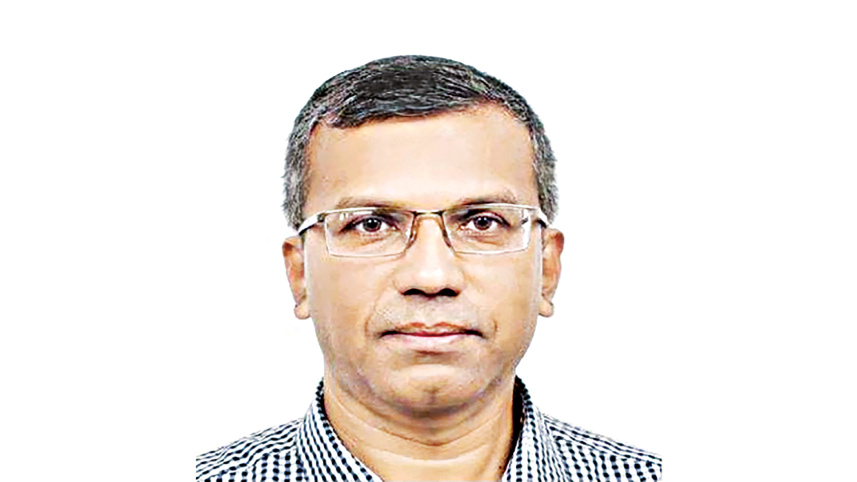
Bangladesh Bank (BB) Governor Md Mostaqur Rahman yesterday dismissed allegations that he is a loan defaulter, saying the claim is false despite being repeated several times.
He made the remarks in response to a question at the finance minister’s post-budget briefing held at the Osmani Memorial Auditorium in the capital.
 For all latest news, follow The Daily Star's Google News channel.
 Rahman said that before becoming governor, he was involved in running a factory and stressed that delayed loan repayments do not automatically make someone a defaulter.
“To this day, that factory has never been shut down for a single day. Not once has it delayed paying workers’ salaries by even a month. Not once has it asked a bank to waive a single taka of its loan,” he said.
He explained that the factory was initially financed under the Financial Sector Support Project at 4 percent interest. However, after investing Tk 150 crore, the company was later informed that the fund had been exhausted and the interest rate would rise to between 9 and 11 percent.
“As a result, repayments did not proceed according to the original projections. There were delays, and this coincided with the Covid-19 pandemic and other challenges,” he said.
“However, you can be assured that we never sought the waiver of even a single paisa or taka. In fact, the company has already repaid more than Tk 100 crore in bank loans,” Rahman added.
“Sometimes, repeating a false claim over and over can make it appear true.”
BANKING SECTOR STABILISATION AND REFORMS
Addressing questions on the banking sector, the governor said the first priority is to stabilise the sector and then recapitalise it.
“One of the first rumours we came across on social media was that the operations of Sammilito Islami Bank had effectively stopped after the current government took office.”
He said that soon after taking charge as governor, he found that the bank’s chairman had resigned and the person selected as managing director had also declined the post.
“We immediately advertised for a new managing director. Such appointments require approval from several authorities. Similarly, forming a new board for Sammilito Islami Bank also takes time.”
Rahman added that BB found the core banking software systems of five Islamic banks had not been properly integrated. “Within the next few weeks, you will see these interconnectivity issues resolved.”
Referring to Islami Bank, he said allegations of interference were being raised, but only one board member was replaced after irregularity claims, and no further action was taken.
“When we took office, we found a board appointed by the interim government, consisting of five members. Allegations of irregularities were raised against one member, and we replaced that individual. Beyond that, we took no further action.”
He added that BB did not order any staff transfers, promotions or removals, saying, “However, social media continues to be active with allegations that the government is interfering unlawfully.”
He said the then-chairman later resigned internally, creating a vacancy. “Since a systemic bank cannot operate with fewer than the required minimum of five board members, we had to make an immediate appointment within a very short time.”
He also said there were attempts to create instability, including social media calls before Eid for the chairman’s resignation.
The governor assured depositors of stability, saying, “I do not believe depositors will face any difficulties. They will be able to withdraw their deposits freely at any time.”
On Islami Bank’s financial position, he said the advance-to-deposit ratio stood at around 93 percent in July 2024 but rose to 97 to 98 percent by March.
“We instructed the bank to bring it down, as the maximum permissible limit for Islamic banks is 92 percent. Such steps are necessary to maintain stability, but instead of falling, the ratio remains close to 98 percent.”
Despite concerns, he expressed confidence in the bank’s stability and said emergency liquidity support would be provided if needed.
“As per the rules, necessary measures are being taken. I believe the bank’s management is acting responsibly and will continue to do so. The board is also alert to the situation. We will provide the emergency liquidity support required.”
NBFI RECOVERY, ASSET TRACING AND DIGITAL PAYMENT PUSH
The governor acknowledged serious challenges in the sector. “One thing everyone must understand is that nearly one-third of our deposits have been stolen. Stabilising the banking system in such circumstances requires patience.”
He also sought public cooperation and said BB would address long-standing problems in phases.
“There are several troubled non-bank financial institutions (NBFIs), and our resolution process has already started. Depositors who have been unable to access their money for the past 12 years will, God willing, begin to see progress within the next one or two weeks.”
Rahman said efforts were also underway to recover allegedly laundered funds abroad. The government has formed a task force and engaged 10 international agencies.
“Asset recovery is a lengthy process worldwide. Success rates are often below 2 percent, and it can take seven to ten years. Nevertheless, no money launderer will be spared,” he said.
He added that some overseas assets have already been frozen and part of the diverted funds recovered.
Rahman also announced that a unified digital payment system, “Bangla QR,” will be made mandatory nationwide from next month to simplify transactions and reduce cash dependency.
He concluded by urging people not to panic about bank liquidity and assured that depositors’ money remains safe within the banking system.
Comments