


Colonialism shaped linguistic struggles of Bangalee Muslims
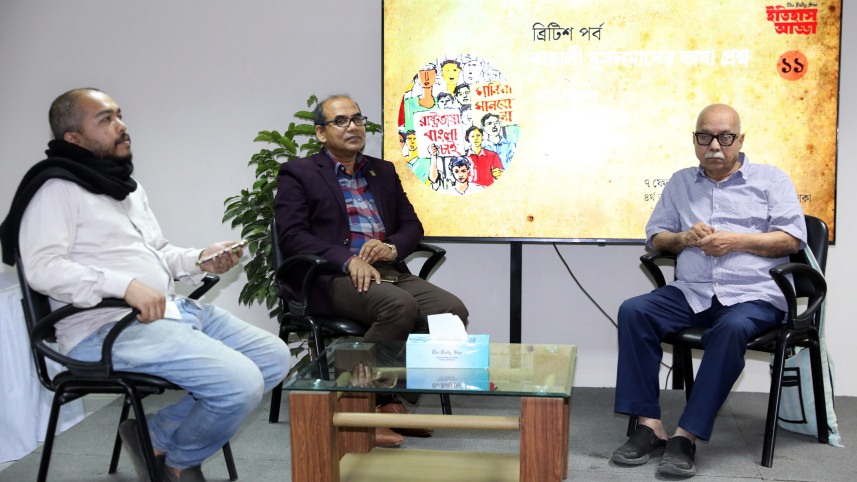
The relationship between Bangalee Muslims and the Bangla language during the British colonial period was not just a simple connection to a mother tongue. Instead, it was a complex and often “fractured” bond involving identity, religion and colonial power, speakers said yesterday.
They made these observations at the 11th session of The Daily Star’s Itihas Adda, titled “The Language Question of Bangalee Muslims: British Period”, held at The Daily Star Centre in the capital.
 For all latest news, follow The Daily Star's Google News channel.
 Speakers discussed how colonial interventions, religious revivalism, and the search for political identity shaped the region’s linguistic history.
Linguist Prof Monsur Musa said while history often focuses on collective identities like “Bangalee Muslim”, language is actually unique to every individual. “We often talk about the language of Bangalee Muslims, but if we look closely, we see that language is personal.
National Prof Abdur Razzaq and writer Abul Mansur Ahmad were both Bangalee Muslims from this region, yet their spoken languages were distinct,” he said.
He challenged the simplistic binary that Sanskrit-derived words are inherently “Hindu” and Arabic-Persian words are “Muslim”.
“Just as English uses Latin terms for medical science, Bangla uses Sanskrit words as the ‘bricks’ of the language. To view these merely through a religious lens is to oversimplify language based on prejudice,” Musa added.
Highlighting the anthropological depth of early colonial scholars like William Carey, Musa said, “Carey’s book Kathopakathan documented even the colloquial quarrels of women in slums (‘maiya kondol’). He grasped the living language in a way that many of us today do not.”
Emphasising the power and responsibility inherent in language, Musa said, “Language is an astonishing human asset. The more refined, sharp, and meaningful it is made, the more beautiful life becomes. One of the main reasons for the current political and social danger in our society is the lack of a sense of proportion (matra-gyan) in our use and application of words.”
Researcher Md Chengish Khan spoke about the historical “displacement” of the language. He said that the Sanskrit-heavy Bangla prose made popular in the 19th century was deliberately created at Fort William College, marginalising the existing language of the common people.
He said William Carey and his pundits purged Arabic and Persian words from the prose, words which had previously been markers of the “Khandani” or elite class.
Chengis explained that a “100-year gap” followed the 1857 Sepoy Mutiny, during which Muslims withdrew from British education. This absence allowed the Sanskritised prose style to become the standard.
He highlighted the counter-narrative that emerged in the 1940s through the East Pakistan Renaissance Society, particularly the vision of Abul Mansur Ahmad.
Abul Mansur Ahmad envisioned a “Dhakaiya Bangla” standard that would reflect the reality of East Bengal’s Muslim majority, distinct from the Calcutta standard. He said just as Assamese developed as a separate language, East Bengal’s language had its own distinct character.
Researcher Tahmidal Zami described the bond between Bangalee Muslims and their language as historically “fractured”. Tracing this tension to the pre-colonial era, he said early poets like Shah Muhammad Sagir had to explicitly justify writing in Bangla, validating it against religious expectations.
Zami said the colonial census helped solidify a distinct “Bangalee-Muslim” identity. This created a dilemma where the community felt torn between their “mother tongue” (Bangla) and a desire for a “national language” (Urdu or Arabic).
He said for a significant period, many educated Muslims believed that while Bangla was spoken at home, their cultural and national identity was tied to Urdu.
This sentiment only began to shift with the rise of the “Anglo-Sanskritic” reality of the colonial state. Zami also challenged the idea that “Musalmani Bangla” was a universal dialect, suggesting it was likely a mixed language born of trade in specific regions like Hooghly.
The session was moderated by The Daily Star journalist Emran Mahfuz, with a welcome speech delivered by another journalist, Shamsuddoza Sajen.
Comments