


Gender budget needs strict oversight
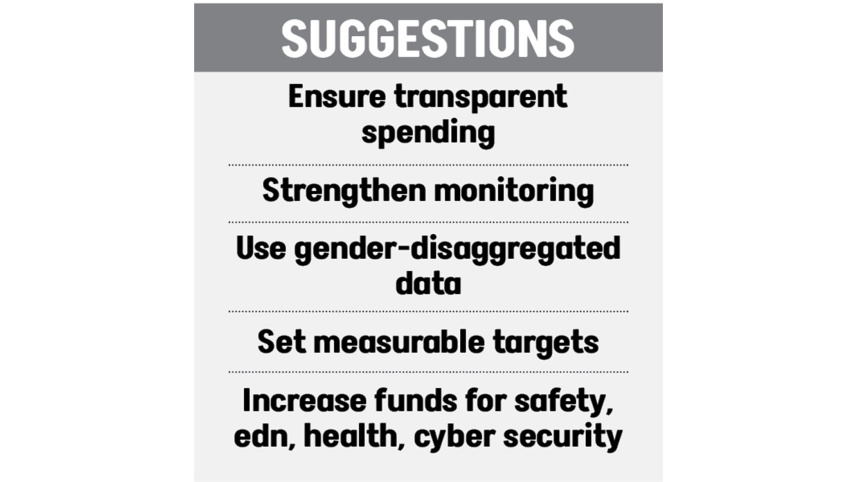
Bangladesh Mahila Parishad yesterday called for greater transparency, accountability and effective monitoring in implementing the gender budget 2026-27 to ensure meaningful progress in women’s empowerment and gender equality.
The call came at a press conference titled “Gender Budget 2026-27 for Women’s Empowerment and Equality: Analysis and Expectations”, held at the Dhaka Reporters Unity.
 For all latest news, follow The Daily Star's Google News channel.
 Mahila Parishad General Secretary Maleka Banu said it was important to assess how far the national budget is gender-sensitive and capable of advancing the rights and empowerment of women and marginalised groups.
Presenting the keynote paper, Prof Sharmind Neelormi of the Department of Economics at Jahangirnagar University said the gender budget includes new analyses relating to women’s empowerment, gender equality and implementation of government commitments.
Among the notable initiatives, she mentioned recognition of women as heads of households under the Family Card programme, free education for female students up to postgraduate level, establishment of women’s welfare centres at union level, and financial and skills-development support for women entrepreneurs.
However, she said despite commitments on workplace safety, equal pay and prevention of violence against women, there was no clear picture of corresponding budget allocations.
According to the analysis, gender-related allocations in FY2026-27 account for 34.8 percent of the national budget and 4.8 percent of gross domestic product, marking a slight increase from previous years.
Prof Neelormi said allocations for women’s safety, prevention of cyber violence, skills and technological capacity development, and decent work opportunities have declined.
Prof Sayema Haque Bidisha of the Department of Economics at Dhaka University stressed the need for accurate data and transparent evaluation to ensure effective implementation of the gender budget.
She called for quality child day-care centres, increased participation of women in technical and technological education, and easier access to information for women entrepreneurs.
The organisation also placed several recommendations, including improved use of disaggregated data, greater expenditure efficiency, measurable key performance indicators, mapping of implementation risks and formation of monitoring committees at local and national levels involving government and civil society representatives.
The event was moderated by Mahila Parishad President Dr Fauzia Moslem.


Comments