


Govt looking at fuel source options


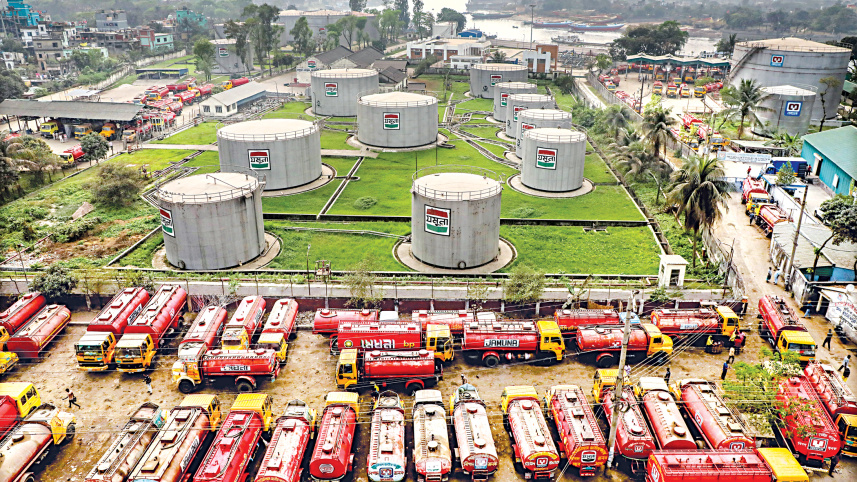
The government is scrambling to secure alternative fuel sources amid the US-Israel war on Iran, as the lion’s share of Bangladesh’s fuel imports originates from the Middle East.
The authorities have already secured fuel consignments for March and are now working to ensure supplies for April and May in case the conflict disrupts global energy markets, said Anindya Islam Amit, the state minister for power, energy, and mineral resources.

“We have been thinking about alternatives since the beginning of the war. We hope wisdom will prevail and the war will end soon. But if it prolongs, we are preparing for April and May to deal with possible global disruptions,” he said yesterday at a briefing at the secretariat.
Bangladesh mainly imports crude oil from the Middle East, particularly through the Strait of Hormuz, while refined fuel is sourced from several Asian suppliers such as Malaysia, Singapore, and Indonesia.
About a fifth of the world’s crude oil usually passes through the narrow waterway, mostly to the Asian markets, so the situation would become critical if the other countries’ refineries fail to secure crude to refine, said officials of the Bangladesh Petroleum Corporation (BPC) involved with the proceedings.
As part of the contingency planning, the government is exploring potential imports from countries including the US, China, and several African nations, while also considering increasing the volumes from existing suppliers like Malaysia, Singapore, Indonesia and India.
Bangladesh imports fuel oil from a range of countries, including Iran, the UAE, Oman, Saudi Arabia, Kuwait, Iraq, and Qatar in the Middle East, as well as Singapore, Malaysia, and India, according to official data.
Between January 2025 and March 8 this year, Bangladesh imported about 20.69 lakh tonnes of crude oil, 77 percent of which came from Saudi Arabia, Iraq, Malaysia and the UAE, according to data from the National Board of Revenue.
Saudi Arabia was the largest supplier, accounting for roughly 35 percent of the total crude oil imports, followed by the UAE (about 30 percent).
Crude oil imported by Bangladesh is refined at Eastern Refinery, where it is processed into around 13 petroleum products, including diesel, petrol, octane and jet fuel.
Between January last year and March 8 this year, Bangladesh imported about 3 lakh tonnes of octane, 5 percent of which came from Middle Eastern countries such as Oman and Qatar.
In addition, Bangladesh imported about 39.07 lakh tonnes of diesel and 17.43 lakh tonnes of furnace oil during the period but neither were sourced from Middle Eastern countries.
The BPC had planned to import more than 120,000 tonnes of diesel from India this year, but after the Iran war, another 50,000 tonnes have been sought. In 2025, about 122,000 tonnes of diesel was imported from the neighbouring country, up 74.1 percent year-on-year.
In the last two days, about 5,000 tonnes of diesel have flown in through the India-Bangladesh Friendship Pipeline, to take the total to 10,000 tonnes so far this year.
The recent long queues at filling stations were caused by panic buying rather than any supply shortage, Amit said, adding that the demand was two to three times the normal in the last five days.
“This abnormal demand had no logical cause. It came from anxiety and panic buying.”
The longer the Middle East crisis goes on, the higher the chances of a foreign exchange crisis for Bangladesh, said Amit, a first-time member of parliament from the Jessore-3 constituency.
As of March 8, gross foreign exchange reserves stood at $29.4 billion, enough to cover at best five months’ import bills, according to data from the Bangladesh Bank.
“It is difficult for any single country to overcome such a situation alone -- it must be addressed collectively,” Amit added.
Meanwhile, the BPC has increased the daily fuel supply limit for ride-sharing motorcycles to five litres as they depend on fuel for income-earning activities, particularly in urban areas, said a statement issued from its Chattogram office.
 For all latest news, follow The Daily Star's Google News channel.
 Previously, the daily quota for motorcycles was two litres.
Filling stations have been instructed to verify the motorcycle’s registration number and the driver’s details with the relevant ride-sharing app before dispensing fuel.
Most of the long queues were for motorcycles and private cars, which primarily use octane and petrol, Amit said. “But there is virtually no shortage of petrol or octane.”
Bangladesh mainly depends on imports for diesel and furnace oil, he said, adding that two ships carrying around 30,000 tonnes of fuel each were scheduled on Monday. One has already arrived and the other has reached outer anchorage.
Another shipment is also scheduled to arrive on March 12, he said.
At the same time, the government is working to expand fuel storage capacity.
“Different government departments have their own storage facilities. We are discussing with them so that these capacities can be used to increase national fuel storage.”
Comments